What can cause very bright stars to appear slightly larger in telescope images than dimmer stars?
Answer
Light spillover or optical overexposure due to overwhelming luminosity.
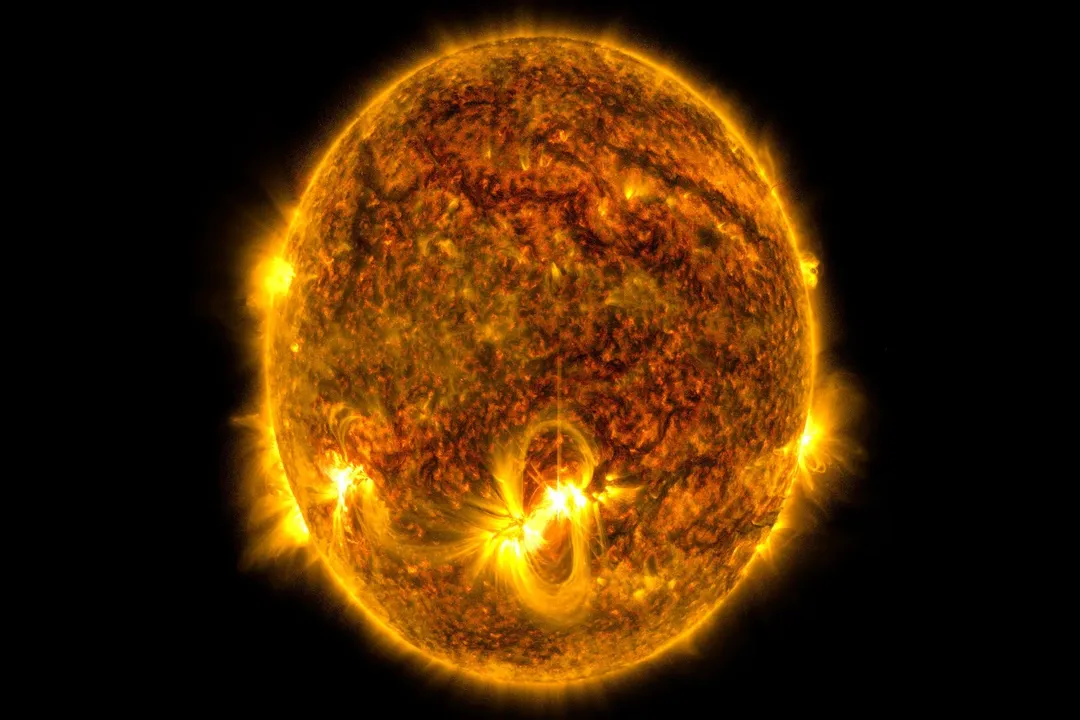
The perceived angular size difference in images is often an optical effect where overwhelming brightness causes light to spill over onto adjacent detector pixels, making the star appear larger than its true physical diameter.
#Videos
Why Would The Size Of A Star Affect Its Luminosity? - Physics Frontier
Related Questions
What term describes the total energy a star emits per second, irrespective of distance from Earth?What is the single most important characteristic determining a star's intrinsic brightness?Approximately how does stellar luminosity (L) scale steeply with mass (M) for stars?What happens to the core temperature and pressure in a star when it accumulates significantly more mass than another?Why do high-mass stars have remarkably short lifetimes compared to smaller stars?Which two immediate physical manifestations translate a star's mass into high intrinsic brightness?According to the inverse-square law, if the distance to a star is doubled, what happens to the observed brightness?Based on the table, how much more luminous is a Supergiant ($60 M_{\odot}$) compared to the Sun ($1 M_{\odot}$)?What does an exceptionally bright star that is *not* a giant usually signal to astronomers?What can cause very bright stars to appear slightly larger in telescope images than dimmer stars?What balance must a more massive star sustain by producing far more energy?