Are giant stars brighter?
Stellar Scaling
The simple answer to whether giant stars are brighter is an emphatic yes, but the reality is a fascinating dance between physical size and surface temperature. When we look at stars, we often think of size directly translating to brilliance, and for the giant star category, this holds true when compared to their smaller counterparts, the main-sequence dwarf stars. [4][9] A giant star is defined as having a substantially larger radius and greater luminosity than a dwarf star of the exact same surface temperature. [4]
This difference in light output, or luminosity, is where the "giant" truly earns its name. While our own Sun is the baseline, typical giant stars can shine anywhere from 10 to 1,000 times brighter than it. [9] Moving up the scale, red supergiants can achieve luminosities tens or hundreds of thousands of times that of the Sun. [6] This massive energy output stems from the Stefan-Boltzmann law, which states that total luminosity () is a function of the star’s surface area (related to radius squared, ) multiplied by the fourth power of its surface temperature (). [8] Since giants, by definition, have a vastly larger radiating area than a main-sequence star at the same temperature, their sheer size guarantees a tremendous increase in brightness. [2][4]
Evolutionary Swell
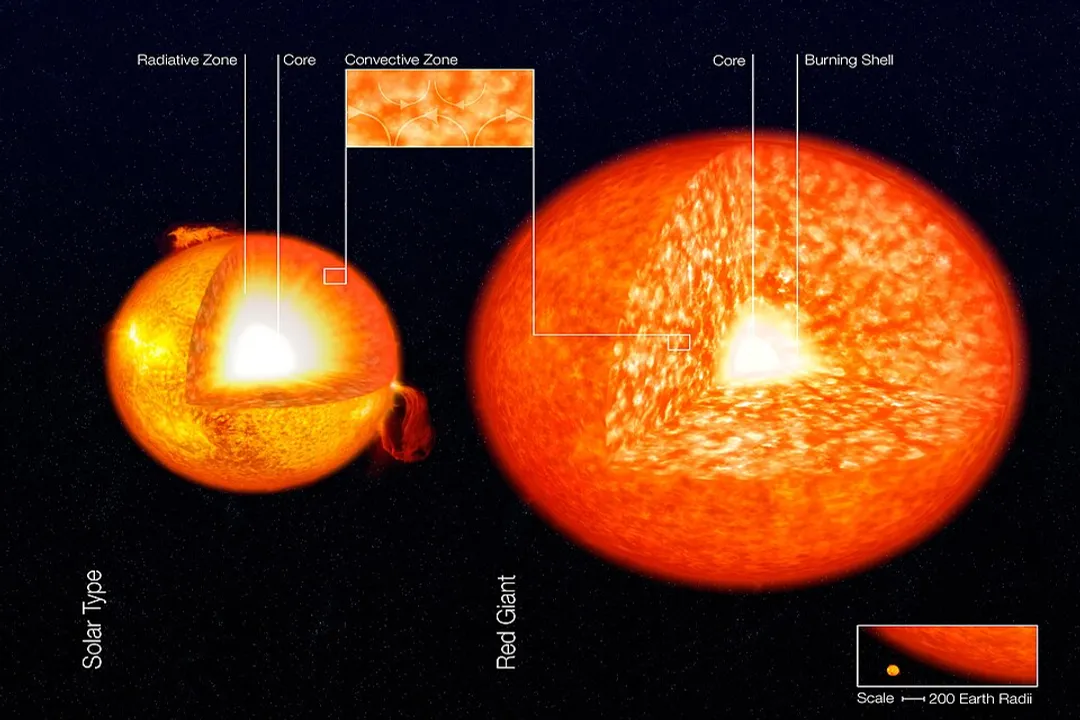
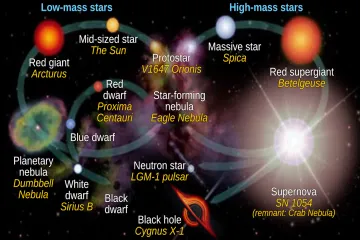
A star doesn't start life as a giant; it evolves into one after exhausting the hydrogen fuel in its core. [2][4] For stars like our Sun (intermediate-mass stars), once the core hydrogen is spent, gravity takes over, causing the core to contract and heat up. This ignites hydrogen fusion in a shell surrounding the inert core. [1][4]
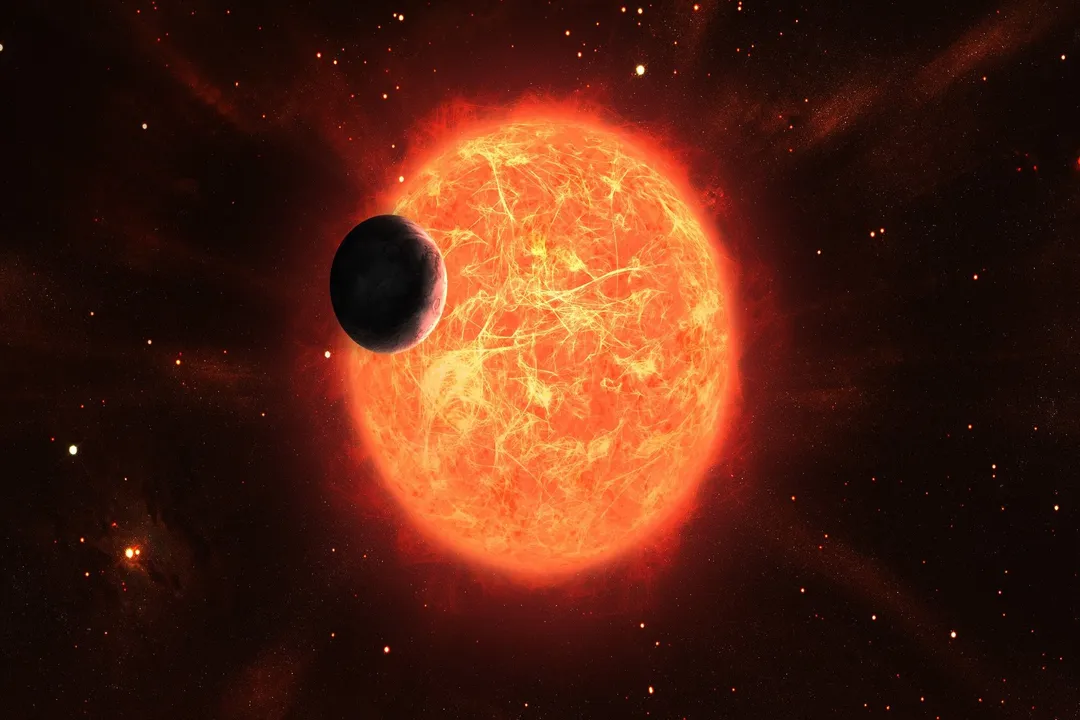
This internal change creates a bizarre situation: while the core contracts, the star's outer layers expand enormously. [1] This expansion inflates the star to immense proportions—sometimes hundreds of times the Sun's diameter. [4][9] Red giants, for example, can swell to diameters between $100$ and $1,000$ times that of the Sun. [1] Because this vast amount of energy is spread over such a gigantic surface, the surface temperature actually drops, causing the star to cool and appear redder. [1][2] This is why the most common giants we observe are red giants—they are large and luminous, but relatively cool on the surface. [2][10]
Class Hierarchy
Astronomers use the Yerkes spectral classification system to categorize these evolved stars based on their spectra, which helps estimate surface gravity and thus size relative to mass. [6] The main sequence stars are designated luminosity class V (dwarfs). [4] Giant stars generally fall into luminosity class III. [2]
The giant category is not monolithic; it is a progression of increasing luminosity:
- Subgiants (Class IV): These are stars just beginning their departure from the main sequence, slightly bigger and brighter than dwarfs. [4][9]
- Giants (Class III): The standard stage after leaving the main sequence. Our Sun is predicted to reach this phase in about five billion years, becoming hundreds of times larger and brighter. [2]
- Bright Giants (Class II): These stars shine more powerfully than typical giants but haven't quite reached the luminosity of a full supergiant. [3][4] Canopus is a noted example. [3]
- Supergiants (Class I): Stars that are even more luminous and larger than bright giants. [4][10] Red supergiants (like Betelgeuse in Orion) are the largest stars by volume in the universe, though not always the most massive or luminous overall when compared to the hottest, most massive main-sequence stars still burning hydrogen. [6]
The designation relies on how much light the star emits for its given temperature. A bright cool giant can easily appear larger than a hotter, less luminous supergiant, showing that size alone isn't the only classification factor, but rather the overall energetic output for that region of the Hertzsprung-Russell diagram. [6]
Color Brightness
The visual manifestation of giant status is often color. When a star expands into a red giant, its surface temperature dips below about $5,800$ degrees Celsius, causing it to shine predominantly in the redder part of the spectrum. [1] Stars like Arcturus and Mira are classic examples of red giants. [2]
However, the most massive stars evolve differently. After leaving the main sequence, they may briefly become blue giants or blue supergiants. [4][6] These stars are incredibly hot—hotter than the Sun—and, combined with their enormous size, they achieve extreme luminosities, sometimes over a hundred thousand times that of the Sun. [4][6] Betelgeuse and Antares A, well-known red supergiants, are visible to the naked eye across vast distances precisely because of this high luminosity, despite their cooler temperature. [6]
Considering the sheer number of stars in any given volume of space, the fact that a star must have already lived a significant portion of its life to become a giant means that the giant phase is relatively brief. [2] For a Sun-like star, the main sequence lasts about nine billion years, but the red giant phase is only a few hundred million years. [2] Despite their rarity in the stellar population at any given moment, their extreme brightness causes them to be significantly over-represented in the count of stars visible to us in the night sky. [2] If every star you saw was visible only due to its intrinsic brightness, it would be natural to assume that the majority of stars are giants, simply because the giants output so much more light that they can be spotted across far greater cosmic distances than dimmer stars of comparable mass. [9]
Mass Luminosity
It's important to remember that size and luminosity, while linked for giants, are governed by mass and the type of nuclear reaction occurring. For stars still on the main sequence, higher mass means higher temperature and greater luminosity—more massive means much brighter. [8] A hot, massive main-sequence star might be referred to as a giant, even though it's officially a dwarf in the main sequence context. [4]
When a star evolves off the main sequence, the rules shift. Luminosity is still high, but it is now a product of the shell burning and core contraction, rather than the steady hydrogen-to-helium fusion that defines its youth. [4] For instance, a lower-mass star that becomes a red giant increases its luminosity greatly, but a much higher-mass star that evolves into a supergiant might only see a factor of three increase in luminosity initially, even though it started far brighter and will burn through its fuel much faster. [6]
The ultimate measure of a star's energy output—luminosity—is intrinsically tied to its current fuel source and internal structure, which is why an enormous red supergiant, while vast, might be less intrinsically luminous than a compact, hotter star in a different evolutionary state, such as a blue supergiant. [8] However, within the general family of stars that have become giants after exhausting core hydrogen, the larger and more evolved they are, the greater their intrinsic brightness will be. [2]

Related Questions
#Citations
Giant star - Wikipedia
eSky: Bright Giant - Glyph Web
G. C. Sloan: Main Sequence Stars, Giants, and Supergiants
What makes a relatively small star more luminous than a large one?
Glossary term: Giant Star - IAU Office of Astronomy for Education
Dwarf and Giant Stars - Easy Peasy All-in-One Homeschool
Giant star | Red Supergiant, Supernova & Neutron Star | Britannica
Giant star Facts for Kids
Red giant stars: Facts, definition & the future of the sun - Space