Why are bigger stars brighter?
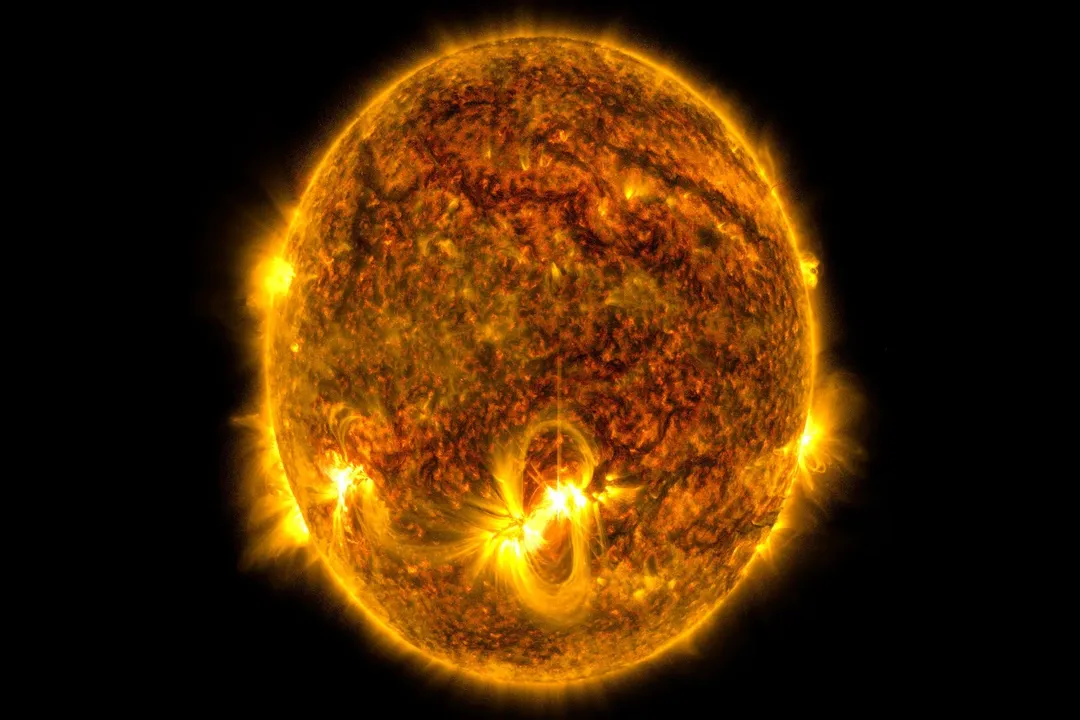
Stars populate the night sky with a striking variation in brilliance. Some blaze with an intensity that demands attention, while others appear as faint, distant pinpricks. The intuitive answer to why the biggest stars are brighter seems straightforward—they are larger, so they must produce more light. While size is undeniably a factor, the reality is far more complex, involving a dynamic interplay between a star's sheer mass, its internal furnace, and the vast emptiness separating it from our eyes. [2][6]
# Brightness Defined
When we talk about a star's brightness, we are actually speaking about two different concepts that often confuse casual observers. There is the light that reaches us here on Earth, which is called apparent brightness. [5][6] This is what we see in images or when we look up; it’s a measure of how luminous a star appears from our vantage point. [2] However, a dim-looking star might be a faint, nearby object, or it could be an unimaginably powerful beacon situated trillions of miles away.
To truly understand why bigger stars shine, astronomers rely on intrinsic luminosity, which is the total amount of energy a star emits per second, irrespective of distance. [5] This intrinsic property is what dictates the relationship between a star's physical characteristics and its light output. [2][6] If we could transport every star in the sky to an identical, standard distance from Earth, their relative intrinsic luminosities would become immediately apparent. The most massive stars would dominate the comparison overwhelmingly. [5]
# Mass Is Master
The single most important characteristic determining a star's intrinsic brightness is its initial mass. [8][9] Mass is the fundamental controlling factor that sets the entire life story and energy budget of a star. [9] A star begins its life as a large cloud of gas, and the sheer amount of material—its mass—dictates the gravitational forces acting upon its core. [8]
When a star accumulates significantly more mass than another, the gravitational squeeze on its center becomes immensely greater. This intense compression drives the core temperature and pressure to substantially higher levels. [8] Higher temperatures mean that the rate of nuclear fusion—the process where hydrogen atoms combine to form helium, releasing massive amounts of energy—accelerates dramatically. [8]
This relationship between mass and luminosity is not a gentle slope; it is a steep cascade. While a more massive star is certainly brighter, the increase in brightness is disproportionate to the increase in mass. Stellar physics suggests that luminosity () scales steeply with mass (), often expressed as to . [1] To put this staggering relationship into perspective, if one star has twice the mass of another, it might be eight to sixteen times more luminous, not just double the brightness. [1] Therefore, a star just a few times larger than our Sun can outshine it by thousands of times simply because that small addition in mass leads to an exponential boost in its internal energy generation. [1][8]
# Internal Engines
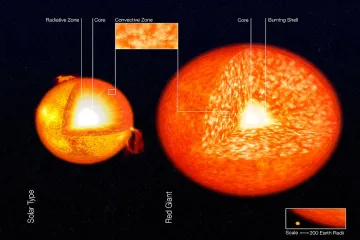
To maintain hydrostatic equilibrium—the balance between gravity pulling inward and the outward pressure generated by fusion—a more massive star must produce far more energy. [8] Think of it like building a structure; a skyscraper requires immensely more support beams and foundation strength than a small house, even if the house is made of slightly denser material. For a star, the "support beams" are the outward pressure generated by fusion. [8]
This furious internal reaction rate in massive stars means they burn through their fuel supply at an astonishing rate. [9] While their sheer volume of fuel is greater, their consumption rate is so high that their lifetimes are remarkably short compared to smaller stars. A star like the Sun might last ten billion years, but a giant star several times the Sun's mass can exhaust its hydrogen fuel in just tens of millions of years. [9] This rapid consumption translates directly into continuous, overwhelming energy output, making them inherently brighter during their active phases. [1]
# Size and Temperature Connection
While mass is the root cause, the immediate physical manifestations that translate mass into light are size (radius) and surface temperature. [2] Bigger stars generally mean larger radii, which provides a greater surface area from which photons (light particles) can escape into space. [2] At the same surface temperature, a star with twice the radius would emit four times the total light just because it has a larger radiating surface.
However, larger stars are also almost always hotter. [2] The intense core pressure that drives high luminosity also heats the outer layers significantly more than in a low-mass star. This heat dictates the color we perceive—from the cooler, reddish stars to the very hot, blue-white giants. Since the energy output is dependent on temperature to a very high power (Stefan-Boltzmann Law, though we are summarizing the known effect), even a modest increase in surface temperature, combined with the increased surface area, ensures that bigger, hotter stars are significantly brighter than their smaller, cooler counterparts. [2]
# Distance Obscures Reality
The greatest challenge in understanding stellar brightness is the intervening space. The sheer scale of the cosmos means that distance can completely mask a star’s true power. [5][6] This is where the concept of apparent magnitude must be carefully weighed against absolute magnitude. [5]
Consider this scenario: A small, relatively dim star orbiting a neighborhood star system might be so close that it appears quite bright to us. Conversely, a supergiant star, perhaps millions of times more luminous than our Sun, might be so incredibly far away that the light reaching us has weakened substantially, causing it to register as only a moderately bright or even faint star in the night sky. [5][6] The light intensity drops off following the inverse-square law—if you double the distance, the observed brightness drops to one-fourth its original intensity. This mathematical reality means that distance is a multiplier on the effect of luminosity. A star ten times farther away needs to be one hundred times intrinsically brighter just to look the same as a closer one. [1][5]
If we were to catalogue the stars in a small section of the Milky Way based purely on visual appearance, we would inadvertently be creating a map of mostly nearby objects, rather than a true census of the most powerful emitters. To get the true picture of stellar power, we must correct for this vast distance factor. [5]
This highlights an interesting observational trick: when astronomers spot exceptionally bright stars that are not giants, it usually signals that they are relatively close neighbors to our solar system, simply because their intrinsic luminosity isn't high enough to overcome great distances while still appearing brilliant to us. [6] Conversely, the most luminous, massive stars we observe are likely the very tip of the iceberg—the brightest-appearing ones are the closest members of that elite, high-power club.
# Stellar Classification Example
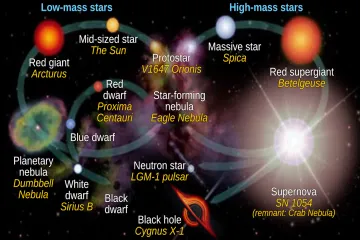
To appreciate the difference in scale, it helps to look at the range. Our Sun, a mid-sized, middle-aged star, has a certain absolute brightness. If we compare it to other main sequence stars—stars fusing hydrogen in their cores like the Sun—the differences are stark. [9]
| Star Type (Relative to Sun) | Mass (Solar Masses) | Luminosity (Solar Luminosities) | Approximate Lifespan (Years) |
|---|---|---|---|
| Red Dwarf (Low Mass) | Trillions | ||
| Sun-like Star (Medium Mass) | |||
| Blue Giant (High Mass) | |||
| Supergiant (Very High Mass) |
Note: This table summarizes the known relationships driven by mass, illustrating the rapid climb in luminosity as mass increases, directly supporting the physical principles discussed above. [1][9]
What the table demonstrates is that while the high-mass star only has 60 times the raw material of the Sun, it burns that fuel so violently that its light output is a million times greater. [1][9] This massive energy production is sustained by the extreme compression created by that initial large mass, leading to immense surface temperatures and large radii—the dual conditions for high intrinsic brightness. [2][8]
When examining astronomical images, especially those capturing large fields of view, one might notice that very bright stars sometimes appear to have slight optical artifacts or might be rendered slightly larger than dimmer background stars, depending on the telescope optics and atmospheric conditions. [3] It is important to remember that this perceived angular size in an image is not a reflection of their true physical size difference; rather, it is an effect of light spillover or optical overexposure caused by their sheer, overwhelming luminosity hitting the detector. [3] Their actual diameters, while larger for the massive stars, are not visually translated in that way through a simple telescope view.
# The Lifespan Trade-Off
Another insightful way to frame the relationship between size and brightness is to consider the evolutionary consequences. The immense brightness of a massive star is essentially a symptom of its frantic pace of life. Because the core of a massive star operates at such high temperatures and pressures, it consumes its nuclear fuel at an unsustainable rate. [9] It is spending its lifetime wealth very quickly to generate that spectacular light show. [9]
In contrast, smaller, lower-mass stars—like the red dwarfs—have much cooler cores and burn their fuel with extreme conservatism. [1] They are dim because their gravity is weak, their core temperatures are moderate, and their surface areas are small. [2] However, this slow burn means they can maintain their light output for trillions of years, far exceeding the age of the universe itself. [1] Thus, the brightest stars are spectacular but fleeting, while the dimmest are modest but eternal contributors to the night sky.
The initial mass, therefore, acts as a cosmic thermostat and fuel gauge simultaneously. It sets the temperature high enough to generate phenomenal brightness over a short period, which is why bigger stars are brighter, even if that brightness comes at the cost of longevity. [9] Understanding this hierarchy—Mass dictates Fusion Rate, Fusion Rate dictates Luminosity, and Distance dictates Appearance—is key to accurately reading the heavens.
#Videos
Why Would The Size Of A Star Affect Its Luminosity? - Physics Frontier
Related Questions
#Citations
What makes a relatively small star more luminous than a large one?
Why are some stars bright and others dim? - Cool Cosmos - Caltech
Why are some stars vastly brighter than others in this image? - Quora
Why Would The Size Of A Star Affect Its Luminosity? - Physics Frontier
Why do brighter stars/planets appear physically larger?
Why Are Some Stars Brighter Than Others? - Name A Star Live
Can you tell me why one star is brighter than the other? - Facebook
Brightness, Luminosity and Radius - How Stars Work | HowStuffWorks
Star Basics - NASA Science