How does the size of a star determine what elements are created?
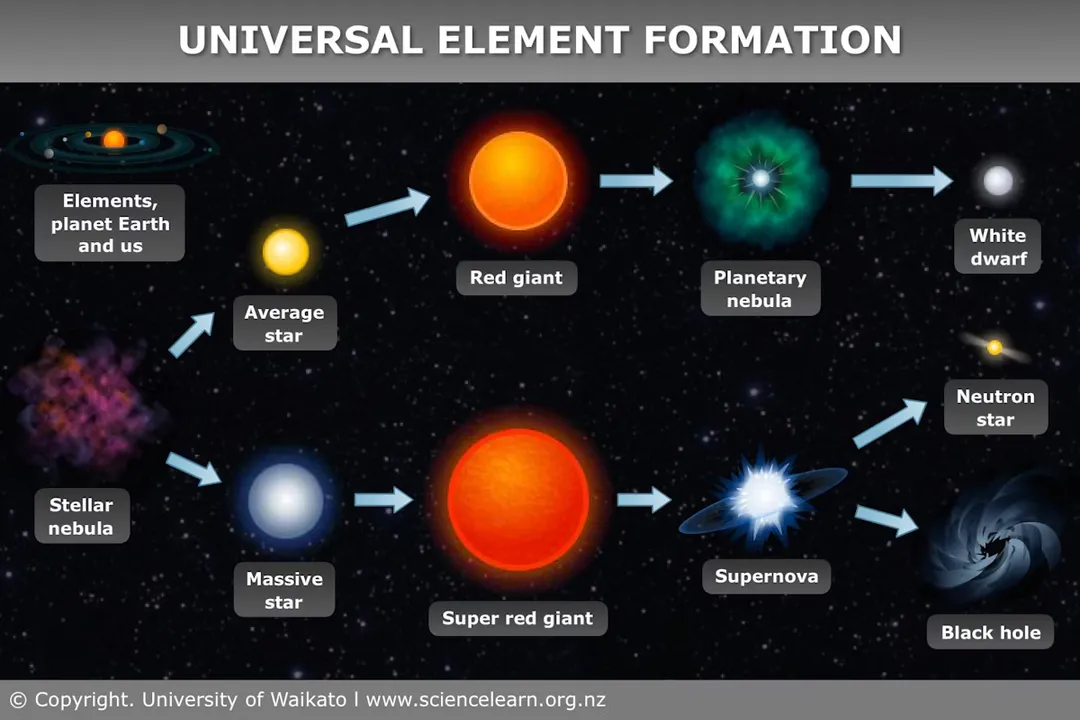
The sheer size, or mass, of a star acts as the universe's ultimate dial setting for chemical creation. It dictates the pressure cooker conditions inside the stellar core, determining not just how long the star will live, but precisely which elements it can forge before it expires. [1][3] Everything that is not hydrogen or helium, the two primordial building blocks created in the Big Bang, has been crafted in the furnaces of stars through a process called stellar nucleosynthesis. [2][8]
# Stellar Fuel
A newborn star is overwhelmingly composed of hydrogen and helium. [1] Its initial mass determines the gravitational force pulling inward. This relentless inward pressure is what generates the extreme temperatures and densities necessary to ignite nuclear fusion in the core, the process that converts lighter elements into heavier ones. [2] As long as the star is successfully fusing hydrogen into helium in its core—the longest phase of its life, known as the main sequence—it maintains a stable equilibrium against its own crushing gravity. [3]
# Massive Cores Heat
The key differentiator between one star and another, in terms of element creation, is the resulting core temperature. A star's mass directly scales the gravitational force exerted on its center. More mass means greater gravity, which translates directly into higher core temperatures and pressures. [2][4] For instance, the process of fusing hydrogen into helium requires temperatures around 15 million Kelvin. [3]
When a star exhausts the hydrogen in its core, it begins to contract and heat up again. In a lower-mass star, like our Sun, this contraction may not be sufficient to ignite the next stage of fusion. But in a much more massive star, the core temperature rockets upward, allowing for the fusion of helium into carbon and oxygen. [3][8] This temperature threshold is a direct consequence of the star's initial size.
# Light Element Building
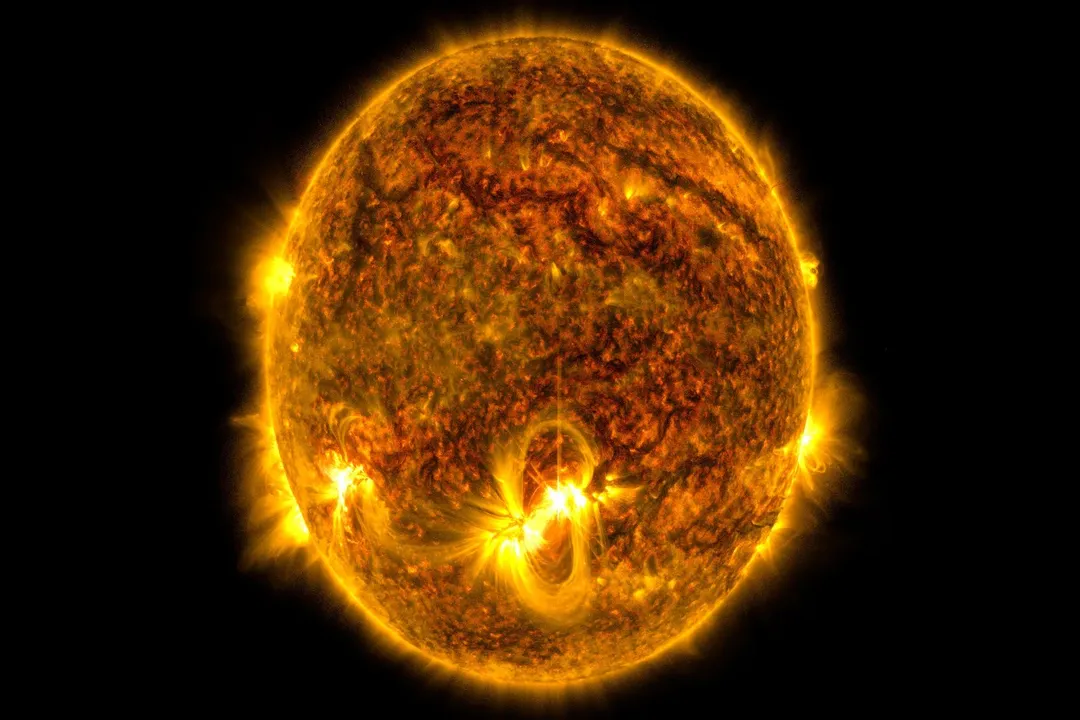
In stars comparable to or slightly larger than the Sun, the helium-burning stage (the triple-alpha process) creates carbon and oxygen. [3] Once the helium is depleted, these stars lack the necessary mass to generate the extreme pressures needed to fuse carbon further. They gently swell into red giants and eventually shed their outer layers, leaving behind a dense core of carbon and oxygen known as a white dwarf. [3] Thus, low-mass stars are essentially factories for carbon and oxygen, which are then slowly dispersed into the galaxy over eons. [8]
In contrast, very high-mass stars—those perhaps eight times the mass of the Sun or more—do not stop there. Their immense gravity forces the core temperature high enough to fuse carbon, neon, oxygen, and silicon in successive, hotter stages. [4]
# Onion Structure Growth
The evolution of a truly massive star results in a layered structure, often described as an onion, with different fusion reactions occurring in concentric shells. [7][9] As one fuel source is exhausted in the center, the core contracts, heats up, and ignites the next heaviest element in its surroundings.
For these giants, the sequence proceeds:
- Hydrogen fusion in the outer shell.
- Helium fusion (creating C, O) in the next shell inward.
- Carbon fusion (creating Ne, Na, Mg) deeper in.
- Neon fusion.
- Oxygen fusion.
- Silicon fusion, finally producing iron () at the very center. [4][9]
A star like the Sun takes about ten billion years to fuse most of its hydrogen. Conversely, a star twenty times the Sun's mass might spend only a few million years on the main sequence, and then burn through the subsequent carbon, neon, and silicon stages in mere days or months. [10] This dramatic acceleration in later burning phases is a direct measure of how much higher the core temperature has to climb to overcome the increasing electrical repulsion between heavier nuclei. It’s a race against gravity where only the most massive stars can afford the incredible energy output required for these advanced stages. [4]

# The Iron Limit
The silicon-burning process terminates when the core is predominantly composed of iron () or nickel. [2][4] Iron marks the critical turning point in stellar nucleosynthesis because it possesses the highest nuclear binding energy per nucleon of all elements. [2][9] Any fusion reaction involving iron to create a heavier element consumes energy rather than releasing it. [4] Since the star relies on the energy released by fusion to counteract gravity, once the core turns to iron, the energy source is effectively shut off. The star has no internal pressure left to support its weight, leading to a catastrophic collapse. [2]
# Supernova Ejection
The creation of elements heavier than iron—like silver, platinum, iodine, and uranium—cannot happen through standard, energy-releasing fusion reactions within the star's normal life cycle. [5][6] These elements require an external energy source or an environment rich in free neutrons to be rapidly added to existing nuclei.
This is where the star's death becomes crucial. When the iron core collapses in less than a second, the sudden stop and rebound create a massive shockwave, resulting in a core-collapse supernova. [5][9] During the peak milliseconds of this explosion, an environment of incredibly high temperature and density is created, flooding the star with neutrons. This process, known as the rapid neutron-capture process or r-process, builds elements heavier than iron quickly before radioactive decay can interfere. [5][6] Supernovae are thought to be the dominant source for elements like gold and uranium. [3][6]
However, not all heavy elements come from this violent end. A gentler pathway exists in certain aging, lower-mass stars called Asymptotic Giant Branch (AGB) stars. These stars produce elements heavier than iron through the slow neutron-capture process, or s-process, where neutrons are captured slowly over thousands of years, allowing unstable isotopes time to decay into stable elements like barium or strontium. [9] The size of the original star dictates whether the final stages of its life will be a gentle AGB phase or a cataclysmic supernova capable of generating the full spectrum of heavy elements via the r-process.
When considering the cosmic inventory, it is fascinating to consider that the elements making up the very ground beneath our feet—the silicates and oxygen that form rocky planets—were largely synthesized in the stable, longer-lived, less massive stars that die relatively peacefully. In stark contrast, the exotic, high-Z elements that power our modern electronics or medical devices almost exclusively owe their existence to the rapid, explosive death of the truly massive stars, whose internal pressures exceeded the limits of iron fusion. [10]
# Cosmic Legacy
Ultimately, the size of a star dictates its entire chemical fingerprint on the universe. [1][8] Small stars enrich the cosmos primarily with carbon and oxygen over billions of years. Large stars create elements up to iron during their relatively brief, intense lives, and then scatter all the elements up to and beyond uranium across the galaxy in a spectacular, final explosion. [3][9] Every element heavier than boron found in our bodies or on Earth was forged in the nuclear reactions of stars that lived and died long before our solar system ever formed. [2][8] The elements we observe today are the mixed residue of stellar generations, sorted and distributed based on the initial mass of their creators. [7]
#Videos
Creating the Elements - Sixty Symbols - YouTube
Related Questions
#Citations
Star Basics - NASA Science
Stellar nucleosynthesis - Wikipedia
The Elements: Forged in Stars | PBS LearningMedia
Formation of the High Mass Elements
The formation of the heaviest elements - Physics Today
How do stars generate elements "heavier" than lead? - Reddit
Stellar Evolution - Chandra X-ray Observatory
Universal element formation - Science Learning Hub
Elemental Abundances | Center for Astrophysics | Harvard ...
Creating the Elements - Sixty Symbols - YouTube