How do stars make heavier elements?
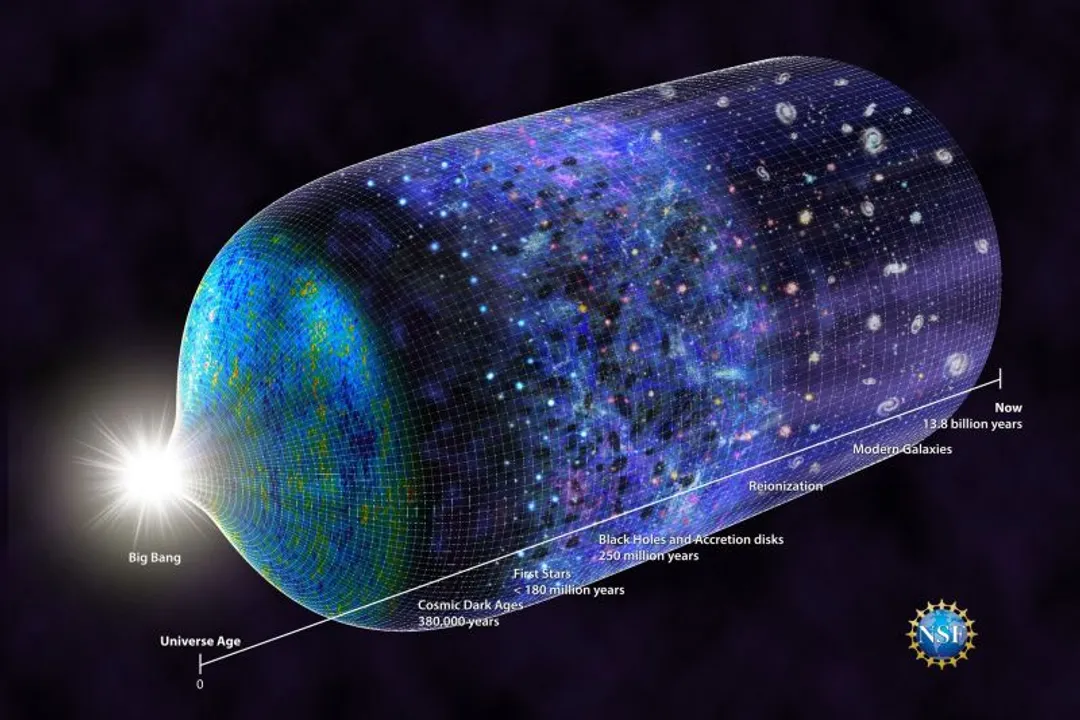
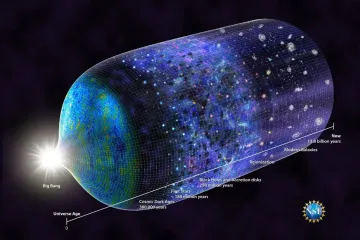
The elements that make up everything we see, from the iron in our blood to the silicon in the rocks beneath our feet, were not present at the very beginning of the cosmos. That initial soup, moments after the Big Bang, was overwhelmingly simple, consisting almost entirely of just hydrogen and helium, with trace amounts of lithium. [2] To build the more complex atomic structures—the building blocks of planets and life—you need the incredible, violent, and sustained energy of stars. This construction project, known as nucleosynthesis, is fundamentally how stars chemically enrich the universe. [2]
# Cosmic Ignition
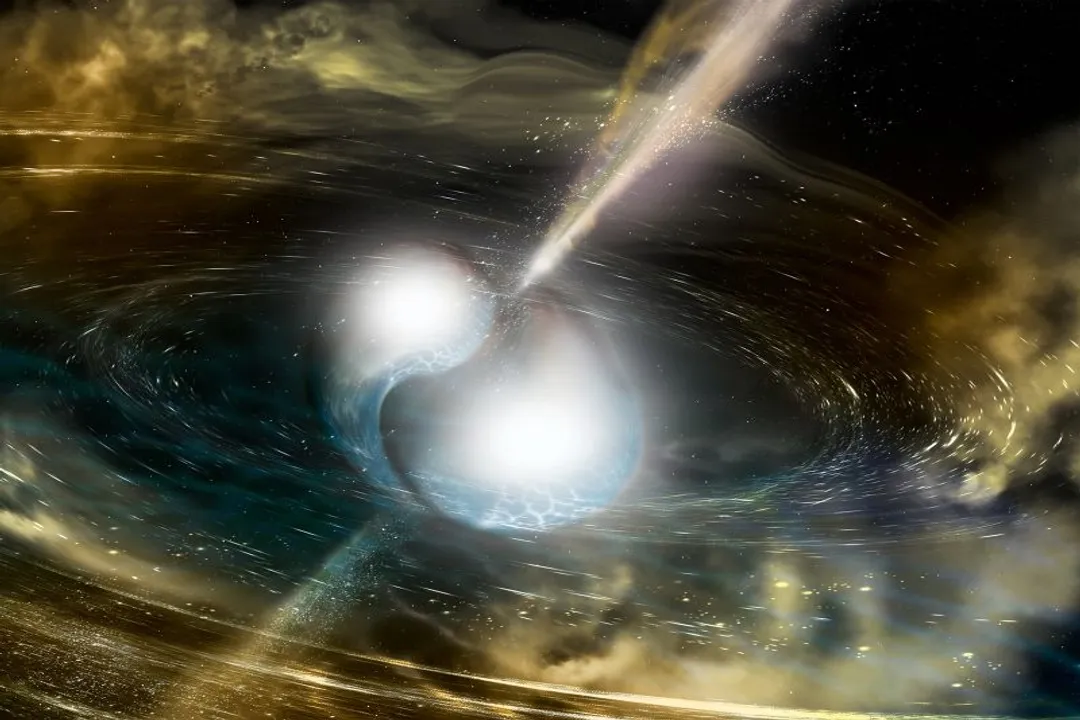
The story of element creation begins inside a newborn star when gravitational collapse heats its core to millions of degrees. [6] For stars like our Sun, this initial stage involves fusing hydrogen nuclei into helium nuclei, a process that powers the star for most of its life. [6][10] This is a highly efficient energy release, as the resulting helium atom has slightly less mass than the four hydrogen atoms that formed it, with the missing mass converted directly into the energy that keeps the star shining. [6]
In smaller to mid-sized stars, this hydrogen fusion primarily occurs via the proton-proton chain, though in hotter, more massive stars, the CNO cycle (Carbon-Nitrogen-Oxygen cycle) becomes the dominant mechanism for turning hydrogen into helium. [6] The key takeaway here is that as long as a star has fuel to burn and release energy, it can sustain itself against the inward crush of gravity.
# Stellar Burning Stages
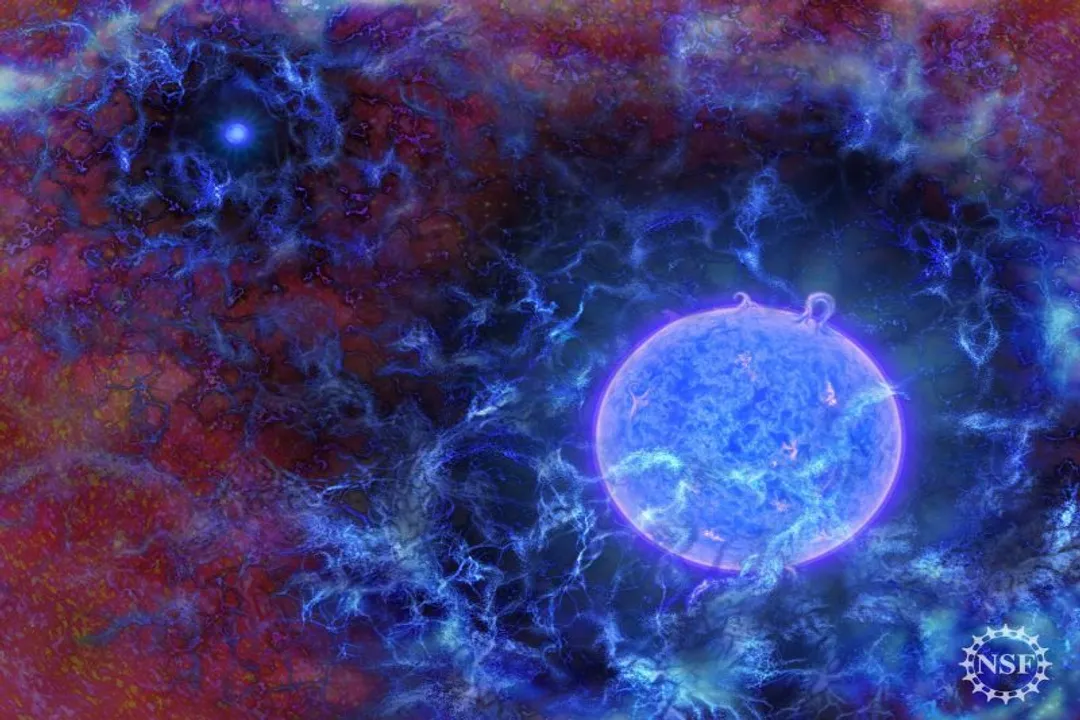
Once a star exhausts the hydrogen in its core, gravity wins temporarily, causing the core to contract and heat up further. If the star is massive enough, this increased temperature sparks the next stage of fusion: helium begins fusing into heavier elements like carbon and oxygen. [6][10] This is sometimes referred to as the triple-alpha process, where three helium nuclei (alpha particles) combine to form one carbon nucleus. [1]
This process of sequential burning continues in massive stars. As one fuel runs out, the core contracts, heats up, and ignites the next available element in the chain. The star develops an onion-like structure, with lighter elements fusing in outer shells around progressively heavier cores. [6] Carbon fuses into neon, neon into oxygen and magnesium, and so on, creating elements further down the periodic table. [6][10] This process creates elements up to iron (, atomic number 26). [1][6]
The fusion of elements stops cold at iron because of a fundamental physical barrier. Iron represents the peak of nuclear binding energy. [1] Fusing elements lighter than iron releases energy, which is what sustains the star. However, fusing iron atoms together or fusing iron with other particles requires an input of energy rather than producing it. [1][6] Once the core turns to iron, the star loses its primary energy source instantaneously, leading to catastrophic core collapse. [6] This collapse is the dramatic setup for creating everything heavier than iron.
If we consider the entire timeline of a star's life powered by controlled fusion, we can think of it as reaching a natural energy ceiling. Up to iron, the universe is literally banking energy from mass conversion. Beyond iron, the universe requires an external, massive energy injection to force nuclei together against their inherent stability. [1] This external injection is provided by the star’s death throes.
# Beyond Iron Explosions

The creation of elements heavier than iron—including gold, uranium, and the platinum in a jeweler's setting—cannot happen gently inside a stable stellar core. These elements require conditions of extreme energy and vast numbers of free neutrons bombarding existing nuclei. [1][5] The two primary astrophysical events responsible for forging these heavyweights are core-collapse supernovae and neutron star mergers. [4][9]
# The Slow Path
Some elements slightly heavier than iron are created through the -process (slow neutron capture) within asymptotic giant branch (AGB) stars, which are stars nearing the end of their lives. [1] In the -process, atomic nuclei capture neutrons one at a time, at a relatively slow rate compared to the supply of neutrons available. [1] If a nucleus captures a neutron, it has enough time to undergo beta decay (turning a neutron into a proton and an electron) before capturing another neutron. [1] This pathway builds elements up the periodic table gradually, creating things like barium and lead, but it cannot produce the very heaviest, most neutron-rich elements. [1]
# The Rapid Path
For the truly heavy hitters, we need the -process (rapid neutron capture). [5] This process requires an environment saturated with free neutrons occurring at an extremely fast pace—so fast that a nucleus captures multiple neutrons before it has a chance to decay. [1][5] The primary candidates for hosting the -process are:
- Core-Collapse Supernovae: The implosion of the iron core creates a super-dense environment where shockwaves and extreme conditions might drive the -process. [1]
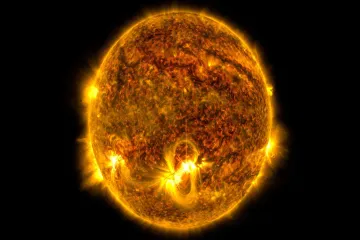
- Binary Neutron Star Mergers: This is now considered the leading source for the heaviest elements. [5][9] When two incredibly dense stellar remnants—neutron stars—spiral inward and collide, they generate an environment of unparalleled density and neutron flux. [5][9] The resulting explosion, called a kilonova, ejects vast amounts of neutron-rich material into space, forging elements like gold, uranium, and others in the -process. [5][9]
Data analysis following the detection of gravitational waves from such mergers has provided strong observational evidence supporting the neutron star collision theory for -process element creation. [9]
It is fascinating to consider the cosmic geography of element production. While the everyday elements like carbon and oxygen are distributed widely by smaller stellar deaths, the creation of gold or platinum requires the rarest, most energetic smash-ups in the universe. This means that the concentration of these precious metals in a given region of space is directly tied to how many neutron star collisions have occurred there over cosmic history. If our solar system had formed in a region devoid of recent kilonova events, our planet might be far poorer in these rare materials than it actually is. [9]
# Distribution and Legacy
Once these elements are forged, they cannot simply stay locked away in the collapsed remnants or the expanding supernova shockwave. For the universe to be enriched, these newly created materials must be returned to the interstellar medium. [4]
In the case of supernovae, the expanding shell of gas and dust disperses the newly synthesized elements—including that vital iron cooked in the core—into the surrounding galaxy. [4][10] These enriched clouds eventually mix with existing gas and dust, forming the raw material for the next generation of stars, planets, and, eventually, life. [10] Our Sun, a relatively young, second or third-generation star, benefits from this recycling process. [5][7]
The elements produced in these stellar furnaces are literally the stuff of life. Carbon is the backbone of organic chemistry; oxygen is essential for respiration; nitrogen is a key component of DNA; and iron is necessary for transporting oxygen in our blood. [5][7]
# The Stellar Inventory
To get a clear picture of this cosmic alchemy, we can summarize the primary element creation sites:
| Element Group | Creation Mechanism | Stellar Location / Event |
|---|---|---|
| Hydrogen, Helium | Big Bang Nucleosynthesis | Early Universe |
| Helium to Carbon/Oxygen | Hydrogen Fusion, Helium Fusion | Main Sequence Stars / Red Giants |
| Elements up to Iron | Progressive Fusion | Cores of Massive Stars |
| Elements near Lead/Bismuth | Slow Neutron Capture (-process) | Asymptotic Giant Branch (AGB) Stars |
| Heaviest Elements (Gold, Uranium) | Rapid Neutron Capture (-process) | Supernovae / Neutron Star Mergers |
This inventory shows a clear progression from the steady, long-term production of light elements in stable stars to the sudden, violent creation of the heaviest ones in cosmic cataclysms. [1][9] The entire cycle highlights the deep connection between stellar evolution and the chemical composition of the cosmos. [4] Every atom heavier than boron was, at some point, cooked inside a star, meaning we are all, chemically speaking, recycled stardust. [5][7] The complex chemistry that supports terrestrial life is entirely dependent on the fiery past and violent deaths of stars across billions of years. [10]
Related Questions
#Citations
Ask Astro: How do stars make elements heavier than iron?
Nucleosynthesis - Wikipedia
Where do heavy elements come from? : r/AskPhysics - Reddit
Stellar Evolution - Chandra X-ray Observatory
The stars within us | NSF - U.S. National Science Foundation
The Elements: Forged in Stars | PBS LearningMedia
The formation of the heaviest elements - Physics Today
Star Basics - NASA Science
Some of the universe's heavier elements are created by neutron star ...
How were heavier elements formed during star formation ... - Quora