What elements do big stars produce?

The elements that compose everything we see—from the air we breathe to the iron in our blood—are not primordial; they are forged within the fiery crucibles of stars through a process known as stellar nucleosynthesis. [1][2] While the universe began predominantly with the simplest elements, hydrogen and helium, the sheer scale and life cycle of massive stars are responsible for manufacturing nearly every other naturally occurring element on the periodic table. [3][8] To understand where the materials that make up Earth and life came from, one must look to the stellar interiors where nuclear reactions convert mass into energy and, in the process, create new atomic nuclei. [2]
# Stellar Furnaces

The fundamental engine driving a star’s life is nuclear fusion, the process where lighter atomic nuclei combine to form heavier ones, releasing tremendous amounts of energy. [1][2] For a star to shine, the outward pressure from this energy must counteract the inward crush of its own gravity. [7] The initial building block, hydrogen, is fused into helium in the star's core—this is the defining activity of a main-sequence star, the longest phase of its existence. [2]
This initial fusion process, often called the proton-proton chain or the CNO cycle (in more massive stars), converts hydrogen into helium. [1] However, the capacity of a star to create new elements is intrinsically tied to its initial mass. [7] Smaller stars, like our Sun, will eventually exhaust their core hydrogen, puff up into a red giant, and gently fuse helium into carbon and oxygen before fading away, leaving behind only these lighter elements. [2][9] It is the truly big stars—those substantially more massive than the Sun—that possess the gravitational power and sustained core temperatures necessary to push elemental creation much further up the periodic table. [7][9]
# Core Burning Stages
When a massive star exhausts the hydrogen fuel in its center, the core contracts and heats up dramatically until the temperature is high enough to ignite helium fusion. [2][9] This process, often called the triple-alpha process, fuses three helium nuclei () into one carbon nucleus (), or fuses helium with carbon to create oxygen (). [1][7]
What sets the giants apart is their ability to sustain subsequent burning stages once the helium is spent. Because of their immense mass, the gravitational pressure continues to compress the core, raising the temperature sufficiently to ignite the next available fuel source. [7][9] This leads to a structure resembling an onion, with successive shells of fusion occurring around an increasingly dense core. [1][7]
For a very massive star, this sequence can proceed through several distinct phases:
- Carbon Burning: Once helium is depleted, carbon can fuse to create neon (), sodium (), and magnesium (). [1][9]
- Neon Burning: Neon is converted into oxygen and magnesium. [1]
- Oxygen Burning: This stage yields sulfur (), phosphorus (), and silicon (). [1][7]
- Silicon Burning: This final pre-supernova burning phase is incredibly rapid and produces elements near the center of the periodic table, including nickel () and, most importantly, iron (). [1][2]
This layered structure is critical. In a star nearing the end of its life, you might find an outer shell fusing hydrogen, then a shell fusing helium, then carbon, and so on, until you reach the inert iron core at the very center. [7]
Here is a conceptual look at the layered synthesis in a massive star just before collapse:
| Layer Location | Primary Fuel | Main Products |
|---|---|---|
| Outermost Shell | Hydrogen | Helium |
| Next Shell Inward | Helium | Carbon, Oxygen |
| Mid-Core Shells | Carbon, Neon, Oxygen | Neon, Magnesium, Silicon |
| Innermost Shell | Silicon | Nickel, Iron |
| Core | None (Iron Accumulation) | Inert Iron |
This sequential burning allows the star to temporarily support itself against gravity for millions of years during the hydrogen phase, but as the burning cycles get shorter (silicon burning can last only a day or so), the star is rapidly approaching its final, catastrophic moments. [7]
# The Iron Ceiling

The production of elements through fusion is exothermic—it releases energy—only up until the formation of iron (). [1][2][4] Iron-56 (-56) possesses the highest binding energy per nucleon of all elements. [4] This is a crucial physical benchmark: fusing elements lighter than iron releases energy because the resulting nucleus is more tightly bound than the starting materials. [1][4] Conversely, trying to fuse iron nuclei together consumes energy rather than producing it. [1][4]
When the core of the massive star becomes pure iron, the internal furnace switches off. [2][9] Since there is no outward thermal pressure generated by fusion, gravity immediately wins the long-fought battle. [7][9] The iron core, often weighing more than the entire Sun, collapses in on itself in mere seconds. [7][9]
This leads to a common point of confusion, as noted by everyday astronomical questions: if fusion stops at iron, where do gold, uranium, and lead come from?. [4][5] The answer lies entirely outside the normal fusion cycle, requiring far more extreme astrophysical events than standard core burning. [5]
# Heavier Creation
The creation of elements heavier than iron requires an immense input of energy and a flood of free neutrons—processes that only occur during the violent death throes of massive stars or in the aftermath of stellar collisions. [5][6][9] These mechanisms are primarily governed by neutron-capture processes. [1]
# Rapid Neutron Capture (The r-Process)
The process responsible for synthesizing the vast majority of elements heavier than iron, such as gold (), platinum (), and uranium (), is the rapid neutron-capture process, or the r-process. [1][5] This process cannot happen during the normal life of a star; it requires an environment where atomic nuclei are bombarded by a massive flux of neutrons extremely quickly. [5]
The gravitational collapse of the iron core triggers a supernova explosion. [7][9] During this cataclysm, the core compresses into an incredibly dense neutron star. [7] The rebound shockwave heats the outer layers tremendously and produces the necessary conditions: an overwhelming supply of free neutrons. [5][9] Nuclei rapidly capture these neutrons before they have time to radioactively decay, leading to very heavy, unstable isotopes that then decay into stable, heavy elements like those found in jewelry or necessary for geological processes. [1][5]
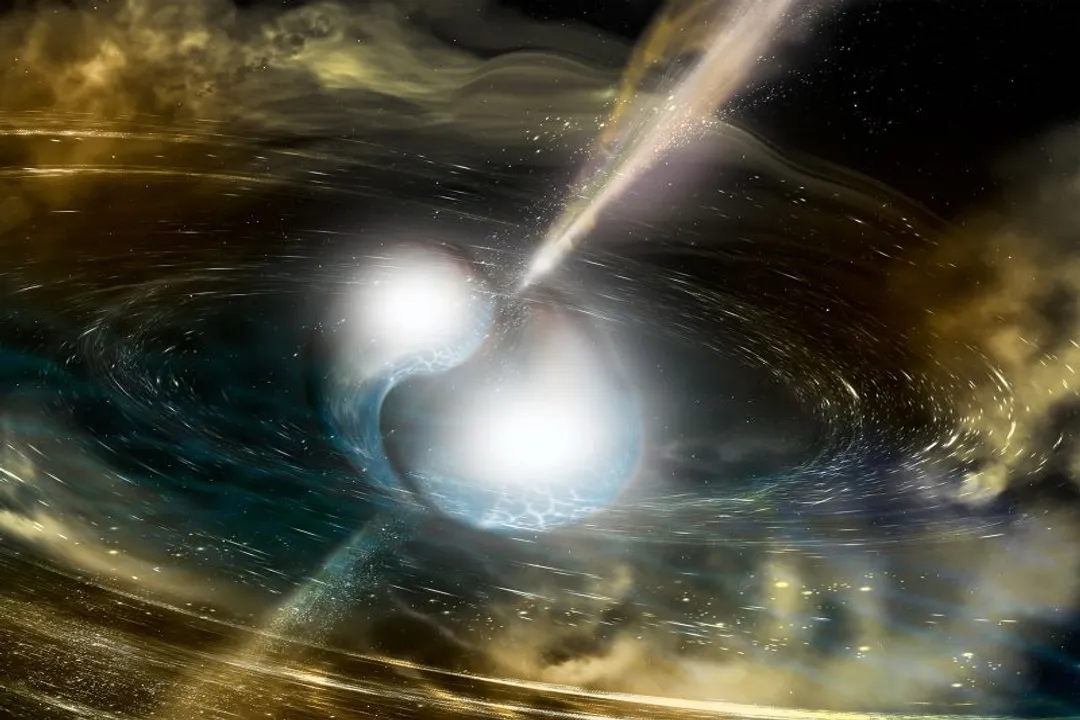
It is fascinating to note that while core-collapse supernovae were long considered the primary site for the -process, recent evidence strongly points to another incredibly energetic event: the merger of two neutron stars. [6] When two of these ultra-dense remnants collide, the resulting explosion—a kilonova—is believed to be one of the most potent factories for the universe’s heaviest elements. [6]
# Slow Neutron Capture (The s-Process)
While the -process handles the heaviest elements, many intermediate-to-heavy elements (like barium or lead) are produced via the s-process, or slow neutron-capture process. [1][9] This occurs over longer timescales, typically within Asymptotic Giant Branch (AGB) stars—the late stage of evolution for lower-to-intermediate mass stars—or perhaps in the late stages of very massive stars before the final collapse. [1][9] In the s-process, a nucleus captures one neutron at a time, and it has enough time to undergo beta decay into a more stable element before capturing another neutron. [1][9]
Considering the vastly different energy requirements, it is an insightful exercise to compare the energy balance. Fusion up to iron involves a net energy gain that sustains the star for millions of years, a gentle downhill slide of energy release. In stark contrast, the -process involves an immediate, overwhelming energy requirement delivered by the shockwave of a supernova or merger to force nuclei to absorb neutrons against their binding preference, creating elements in mere seconds that would otherwise be impossible to synthesize. [5]
# Cosmic Legacy
If massive stars only kept their newly minted elements locked away in their collapsed remnants, the universe would never have developed past the initial hydrogen/helium stage, and planets like Earth, rich in silicates and iron, could not exist. [3] The elements forged in stellar cores and during the supernova explosion must be dispersed back into the interstellar medium. [8]
This recycling happens in two primary ways:
- Stellar Winds: Even before a supernova, very massive stars lose significant amounts of material through powerful stellar winds, seeding the nearby space with elements synthesized during their main-sequence and giant phases (like carbon and oxygen). [7]
- Supernova Ejecta: The explosion itself blasts the star's outer layers, enriched with elements up to iron from the main burning phases, and the freshly synthesized -process elements, out into the galaxy at immense speeds. [7][9]
These enriched clouds of gas and dust eventually mix, become the raw material for the next generation of stars and solar systems. [8] Our Sun is a second- or third-generation star, meaning the raw materials that formed our planet and our bodies were created inside stars that lived and died long ago. [3] The calcium in your bones and the iron that carries oxygen in your blood were once part of a massive star burning silicon in its final hours, or perhaps liberated in the cataclysmic collision of two neutron stars billions of years ago. [3][6] Therefore, every atom heavier than boron was, quite literally, cooked in a star. [8]
Related Questions
#Citations
Stellar nucleosynthesis - Wikipedia
Stellar Nucleosynthesis: How Stars Make All of the Elements
The stars within us | NSF - U.S. National Science Foundation
Honest question: if Iron is the heaviest element created in stars, how ...
Ask Astro: How do stars make elements heavier than iron?
Some of the universe's heavier elements are created by neutron star ...
Stellar Evolution - Chandra X-ray Observatory
What Did Stars Give Us? - OER Project
The Creation of Heavy Elements - Teach Astronomy