What is the primary process by which elements are formed in stars?
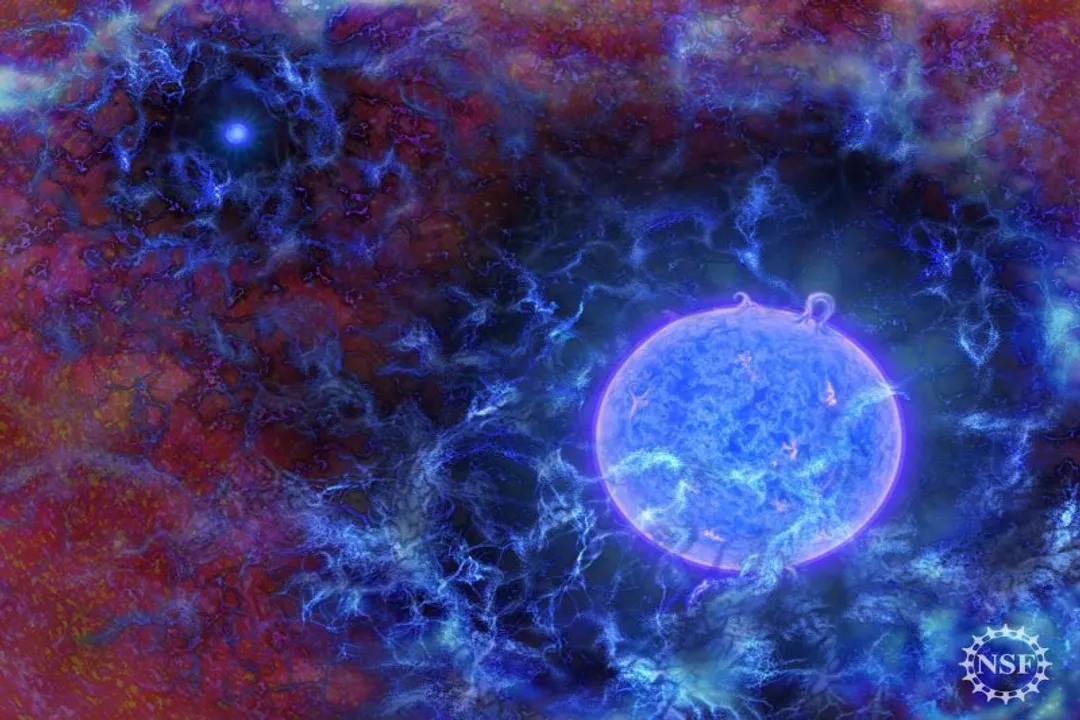
The creation of elements, from the simplest ones we know to the complex building blocks of life, is fundamentally tied to the violent, luminous engines we call stars. [1][4] This cosmic alchemy, known scientifically as stellar nucleosynthesis, describes the process where lighter atomic nuclei fuse together under extreme conditions to form heavier ones within the stellar interior. [2][3][6] It is the engine that lights up the universe, converting mass directly into the tremendous energy that powers stars for billions of years. [3][7]
# Stellar Furnace
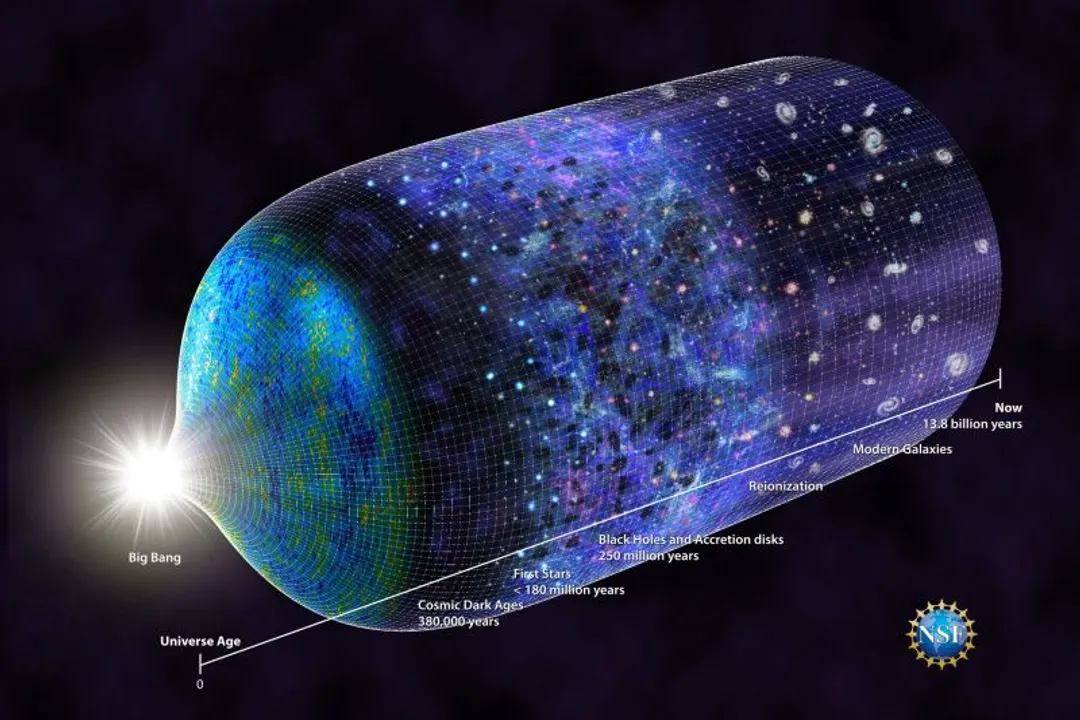
Stars are essentially gigantic, self-sustaining balls of superheated plasma held together by their own gravity. [1] The energy they emit stems from nuclear fusion occurring deep within their cores. [7] For the majority of a star's life—the main sequence phase—the primary activity involves fusing the lightest element, hydrogen (), into the next simplest, helium (). [2][7] This reaction releases vast amounts of energy, following the famous relationship , where a small amount of mass is converted into energy. [3] While hydrogen and helium themselves originated in the immediate aftermath of the Big Bang, virtually every other element on the periodic table owes its existence to these stellar furnaces. [4][5]
# Core Conditions
The initial hurdle for fusion is not the lack of fuel, but the powerful electrical repulsion, or electrostatic barrier, that exists between positively charged atomic nuclei. [9] For fusion to occur, nuclei must be brought close enough for the strong nuclear force to overcome this repulsion and bind them together. [9] This requires immensely high temperatures and densities found only in a star's deepest regions. [9] In a star like our Sun, the core temperature must reach millions of degrees, creating the necessary kinetic energy for the nuclei to collide violently enough to fuse. [9] This delicate balance between the outward push of fusion pressure and the inward pull of gravity maintains the star in a state called hydrostatic equilibrium, defining its stable lifetime. [8]
# Mass Matters
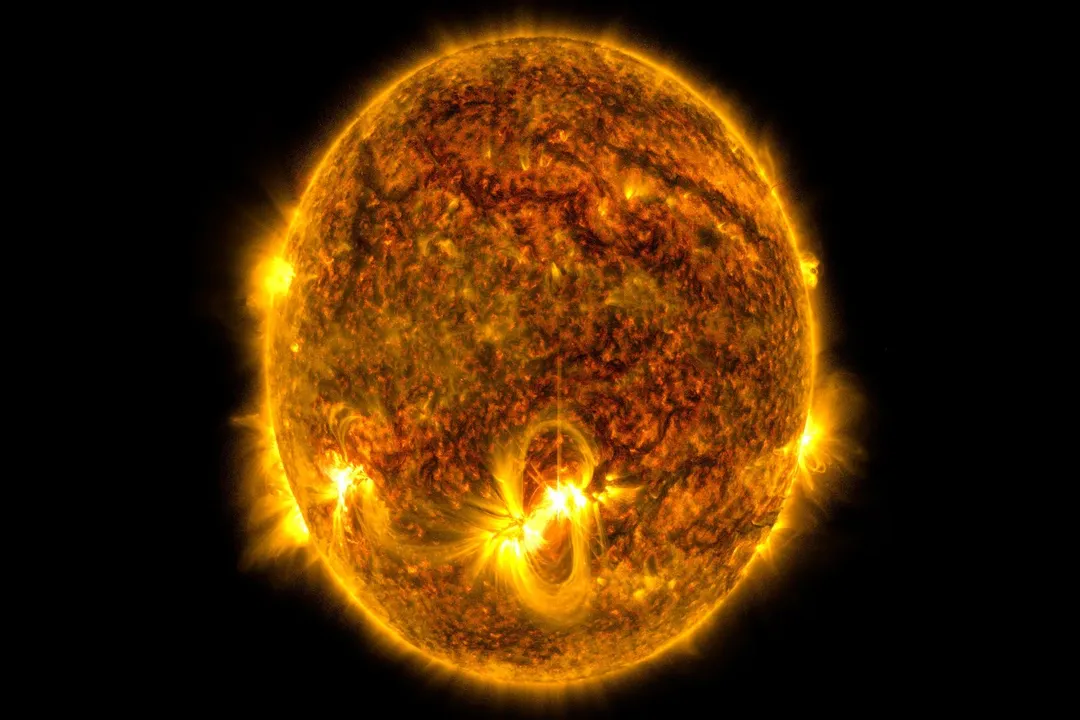
The ultimate fate of a star and the specific elements it manufactures depend almost entirely on its initial mass. [8] Stars come in a wide variety of sizes, leading to fundamentally different evolutionary paths and nucleosynthetic outputs. [8]
For stars similar to our Sun, or those of low to intermediate mass, the fusion process is relatively constrained. [4] These stars have sufficient core temperatures and pressures to fuse hydrogen into helium, and later, helium into heavier elements like carbon. [4] However, once the core runs out of helium to fuse, a star like the Sun lacks the necessary gravitational crush to raise temperatures high enough to ignite further fusion steps. [4] Consequently, these stars gently shed their outer layers, leaving behind a white dwarf, having enriched the cosmos primarily with carbon and oxygen—elements vital for life, but not much beyond. [4]
Massive stars, those significantly larger than the Sun, offer a far more dramatic environment for element creation. [2] Their greater mass results in immensely higher core temperatures and pressures, allowing them to ignite successive stages of fusion after the main sequence is over. [8]
| Star Mass Type | Primary Fusion Limit | Final Core Element |
|---|---|---|
| Sun-like (Low/Intermediate) | Helium Burning | Carbon / Oxygen [4] |
| Massive Star (> 8 Solar Masses) | Silicon Burning | Iron () [2][8] |
It is interesting to note the sheer contrast in stellar lifetimes related to this process. A small star might happily burn its hydrogen fuel for billions of years, a process dictated by the slow rate of proton-proton chain reactions, while a super-massive star might exhaust its fuel and move through its advanced fusion stages in a fraction of that time, ending its life in a cataclysmic explosion within mere millions of years. [2] This swift acceleration of energy production as a star ages demonstrates how the crushing pressure dictates reaction speed.
# Fusion Chains
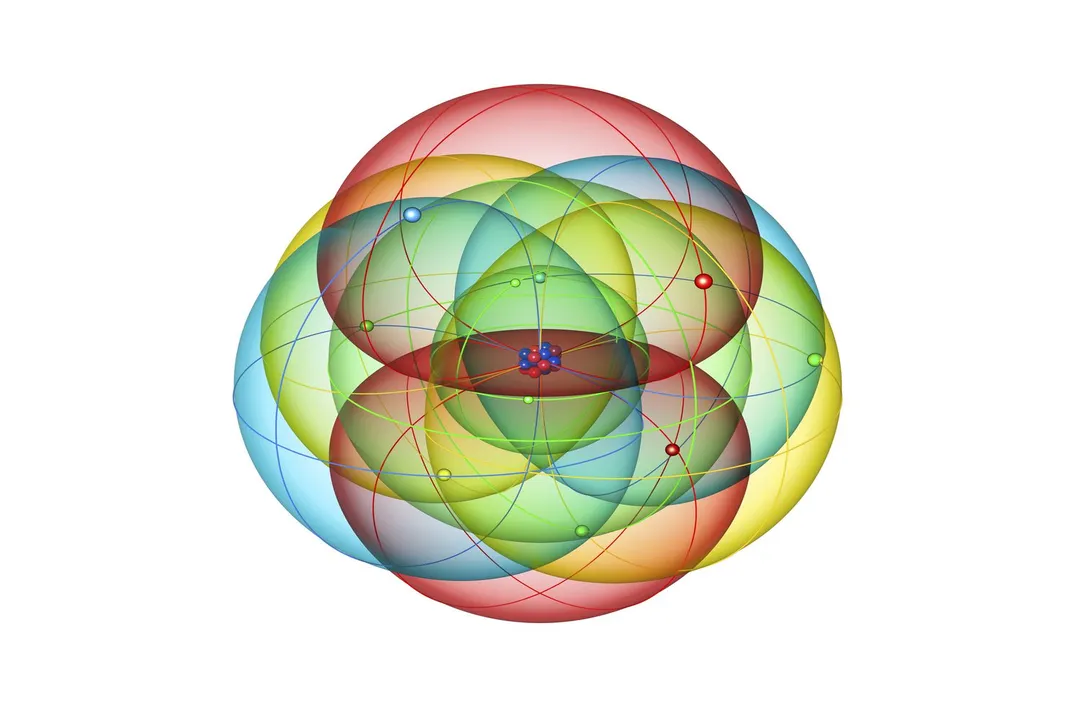
As a massive star exhausts its initial helium supply, the core contracts until the temperature is high enough to fuse helium nuclei into carbon () and oxygen (). [8] This new fuel then burns, and the process continues in a layered onion-like structure within the star's core. [8] Each subsequent stage requires higher temperatures and is shorter in duration than the last. [8]
The sequence follows a pattern where progressively heavier elements are built up:
- Hydrogen fuses to Helium.
- Helium fuses to Carbon and Oxygen.
- Carbon and Oxygen fuse to create elements like Neon (), Magnesium (), and Sodium ().
- These elements continue fusing, eventually forming Silicon (). [2][8]
Each step in this chain releases energy, which temporarily halts gravitational collapse and allows the star to maintain equilibrium for a period. [8] The complexity of the resulting elements grows with the increasing stellar temperature required to initiate the next reaction.
# Iron Limit
This chain of energy-releasing fusion reactions eventually culminates in the creation of iron () in the star's core. [2][8] Iron sits at a unique turning point in nuclear physics. Because the binding energy per nucleon peaks around iron, fusing elements lighter than iron releases net energy, but fusing iron or elements heavier than iron actually requires an input of energy rather than releasing it. [8]
This marks the definitive end of standard thermonuclear energy generation for the star. Once the core is predominantly iron, the energy source that has fought gravity for millennia is abruptly cut off. [2] The star can no longer generate the thermal pressure needed to counteract its own colossal weight, leading to an instantaneous and catastrophic gravitational collapse. [8]
# Heavier Creation
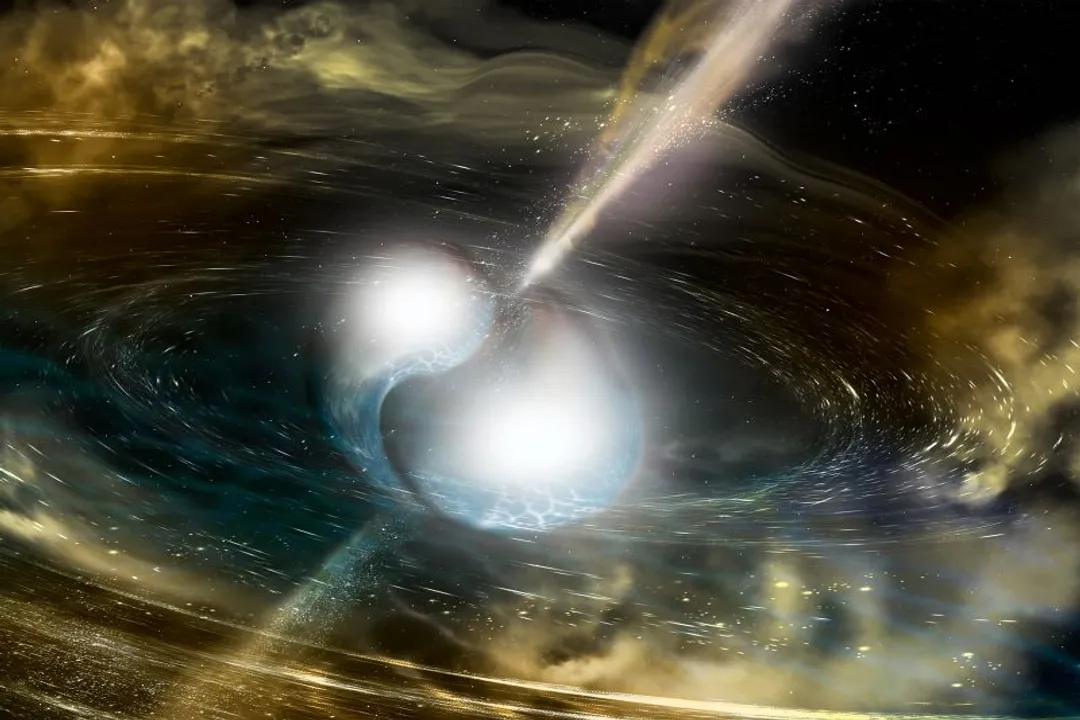
Since fusion cannot create elements heavier than iron in the core, the formation of these rarer, heavier elements—like gold, platinum, and uranium—must occur through different, more violent mechanisms. [2] When the iron core collapses, it triggers a supernova explosion. [2]
During this hyper-energetic event, the core compacts to incredible densities, often forming a neutron star, and releases an enormous flux of neutrons. [2] In this extreme neutron-rich environment, nuclei rapidly capture these neutrons in a process often described as rapid neutron capture, or the r-process. [2] This allows atomic nuclei to grow much heavier than iron before they undergo beta decay, settling into the stable, heavy elements that are then scattered across the galaxy by the supernova blast. [2] This scattering is how these heavy elements—including many essential for planets and biology—are seeded into new generations of stars, gas clouds, and eventually, rocky worlds like ours. [1][4] The sheer violence of a supernova, unlike the gradual pressure cooker of a main sequence star, is necessary to force nuclei past that energetically unfavorable iron barrier.
Related Questions
#Citations
Star Basics - NASA Science
Stellar Nucleosynthesis: How Stars Make All of the Elements
Nucleosynthesis | Research Starters - EBSCO
The stars within us | NSF - U.S. National Science Foundation
Elements Formed In Stars - Consensus Academic Search Engine
DOE Explains...Nucleosynthesis - Department of Energy
Stellar Evolution - Chandra X-ray Observatory
Stellar Nucleosynthesis - an overview | ScienceDirect Topics
Why does a star's fusion process proceed in the particular order of ...