What is used by stars to create new elements?
The raw material for almost everything around us—the calcium in our bones, the iron in our blood, and the oxygen we breathe—was forged inside stars across billions of years. [2][3] The process stars use to build these new, heavier elements is called stellar nucleosynthesis. [1] Essentially, stars are cosmic element factories, starting with the simplest ingredients provided by the Big Bang and transforming them under immense heat and pressure. [6] The fundamental "fuel" that drives this transformation is lighter atomic nuclei, primarily hydrogen, which are fused together in the star's core. [2][3]
# Main Sequence Fusion
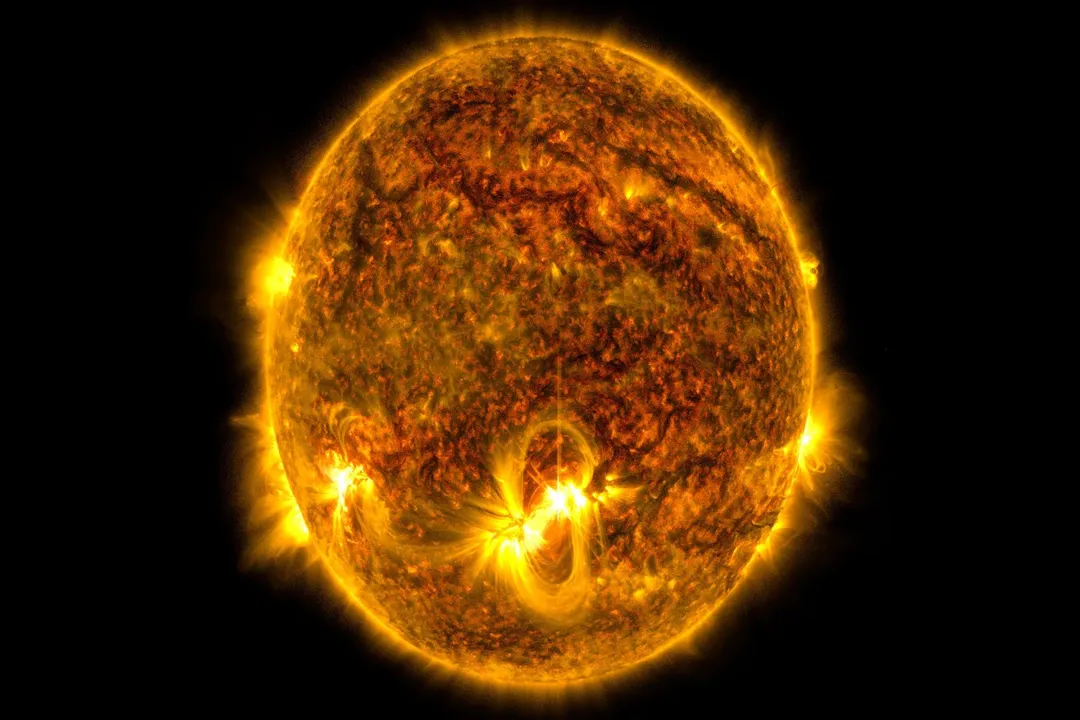
For the vast majority of a star's life, it resides on the main sequence, operating much like our Sun. [2] During this long phase, the star is fusing hydrogen nuclei into helium nuclei in its core. [1] This is the most stable and energy-efficient process a star undertakes. [3]
In stars like the Sun (low to intermediate mass), the dominant method is the proton-proton chain, where successive collisions combine hydrogen atoms until a helium nucleus () is formed. [1] In more massive stars, the temperature is high enough to use the Carbon-Nitrogen-Oxygen (CNO) cycle, which utilizes carbon, nitrogen, and oxygen as catalysts to turn hydrogen into helium much faster. [1] In both cases, the net result is the creation of helium from hydrogen, releasing vast amounts of energy that counteract gravity and keep the star stable. [2]
# Core Burning Stages
Once the hydrogen fuel in the core is depleted, gravity causes the core to contract and heat up significantly. [1] This increased temperature is necessary to initiate the next stage of fusion, which builds heavier elements, often described as an onion-like layering of burning shells in the most massive stars. [1][6]
# Helium Ignition
When the core reaches about (), helium fusion begins. [1] This is often referred to as the triple-alpha process, where three helium nuclei (alpha particles) fuse to create a carbon nucleus (). [1][3] Following this, carbon can capture another helium nucleus to form oxygen (). [1] These elements, carbon and oxygen, are the critical precursors for life as we know it. [2]
# Successive Fusion
In stars significantly more massive than the Sun—perhaps eight times the Sun’s mass or more—the gravitational pressure is sufficient to continue escalating the core temperature, allowing for further fusion cycles. [1] These stages occur sequentially, with each one lasting a progressively shorter time because the fuel density is lower and the energy output is higher. [6]
| Burning Stage | Product Elements | Approximate Temperature () |
|---|---|---|
| Hydrogen | Helium | $10^7$ |
| Helium | Carbon, Oxygen | $10^8$ |
| Carbon | Neon, Sodium, Magnesium | |
| Neon | Oxygen, Magnesium | |
| Oxygen | Silicon, Sulfur, Phosphorus | |
| Silicon | Iron, Nickel |
The temperature required for silicon burning alone is around . [1] The products of these successive shell burnings—neon, oxygen, silicon, and others—eventually accumulate until the core is primarily composed of iron () or nickel (). [1][6]
# The Iron Barrier
The formation of iron marks a fundamental stopping point for energy-generating fusion within a star. [7] Iron sits at a unique spot on the nuclear binding energy curve: it has the tightest binding energy per nucleon of any element. [1] This means that fusing elements lighter than iron releases energy (exothermic), but fusing iron or elements heavier than iron consumes energy (endothermic). [7]
When the core converts to iron, the star loses its internal energy source that was holding up its immense mass against gravity. [1] With no outward pressure being generated by fusion, catastrophic collapse is inevitable. [7] This collapse triggers the dramatic supernova event that creates the heaviest elements.
# Creating Heavy Elements
The elements heavier than iron, such as gold, uranium, and silver, cannot be made through standard, energy-releasing fusion because those reactions require an energy input. [7] Their creation relies instead on neutron capture processes, which require an environment rich in free neutrons and are typically associated with stellar death. [1][7]
# Slow Neutron Capture (s-process)
In certain evolved stars known as Asymptotic Giant Branch () stars, a relatively slow, steady source of neutrons allows nuclei to capture neutrons one at a time. [7] If a nucleus captures a neutron but does not immediately fission or undergo beta decay, it builds up mass slowly, moving up the chart of nuclides until it reaches a stable configuration or decays into a heavier element. [1][7] This process is responsible for roughly half of the elements heavier than iron, up to and including bismuth (), the heaviest element produced primarily via this method. [7]
# Rapid Neutron Capture (r-process)
To create elements much heavier than iron, such as platinum or gold, a massive influx of neutrons is required faster than the nucleus has time to decay. [7] This r-process (rapid neutron capture) requires extreme conditions, such as the shockwave of a Type II core-collapse supernova or, more recently confirmed, the collision of two neutron stars (a kilonova). [1][7][9] In these brief, violent events, the neutron density is so high that nuclei are flooded with neutrons, rapidly forming very heavy isotopes which then decay into stable, heavy elements. [7][9] For a long time, supernovae were considered the sole source, but observations of kilonovae have shown that neutron star mergers are a dominant, perhaps even primary, source for the heaviest elements in the universe. [9]
It’s interesting to consider that the elemental composition of our Solar System shows a mix of these two processes. [5] The presence of elements created by the slow s-process suggests that our Sun formed from gas already enriched by older, less massive AGB stars, while the heavy, rare elements required the explosive violence of supernovae or mergers. [7]
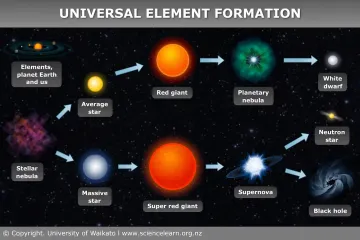
# Distribution into Space
A star's creation of new elements is only half the story; these atoms must then be dispersed into the interstellar medium () to seed the next generation of stars, planets, and life. [4][8]
For intermediate-mass stars, the outer layers puff away gently as they end their lives as planetary nebulae, enriching the surrounding space with carbon, oxygen, and nitrogen. [4]
However, the elements forged in the silicon-burning shells and, critically, the heavy elements from the r-process, are unleashed by the catastrophic shockwave of a supernova explosion. [1][8] The shock wave blasts the superheated inner layers, containing elements from oxygen all the way up to iron, and the newly synthesized heavy elements, outward at tremendous speeds. [4][6] The resulting nebula glows brightly in X-rays as it expands, a visible testament to the star’s demise and its final act of creation. [4]
The resulting distribution of elements across the galaxy is not uniform. [5] Elements are created at different times and by different stellar mechanisms, meaning that the chemical makeup of a star cluster depends heavily on the history of star formation preceding it. A younger star-forming region, like our own neighborhood, is significantly more metal-rich (astronomers call all elements heavier than helium "metals") than the very first stars that formed in the early universe, which were composed almost entirely of hydrogen and helium. [1][5]
The chemical signature imprinted upon a star or a cloud of gas allows astronomers to trace back its history, observing the specific ratios of elements like iron, neon, and silicon to infer the types of massive stars that exploded nearby long ago. [5] This incredible recycling system ensures that the building blocks of complexity—from heavy metals to organic molecules—are continually made available throughout the cosmos. [8] This slow, ongoing enrichment process is why the material that formed Earth, and eventually us, was so much richer in diverse atomic species than the pristine gas from which the very first stars ignited. [1]
Related Questions
#Citations
Stellar nucleosynthesis - Wikipedia
Star Basics - NASA Science
The Elements: Forged in Stars | PBS LearningMedia
Stellar Evolution - Chandra X-ray Observatory
Elemental Abundances | Center for Astrophysics | Harvard ...
Creation of Complex Elements - OER Project
The formation of the heaviest elements - Physics Today
How Elements are Forged from Stars | Spaceaustralia
Populating the periodic table: Nucleosynthesis of the elements