What elements are used to make a star?
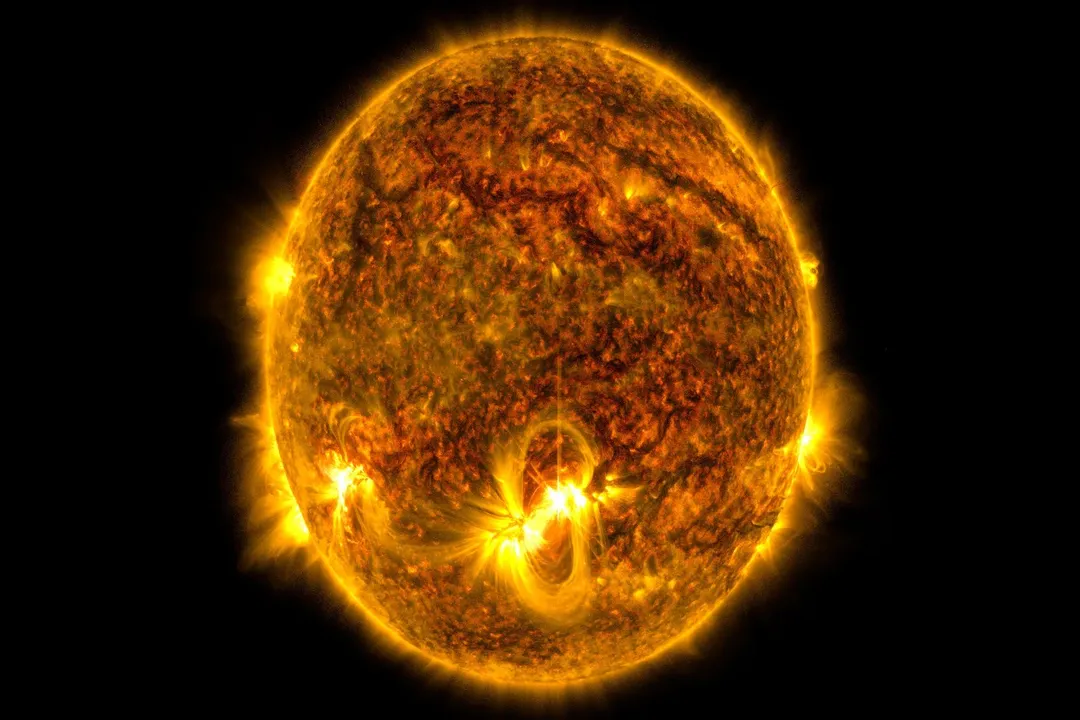
The composition of a star is one of the most fundamental questions in astronomy, moving us from the simple notion of a shining ball in the night sky to understanding the engine room of cosmic creation. At its most basic, a star is a colossal sphere of incredibly hot gas, held together by its own immense gravitational force. The elements that comprise these stellar giants are not static; they are constantly being transformed over billions of years, dictating the star’s life, its energy output, and eventually, its dramatic end.
# Initial Makeup
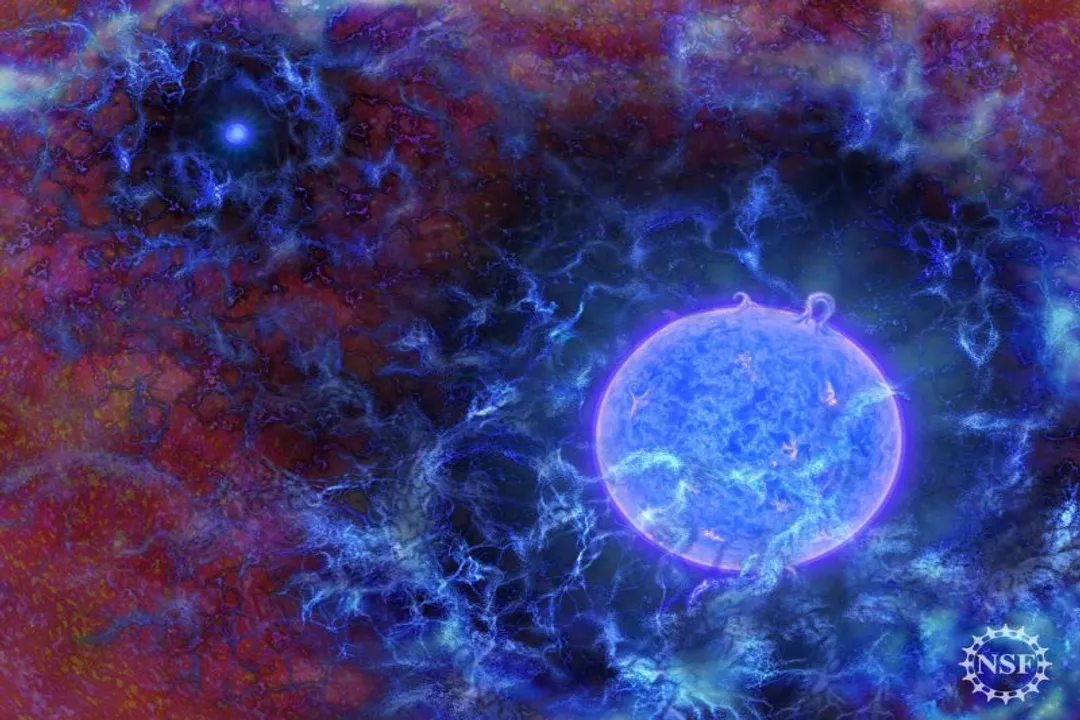
Right after the universe began in the Big Bang, the material available was overwhelmingly simple. Nearly all the matter created in those first moments consisted of just two elements: hydrogen and helium. Estimates suggest the early universe was approximately 75% hydrogen and 25% helium by mass. The very first stars formed out of these molecular clouds of hydrogen and helium gas that condensed under gravity. Even today, across the vast expanse of space, hydrogen and helium still account for about 98% of all the atoms present in the universe.
However, to become a star, this gas cloud must accumulate enough mass for gravity to cause a collapse, heating the core until it reaches the threshold for nuclear fusion. This is the process that defines a star: the sustained, self-regulating nuclear reaction within its core.
# Core Reaction
The energy that allows a star to shine and resist further gravitational collapse comes from fusing the lightest elements into slightly heavier ones. For the vast majority of a star's existence—the main sequence phase—the primary fuel is hydrogen, which is converted into helium nuclei. This process is known by the general term "hydrogen burning," though it is fusion, not chemical combustion like burning wood.
The specific pathway for this hydrogen fusion is highly dependent on the star's mass and, consequently, its core temperature.
In stars with masses up to about that of our Sun, the dominant mechanism is the proton–proton (PP) chain reaction. This starts with two protons fusing to form deuterium (a hydrogen isotope), ultimately yielding a helium-4 nucleus and releasing energy, as some mass is converted to energy according to . This reaction is quite sensitive to temperature, relying on roughly the fourth power of the core temperature (). This sensitivity means that while it can occur at relatively lower temperatures (starting around Kelvin), it generates less intense, more distributed energy across the inner region of the star.
Conversely, in stars more massive than about 1.3 times the Sun's mass, the Carbon–Nitrogen–Oxygen (CNO) cycle takes over. This process uses carbon, nitrogen, and oxygen nuclei as catalysts to convert hydrogen into helium. The CNO cycle requires a higher ignition temperature (approximately Kelvin) but increases its energy production far more steeply with temperature, proportional to to . Because its energy generation ramps up so quickly with minor temperature increases, nearly 90% of the CNO cycle’s output is concentrated in the star's very innermost core, leading to a convective region that vigorously mixes the fuel.
It is fascinating to note that while the Sun's core temperature is about K, it generates only about 1% of its energy through the CNO cycle, relying mostly on the PP chain. This highlights a crucial point: the elemental mixture you observe in a star's spectrum is a direct fingerprint of its mass and evolutionary stage, as the ratio of PP-to-CNO processing changes with age and temperature.
# Element Cooking
Once the hydrogen fuel in the core is exhausted, the star's gravity causes the core to contract and heat up dramatically, enabling the next stage of fusion. For stars around the Sun's mass, this leads to the ignition of helium, often starting with a "helium flash" in a degenerate core.
Helium burning occurs primarily through the triple-alpha process, where three helium nuclei combine to form carbon. This carbon can then capture more helium nuclei in a process known as helium capture (or the alpha process) to preferentially create elements with even numbers of protons, such as oxygen and neon.
In more massive stars, the aging process accelerates as the star leaves the main sequence and evolves into a supergiant. The core continues to contract, raising temperatures high enough to fuse carbon into neon, then neon into oxygen, and eventually oxygen into silicon. This layered fusion structure resembles an onion, with the heaviest elements being created closer to the center. Each successive stage burns fuel much faster than the last. A star 25 times the Sun's mass might spend millions of years fusing hydrogen, but only about one day fusing silicon into iron.
The line is drawn firmly at Iron (Fe), element number 26. Once the core is primarily iron, fusion stops being an energy source. Attempting to fuse iron nuclei requires an input of energy rather than releasing it, meaning the star loses its primary outward pressure support almost instantly.
# Explosive Forge
The elements that constitute everything beyond iron on the periodic table—the gold in your jewelry, the platinum in electronics, and many others—were not made during the steady-burning phases of stellar life. They require the catastrophic violence of a star's final moments.
When the iron core of a massive star can no longer support itself, it collapses catastrophically. This collapse rebounds off the super-dense center, sending a powerful shock wave outward, resulting in a supernova explosion. These explosions generate staggering temperatures for a short period. It is within this brief, extreme environment that elements heavier than iron are manufactured, often through rapid neutron capture (the r-process). A supernova can briefly outshine an entire galaxy as it casts its chemically enriched material back into interstellar space.
A crucial piece of evidence for this came in 2017 when gravitational waves were detected from the collision of two neutron stars. These observations confirmed that such mergers are key sites for synthesizing some of the heaviest elements, including gold and platinum, effectively solving a long-standing mystery about their cosmic origin. In contrast, lower-mass stars like our Sun end their lives more gently, puffing off their outer layers to form a planetary nebula, leaving behind a white dwarf remnant composed mostly of carbon and oxygen.
Considering the prevalence of the original ingredients, it might seem counterintuitive that elements like carbon, oxygen, and iron, which are essential for forming rocky planets and life, exist at all. Yet, this tiny fraction—the 2% of the universe's atomic mass that is not hydrogen or helium—is the direct product of billions of years of stellar alchemy. Without the violent deaths of massive stars and neutron star mergers, the building blocks for Earth, water, and biology simply would not be available. Our very existence is predicated on the failure—the collapse and explosion—of these massive furnaces.
# Cosmic Cycle
The process of stellar element creation and dispersal is cyclical. The material ejected by supernovae and planetary nebulae mixes with existing interstellar gas clouds, forming new, more chemically complex molecular clouds. Subsequent generations of stars are born from this enriched material. Astronomers classify stars by their metallicity—the astrophysical term for the abundance of all elements heavier than hydrogen and helium. The youngest stars (Population I) contain a higher percentage of these "metals" because they formed from gas already seeded by many previous stellar generations, while the oldest stars (hypothetical Population III) would have been almost entirely hydrogen and helium.
For us on Earth, the elements that make up our bodies, our air, and the ground beneath us were forged in the fiery cores or explosive deaths of stars long before our Sun existed. We are, quite literally, made of star stuff. Understanding the specific elements involved is not just an abstract exercise in physics; it is the history of every atom in our solar system and ourselves.
While hydrogen and helium are the essential ingredients to start the fusion process and create a star, the resulting heavier elements are essential for complexity in the universe. An object made solely of pure hydrogen, even if massive enough to start fusion, would rapidly convert its fuel into helium and then cease significant activity, lacking the elements necessary for advanced chemistry or planetary formation. The elements created after the initial hydrogen/helium phase are what provide the raw material for everything we see and interact with daily, from the silicon in our electronics to the iron in our blood. This distinction between the "fuel" (H/He) and the "ash" (everything else) clearly defines the role of stellar processes in the grand cosmic inventory.



Related Questions
#Citations
Star Basics - NASA Science
Stellar nucleosynthesis - Wikipedia
What are stars made of? - Cool Cosmos - Caltech
What Are Stars Made of? - Reddit
What Are Stars Made Of? - Layers of the Sun and More at Little ...
The Elements: Forged in Stars | PBS LearningMedia
What elements would be essential for a star to exist? Is it even ...
What Did Stars Give Us? - OER Project
The stars within us | NSF - U.S. National Science Foundation