What tool is used to measure the distance between stars?
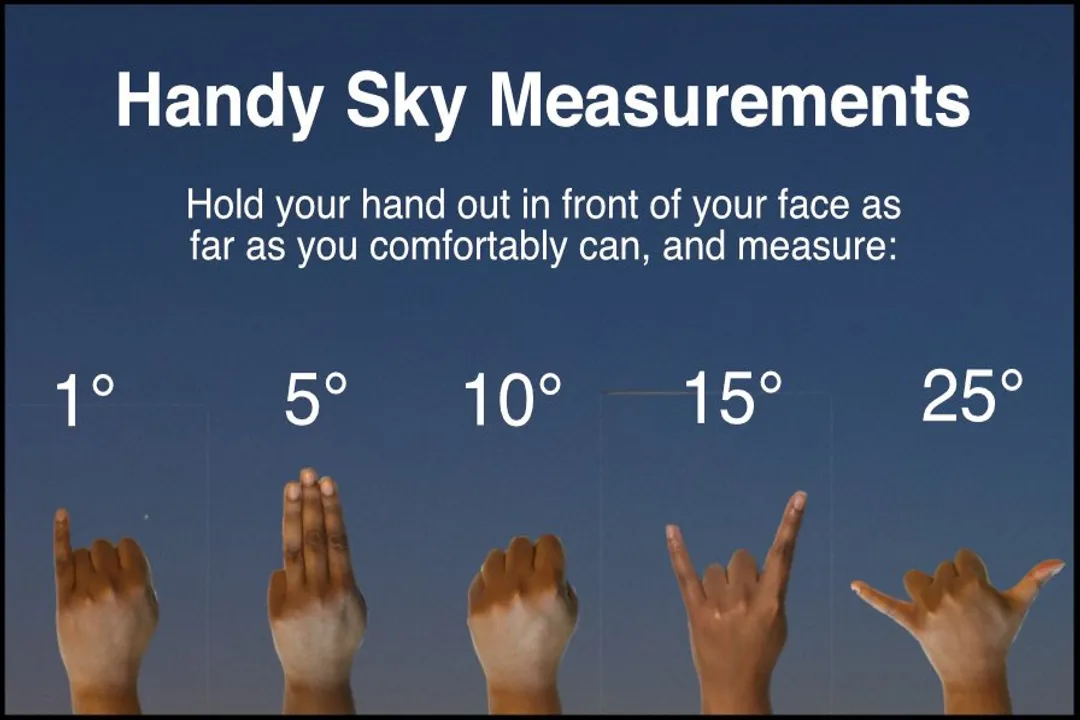
Measuring the distance to the stars is one of astronomy’s oldest and most fundamental challenges. Unlike measuring distances here on Earth, where we might use a tape measure or radar, the sheer emptiness of space demands incredibly clever geometric techniques. For the stars nearest to us, the primary and most direct tool relies not on a machine you can hold, but on the movement of our own planet: the method known as stellar parallax. [2][6]
This technique is the bedrock upon which nearly all other cosmic distance measurements are built, forming the first, essential rung on the cosmic distance ladder. [7] If we didn't have a reliable way to measure the nearest stars, everything calculated beyond them would be suspect. [6]
# Orbital Baseline

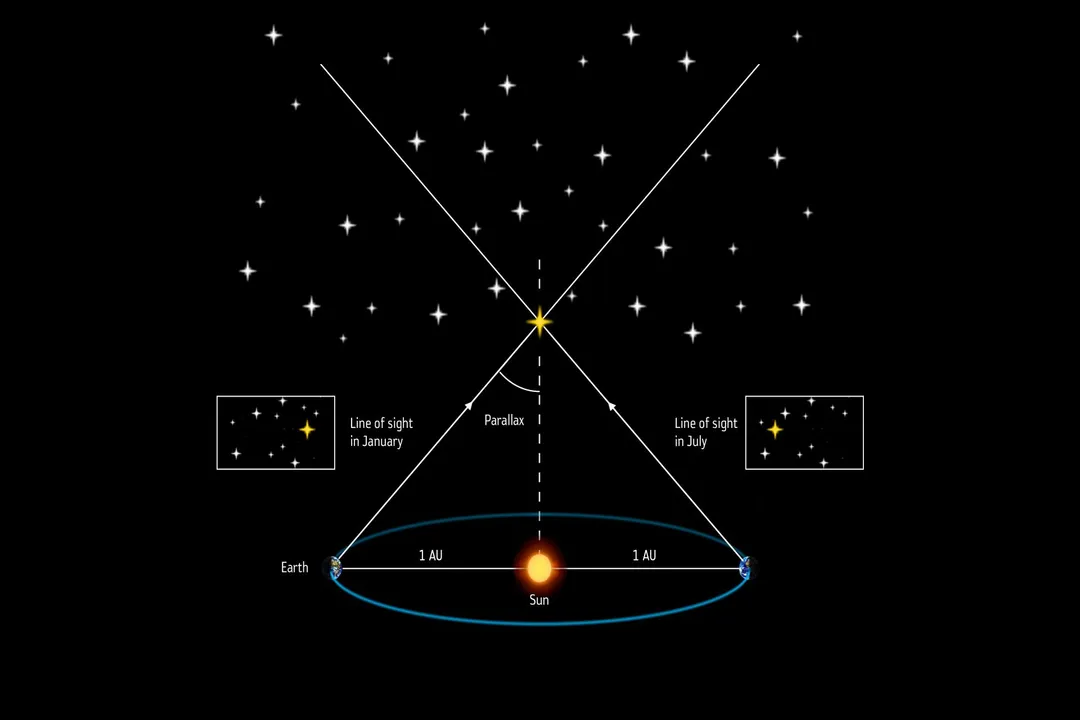
Stellar parallax is essentially triangulation applied across the vastness of space. [2] The principle is simple: hold your thumb out at arm's length and close one eye, then switch eyes. Your thumb appears to jump against the background objects. This apparent shift, caused by changing your viewing position, is parallax. [2]
Astronomers do the exact same thing with stars, but their "eye switch" requires a six-month wait. [2] The baseline used is the diameter of Earth's orbit around the Sun. [1][6]
- First Observation: An astronomer measures the precise position of a target star relative to much more distant, seemingly fixed background stars. [1]
- Wait: Six months pass, allowing the Earth to move to the opposite side of its orbit—a distance of about 300 million kilometers (186 million miles) from the first observation point. [2][6]
- Second Observation: The star’s position is measured again relative to the fixed background. [1]
If the star is relatively close, it will appear to have shifted slightly against the distant stellar backdrop. [6] The angle of this apparent shift is the parallax angle. [1][2] The closer the star, the larger this angle will be. [6]
# Cosmic Yardstick

The relationship between this measured angle and the actual distance is an inverse one, governed by trigonometry. [1] Because the angles involved are incredibly small—even for the nearest stars—astronomers devised a specific unit perfectly suited to this measurement: the parsec. [1][7]
The parsec, short for "parallax-second," is defined as the distance at which a star exhibits a parallax shift of exactly one arcsecond. [1][7] An arcsecond is an extremely tiny measurement; there are 3,600 arcseconds in a single degree, and the Moon appears about 1,800 arcseconds wide in the sky. [1]
This means that if a star has a measured parallax angle of arcseconds, its distance in parsecs is calculated using the simple formula: . [1][7]
The parsec is more than just a mathematical convenience; it helps visualize the scale of our local neighborhood. For instance, the star nearest to our Sun, Proxima Centauri, has a measured parallax of about $0.772$ arcseconds. [1] When we apply the simple formula, we find its distance is , which equals approximately $1.295$ parsecs. [1] While light-years are often preferred in popular science because they are more intuitive (representing how far light travels in a year), the parsec remains the standard unit derived directly from the parallax method. [9] To give that figure context, one parsec translates to roughly 3.26 light-years. [1][7] This means Proxima Centauri is about $4.24$ light-years away, fitting neatly into the parsec-based calculation. Think of it this way: if Proxima Centauri were exactly one parsec away, the shift we observe over six months would be one full arcsecond—a truly significant angular movement in astronomical terms. [1]
# Angle Precision

The effectiveness of stellar parallax hinges entirely on our ability to measure these minuscule angles with extreme accuracy. [2] Ground-based telescopes are significantly hampered by the Earth’s atmosphere, which blurs and distorts the light from the stars, making precise measurement of sub-arcsecond angles incredibly difficult. [6]
Historically, this limited reliable parallax measurements to stars within a few hundred light-years. [6] To overcome atmospheric distortion and push the boundaries of measurable distance, space-based observatories have become essential. The most revolutionary recent mission in this field is the Gaia space observatory from the European Space Agency (ESA). [5]
Gaia is not merely a bigger telescope; it is a specialized astrometry machine designed specifically to measure stellar positions and movements with unprecedented accuracy. [5] Missions like Gaia can measure angles down to microarcseconds—millionths of an arcsecond. [5] This incredible sensitivity allows astronomers to map the distances to billions of stars across the Milky Way with far greater precision than ever before. [5] For context, while earlier ground-based parallax measurements might have an error margin of 10 to 20 percent for relatively close stars, missions like Gaia aim for errors of less than 1 percent for the most distant measurable stars. [5]
When considering the data, it’s important to recognize that parallax measurements are direct determinations of distance, meaning they rely purely on geometry and known quantities (the Earth's orbit). [6] This directness is why parallax is so highly trusted for establishing the nearest distances.
# Rungs Higher
As we look farther out into the galaxy, the parallax angle becomes too small to measure, even for the most sensitive instruments. For instance, a star 10,000 light-years away has a parallax angle of only about $0.0003$ arcseconds, which is currently beyond the reliable detection limit for most stellar targets. [6] This is where the cosmic distance ladder comes into play. [7]
Once the direct parallax measurements have accurately established the distances to certain types of stars in our local stellar neighborhood, astronomers can use those stars to calibrate secondary methods, which then allow them to measure objects farther away. This scaling process defines the ladder. [7]
For example, astronomers look for specific types of variable stars, such as Cepheid variables. [6] By observing these stars, they discovered a direct relationship between how fast they pulse (their period) and their true intrinsic brightness (their luminosity). [6] This relationship turns them into standard candles. [6]
The process looks like this:
- Use parallax to find the actual distance to a few nearby Cepheids.
- Use that actual distance to calculate their true absolute magnitude (intrinsic brightness).
- Establish the precise Period-Luminosity relationship for Cepheids.
- Now, find a Cepheid in a distant galaxy where parallax is impossible. Measure its period to find its absolute magnitude.
- Compare its measured apparent magnitude (how bright it looks from Earth) to its calculated absolute magnitude. The difference tells you the distance to that entire galaxy. [6]
This reliance on calibration means that the uncertainty inherent in the first rung (parallax) gets carried up to every subsequent rung. An error of, say, 1% in measuring the nearest stars propagates as we move to Cepheids, then to Type Ia supernovae, and finally to the farthest galaxies we can observe. [6][7]
# Measurement Limits
While the distance ladder allows us to map the entire universe, the reliability of these measurements decreases with distance because each step relies on the accuracy of the previous one. [6] The tool used to measure the distance between two stars in the Pleiades cluster might be parallax, but the tool used to measure the distance to the Andromeda Galaxy requires a complex chain of overlapping techniques. [6][7]
It is fascinating to consider how errors accumulate across the ladder. If we slightly overestimate the distance to the nearest Cepheids—the stars used to calibrate the relationship—then every galaxy measured using that Cepheid scale will also be overestimated by the same proportion. This compounds as we move to standard candles like Type Ia supernovae, which are used to measure objects billions of light-years away. A tiny, near-imperceptible error in the parallax measurement of a star just a few hundred light-years away can translate into errors spanning millions of light-years at the edge of the observable universe. [7] The ongoing work of missions like Gaia is therefore not just about mapping our local stars better; it's about tightening the foundation of the entire cosmological distance scale. [5]
#Videos
The Ultimate Guide to Determining Star Distances: Methods Unveiled
Related Questions
#Citations
Stellar parallax - Wikipedia
What Is Parallax? - How Astronomers Measure Stellar Distance
How can we tell how far away a star is or how old it is? - Reddit
The Ultimate Guide to Determining Star Distances: Methods Unveiled
Measure the Night Sky - News & Resources | Night Sky Network
How do astronomers measure distances to stars and galaxies?
How do we measure distance in space? | BBC Sky at Night Magazine
What is the unit for measuring the distance between two stars? - Quora