What is the most accurate way to measure distance?
The most accurate way to measure distance is not a single tool or method, but rather a decision dictated entirely by the scale of the measurement and the required precision. What constitutes "accurate" for marking out a tabletop is vastly different from what is needed to map tectonic plate movement or determine the separation between galaxies. [5] Achieving high accuracy often means employing systems that minimize human interpretation, account for environmental variables, and rely on highly stable reference standards. [4]
# Workshop Precision
For everyday measurements, such as those encountered in woodworking or small fabrication, accuracy is often limited by the quality of the tool and the technique of the user. [1] A standard retractable tape measure, while convenient, introduces several sources of potential error. The hook at the end can have varying amounts of "play" or slack, affecting measurements taken internally versus externally. [1] Furthermore, if the tape is not held perfectly perpendicular to the surface or if parallax error occurs when reading the markings, the reading will deviate from the true dimension. [1]
Laser distance measures have become popular for these scales due to their speed and ability to take measurements without physical contact, reducing handling errors. [7] These devices typically work on the principle of time-of-flight—measuring how long a laser pulse takes to travel to the target and return. [8] However, their accuracy can be compromised by reflective surfaces, dust in the air, or the inherent tolerance of the internal electronics. [7] When checking very small components, even a laser measure might be insufficient; high-precision tools like micrometers or vernier calipers, which rely on direct contact and highly accurate screw threads or sliding scales, offer superior resolution for sub-millimeter work. [8]
When measuring a long object with a standard tape measure, one practical method to minimize the uncertainty related to the hook's slack or the starting zero point is to deliberately measure past the required length and then subtract the excess. This focuses the reading error onto the less critical end of the tape, often resulting in a more reliable dimension for the primary length needed. [1]
# Engineering Scales
Moving up to engineering, construction, and robotics, the requirements shift toward repeatable, instrument-aided measurements. In environments where non-contact measurement is necessary, such as measuring the distance traveled by a mobile robot, different technologies come into play. Ultrasonic sensors, for instance, use sound waves to determine distance based on the time it takes for an echo to return, similar to how a laser works with light. [8] While they are cost-effective for robotics or simple automation, their accuracy is significantly hampered by temperature fluctuations affecting the speed of sound, and by non-uniform surfaces that scatter the sound pulse. [8]
For structural layout or setting out foundations, electronic measuring instruments become necessary. These tools build upon the time-of-flight principle but incorporate far more precise timing electronics and better beam focusing than consumer-grade devices. The real leap in accuracy for professional applications often comes from systems that incorporate angle measurement alongside distance measurement, leading to tools like the Total Station. [4]
# Surveying and Geodesy
The most accurate terrestrial distance measurements—those covering ground distances on Earth—are typically achieved through modern surveying techniques, primarily relying on Electronic Distance Measurement (EDM) technology integrated into Total Stations or specialized GPS/GNSS receivers. [4][5]
EDM devices measure the phase shift or time delay of an electromagnetic wave transmitted and reflected back from a target prism. [4] The accuracy here is extraordinarily high, often reaching millimeter-level precision over distances of several kilometers. [4][5] However, this level of performance is not guaranteed simply by owning the equipment; it demands rigorous environmental correction. Surveyors must constantly account for atmospheric conditions, specifically temperature, pressure, and humidity, because these factors change the refractive index of the air, which in turn alters the speed of the electromagnetic wave. [4] Without these corrections, a kilometer-long measurement could be off by several centimeters, rendering the survey useless for high-specification projects. [4]
When comparing this to a simple tape measure, the difference is scale: a high-quality tape might have an error of 1 part in 10,000, whereas a modern, well-calibrated EDM setup can achieve accuracies on the order of 1 part in a million or better. [5]
When considering establishing fixed benchmarks across large areas, Global Navigation Satellite Systems (GNSS), which includes GPS, provide coordinates. While GNSS is excellent for positioning relative to the Earth's center, for highly precise baseline measurements between two points on the ground, direct EDM measurement is often superior due to atmospheric path uncertainties inherent in satellite signal reception. [4] However, the methodology itself is highly refined; the relationship between distance and the physical constant defining the speed of light serves as the basis for this high terrestrial accuracy. [5]
# Cosmic Rulers
When we discuss measuring distance to the Moon, planets, or stars, the methods diverge completely, relying on fundamental physics and astronomical observations. [3][6]
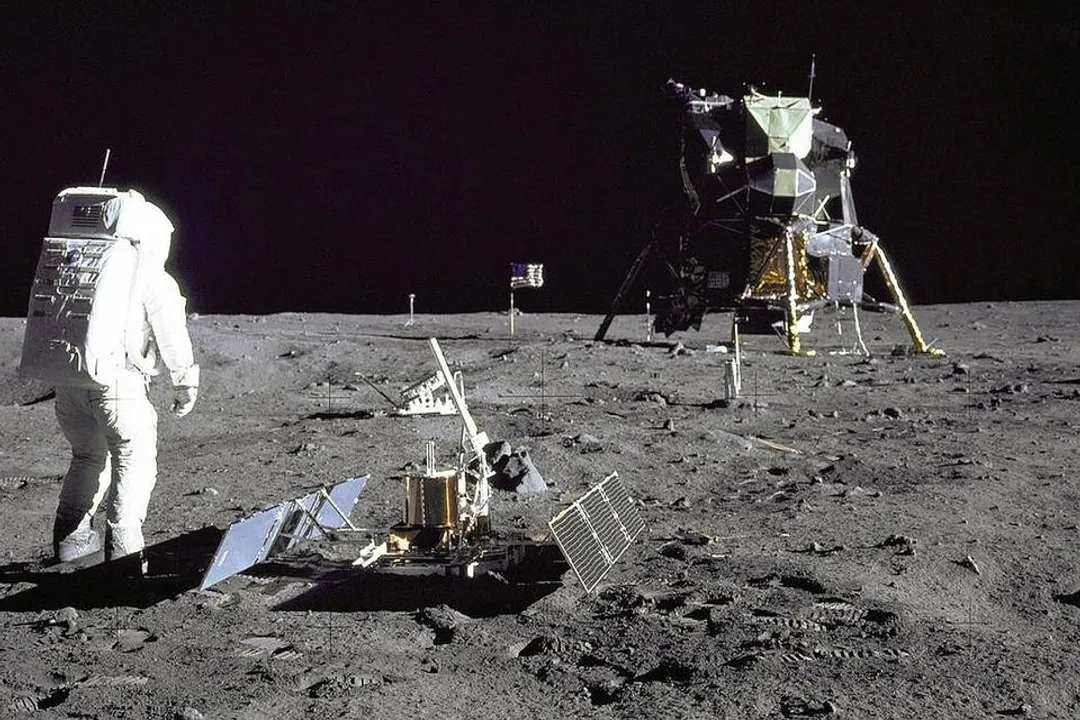
For relatively nearby objects in our solar system, such as the Moon, the most accurate method involves Lunar Laser Ranging (LLR). [3] This is a specialized, ground-based form of EDM where powerful laser pulses are fired at retroreflectors left on the Moon by Apollo and Soviet missions. [3] By timing the return trip of the light, distances accurate to within a few centimeters can be determined over an average distance of about 384,400 kilometers. [3]
Measuring distances beyond the solar system requires entirely different approaches, often referred to as the "Cosmic Distance Ladder". [6]
- Parallax: For stars relatively close to Earth (within a few thousand light-years), the most direct method is trigonometric parallax. [6] This involves measuring a star's apparent shift against the background as the Earth orbits the Sun. The accuracy is limited by the precision of the angular measurement, which decreases rapidly with distance. [6]
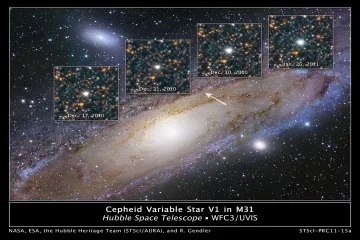
- Standard Candles: For greater distances, astronomers rely on objects with known intrinsic brightness, or "standard candles," such as Cepheid variable stars or Type Ia supernovae. [6] By comparing the known absolute magnitude (actual brightness) to the observed apparent magnitude (how bright it looks from Earth), the distance can be calculated using the inverse-square law for light intensity. [6] The accuracy here is highly dependent on the validity of the physical model used to determine the absolute luminosity of the standard candle. [3]
A key analytical difference between terrestrial measurement and deep-space measurement is the nature of the inherent error. Terrestrial EDM error is predominantly additive (a few millimeters plus an environmental factor). [4] In contrast, astronomical distance derived from standard candles has a significant relative error component, often expressed as a percentage uncertainty, as the calibration of the standard itself (e.g., the peak luminosity of a Type Ia supernova) carries a base uncertainty that propagates through all subsequent calculations. [3]
# Comparing Methods Contextually
When evaluating which method is most accurate, one must frame the requirement. If the task is to confirm that two machined parts mate perfectly, a calibrated micrometer is arguably the most accurate available tool, even though its absolute measurement precision is far lower than an EDM survey. [1][4] If the task is to map the precise location of a property boundary, the laser-corrected Total Station is the standard bearer. [4]
The hierarchy of accuracy across scales looks something like this, moving from smallest to largest scale:
| Measurement Scale | Exemplar Method | Typical Accuracy/Precision | Limiting Factor |
|---|---|---|---|
| Sub-millimeter | Micrometer/Gauge Block | or better | Tool wear, thermal expansion, resolution |
| Workshop (Meters) | Calibrated Laser Measure | Beam quality, environmental interference | |
| Engineering (100s of meters) | Total Station (EDM) | Atmospheric correction, instrument calibration | |
| Planetary (Distance to Moon) | Lunar Laser Ranging | Timing resolution, tidal effects | |
| Interstellar (Stars) | Trigonometric Parallax | Accuracy drops rapidly with distance | Angular resolution of telescopes |
The development of measurement standards, traceable back to fundamental physical constants like the speed of light, underpins the entire structure of modern distance metrology. [5] The National Institute of Standards and Technology (NIST), for example, works to ensure that the definitions and realizations of these measurements are consistent globally, providing the foundation of trust required for high-accuracy work, whether you are measuring the length of a meter stick or the path length to Mars. [3] Ultimately, the pursuit of the most accurate distance measurement is a constant balancing act between the physical limits of the environment, the resolution of the sensing technology, and the skill applied by the operator.
#Videos
Measure distance, no maths, no map, no compass - YouTube
3 Measuring Tools Better than the Measuring Wheel - YouTube
Related Questions
#Citations
What's the most accurate way to measure long lengths thats not a ...
Measure distance, no maths, no map, no compass - YouTube
What is the most accurate method for measuring distance ... - Quora
Survey Methods for Accurate Distance Measuring
Measuring longer distances with high accuracy
What's the most accurate way to measure distance? - VEX Forum
How Do You Measure the Distance to the Moon, Planets, Stars and ...
Distance measurement tool - General Guidance - Arduino Forum