Why can't you see the Milky Way anymore?
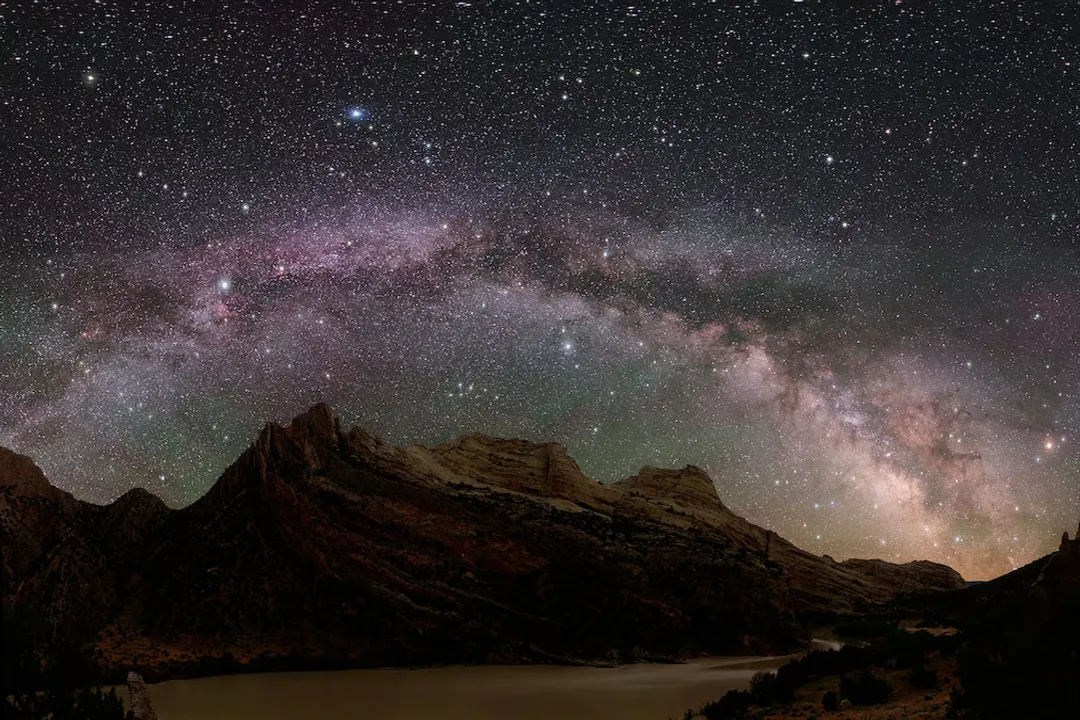
For many people today, the night sky above their homes is a canvas painted with stars, but it lacks the defining feature that once dominated celestial views: the soft, luminous band of the Milky Way galaxy. Our home galaxy, viewed edge-on from our position within one of its spiral arms, appears as a spectacular, diffuse swath of light stretching across the darkness. [1] This structure is not a cloud, but the combined light of billions of distant stars, too far away for the eye to resolve individually. [1] For generations, this sight was a given, a constant in the human experience, yet for roughly one-third of the global population, it has vanished entirely from view. [3][8]
# Missing Band
The experience of seeing the Milky Way is fundamentally tied to contrast. When observing from a location with a truly dark sky, the faint structure of our galaxy stands out starkly against the absolute blackness. It appears milky or cloudy because the light is spread thinly over a vast area of the sky. [1] When that contrast diminishes, the visual information we rely on to perceive this structure is overwhelmed, making it appear as though the galaxy is simply absent. This obscuration is not due to any physical change in the galaxy itself, but rather a terrestrial phenomenon that has crept into our view over the last century. [6]
# Atmospheric Glow
The primary agent responsible for erasing the Milky Way is light pollution, which manifests as skyglow. [5][7] When artificial lights—streetlights, billboards, building illumination—are directed upward or shine inefficiently, that light scatters off the atmosphere. [5] This light doesn't just travel upwards; it interacts with air molecules and any airborne particulates like dust or humidity, effectively creating a luminous veil across the entire night sky. [7] Think of trying to read very faint print while holding a powerful floodlight right next to your face; the light itself doesn't erase the print, but it overpowers the minute contrast required to detect it. The skyglow raises the baseline brightness of the night until the faint, diffuse light of the galactic center falls below the threshold of human visibility. [5][6]
A common question arising from this phenomenon concerns air travel. If one boards an airplane at night, the view might seem to clear up slightly once the aircraft climbs above the lowest layers of the atmosphere. However, even at cruising altitude, the immense dome of light cast by a large metropolitan area still illuminates the air thousands of feet above the plane, preventing a clear view of the faintest celestial objects. [4] The light source pollution blankets a vast region, not just the immediate area beneath the lamp. [4]
# Urban Centers
The effect is most severe in and around heavily populated, brightly lit areas. The culprits are often inefficient lighting designs—fixtures that spill light horizontally or upward instead of focusing it strictly downward where it is needed. [7] This phenomenon is often termed light trespass. [7] For example, if you live in a city where lights are not properly shielded, your upward gaze is immediately met by the collective glow of thousands of lamps, making the experience of the deep night sky impossible from your own backyard. [6] This widespread application of bright, inefficient lighting across entire regions is what drives the sobering statistics we see today.
When considering the sheer scale of human habitation clustered in urban centers, it becomes clear why so many people are affected. If we map out light pollution intensity against population density, the areas where the sky is completely washed out correspond directly to major global population centers. [7] For someone born today in a sprawling metropolitan area, they might have to travel hundreds of miles—perhaps to a designated dark-sky reserve—to witness the same starry vista their great-grandparents took for granted in the outskirts of the very same city. [6]
# Rapid Loss
The data paints a concerning picture regarding the speed of this decline. Researchers have quantified that approximately one-third of humanity can no longer see the Milky Way from where they live. [3][8] This is not a slow, gradual creep affecting only the most distant rural areas; it is a significant reduction in the accessible night sky for a massive portion of the world's population. [9] Furthermore, astronomical projections suggest that this loss is accelerating. If current trends in artificial lighting installation and waste continue unabated, there is a projection that within the next two decades, the visible stars could be largely erased for even more people, threatening the very cultural heritage tied to stargazing. [9] This highlights that the issue is not static; it is an active process of diminishing access occurring over a single generation.
# Seeking Shadows
Since the problem is caused by excessive, misdirected light, the solution lies in managing artificial illumination responsibly. While global policy changes are slow, understanding the mechanics offers insight into where one might still find that glorious band of stars. The key factor is achieving sufficient distance from the light source, not just altitude. [6] Dark sky advocates often push for three main principles in lighting design: ensuring lights are fully shielded so they point only downward, using lower intensity bulbs appropriate for the task, and choosing warmer color temperatures that scatter less effectively in the atmosphere. [7][9]
If your immediate environment is too bright, the only recourse is travel. Seek out remote areas, preferably at a high elevation where the air is clearer, and which are far removed from regional light domes. Observing during the new moon phase is also critical, as even a bright full moon contributes significant light pollution, reducing the contrast needed to discern the Milky Way's structure. [6] Preparing for a viewing session involves not just traveling, but allowing your eyes time—often twenty to thirty minutes—to fully adapt to the darkness so that your rod cells become sensitive enough to register the galaxy’s faint signature when it finally appears against the blackness. [1] The Milky Way remains there, a constant, but reclaiming the view requires actively seeking out the rare pockets of genuine terrestrial darkness that technology has nearly eradicated.
#Videos
You will NEVER see The Milky Way again - YouTube
The Big Milky Way Problem (80% Will Never See This) - YouTube
Related Questions
#Citations
80 Percent of Americans Can't See the Milky Way Anymore
How come I can't see the Milky Way? : r/space - Reddit
One Third of People Cannot See the Milky Way - AAAS
How come we never see Milky Way Galaxy when we fly at night ...
You will NEVER see The Milky Way again - YouTube
The Diming of Night Sky: Why You May Never See the Milky Way ...
The night sky is vanishing: 80 percent of Americans can no longer ...
One-Third of Humanity Can't See the Milky Way - Astronomy Magazine
Stars could be invisible within 20 years as light pollution brightens ...