Why do astronauts see black sky in space?

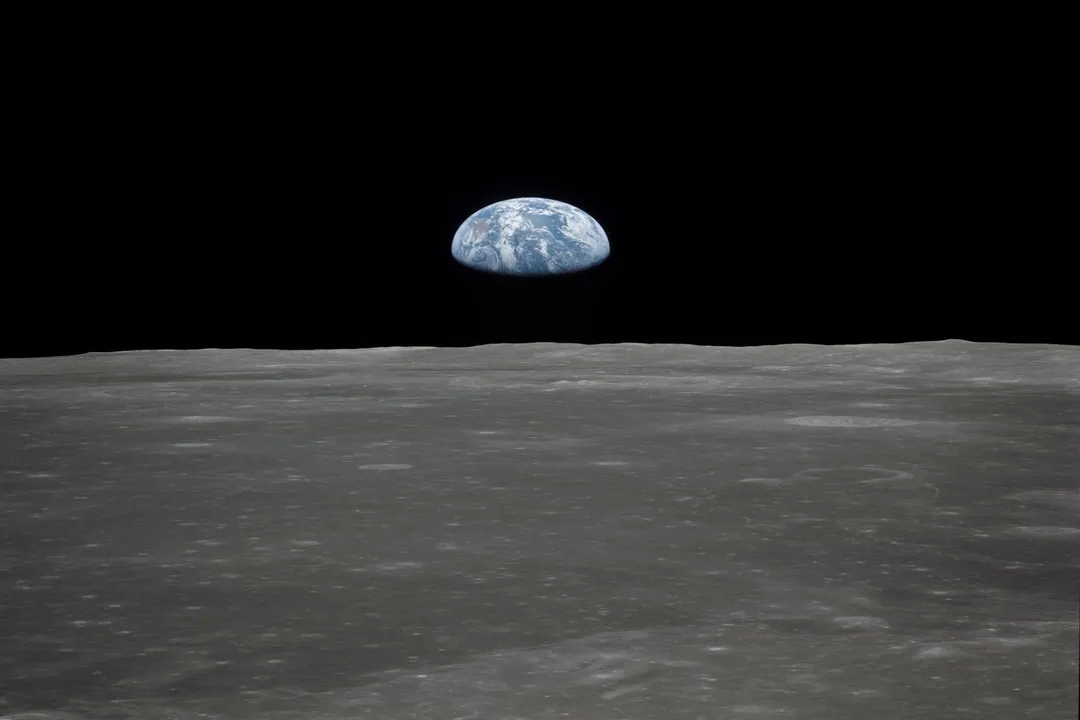
The immediate impression for anyone looking out from orbit or the Moon is that space is an inky, deep black, even when the Sun is blazing directly in view. It seems counterintuitive; if you move closer to the primary light source in our solar system, shouldn't the surroundings be brighter, not darker? The answer hinges entirely on what fills the space between your eye and the distant stars—or, more accurately, what doesn't fill it. [2][7]
# Earth's Blue
On Earth, the sky appears blue during the day for a very specific reason: the atmosphere acts as a giant, necessary filter and diffuser. Sunlight, which is composed of all colors, hits the gas molecules that make up our air, like nitrogen and oxygen. [1][7] These tiny molecules are highly effective at scattering shorter wavelengths of light, predominantly blue and violet, in every direction across the sky. This process, known as Rayleigh scattering, bathes our entire environment in diffuse blue light, making the sky seem uniformly bright and colored. [1][7]
# Vacuum Darkness
When an astronaut leaves the protective shell of the atmosphere, that scattering medium vanishes. [2][7] In the vacuum of space, there are virtually no particles to intercept the sunlight and redirect it toward the observer's eye from directions other than the Sun itself. [3][7] Because light travels in straight lines, if you look away from the Sun, the Moon, or the brightly illuminated Earth, there is simply no light reaching you from that direction. The result is absolute blackness—the absence of scattered light makes the background look completely dark. [2][9]
When capturing the brilliant white of a spacesuit or the vibrant blue of Earth, a camera's exposure is set for the bright object. This forces the sensor to capture almost no light from the faint background stars, mimicking the human eye's difficulty in adapting instantly to such a massive contrast difference. This is fundamentally a problem of dynamic range, a concept the human visual system handles much more flexibly than traditional film or early digital sensors. [6]

# Sunlight Contrast
The presence of the Sun, or even a sunlit section of the Moon or Earth, doesn't illuminate the rest of space. It only illuminates objects directly in its path or surfaces that reflect its rays. [6] This creates an extreme contrast. Near the surface of the Moon, for instance, the sunlight hitting the lunar dust can be incredibly bright, yet the sky above remains pitch black because that sunlight is not scattered by an atmosphere. [1][6] If you were to shield your face entirely from the direct glare, you would instantly be surrounded by blackness, which is why photos taken from the Moon often show a black sky even when the lunar surface is fully sunlit. [1][6]
If you were to hold up a perfectly black pane of glass in the vacuum of space, the light from distant stars would still pass through it unimpeded. The darkness isn't an object blocking light; it's the absence of an intermediary medium to redirect that light into your line of sight when you aren't looking directly at the source. Think of it as waiting for a signal that has no repeater station between you and the transmitter. [2][7]
# Stars Visible
A common misconception is that the stars disappear. They absolutely do not disappear. [2] Stars are always present, shining brightly trillions of miles away. The reason they are invisible during a daytime EVA (Extravehicular Activity) or from the brightly lit surface of the Moon is that the direct and scattered light from the nearby Sun (or the reflection off the Earth/Moon) completely overwhelms the faint, point-source light of the distant stars. [1][9]
Astronauts confirm they can see the stars, but only when they take specific measures to block out the overwhelming foreground light. If an astronaut shades their eyes with their hand or moves into the shadow of the spacecraft, the stars immediately become visible against the black backdrop. [2][5] It is an issue of relative brightness, not absence. From the perspective of the International Space Station, the daylight side of Earth is dazzlingly bright, making the stars invisible in that direction, but the stars are still there in the shadow regions. [6]

# Color Perception
Even though the background is black, astronauts certainly see colors in space, as confirmed by their reports and video feeds. [4] The darkness of the background sky actually enhances the perception of color on illuminated objects. When looking at the Earth, astronauts report seeing incredibly vivid blues, whites, and browns, far more intense than what we see through Earth's atmosphere. [4]
This heightened perception relates to how our eyes handle light contrast. In the absence of atmospheric haze, the colors of illuminated objects appear cleaner and sharper against the absolute black of the void. [4] For example, the blackness provides the ultimate contrast, meaning the specific frequency of light reflecting off a solar panel or an astronaut’s visor appears pure because there is zero ambient light pollution to dilute it. [9] The light that does reach the eye is traveling directly from the source object, untainted by intervening scatterers, leading to a very high-fidelity visual experience, provided the light source itself is bright enough to register. [4]
Related Questions
#Citations
Why do pictures of Earth taken from the Moon show a black sky with ...
From Earth, we see stars in the night sky. When astronauts look into ...
ELI5 why is it dark in space when you're closer to the sun ... - Reddit
Can We Really See Colors in Space? What Astronauts Say
How do astronauts see in space since it is completely black there ...
Why does outer space look black? - Live Science
Why does space appear black to an astronaut? - Eduauraa