What does the zodiac look like in the sky?

The grouping of stars we refer to as the zodiac appears in the sky as a band of familiar, if sometimes faint, patterns running along a specific path that the Sun, Moon, and planets seem to follow. [2][9] Astronomically, this band is defined by the ecliptic, which is the apparent circular path the Earth traces around the Sun projected onto the celestial sphere. [5][7] This structure isn't a single feature but a collection of recognized constellations that happen to lie near this central line of sight. [2]
# Ecliptic Path
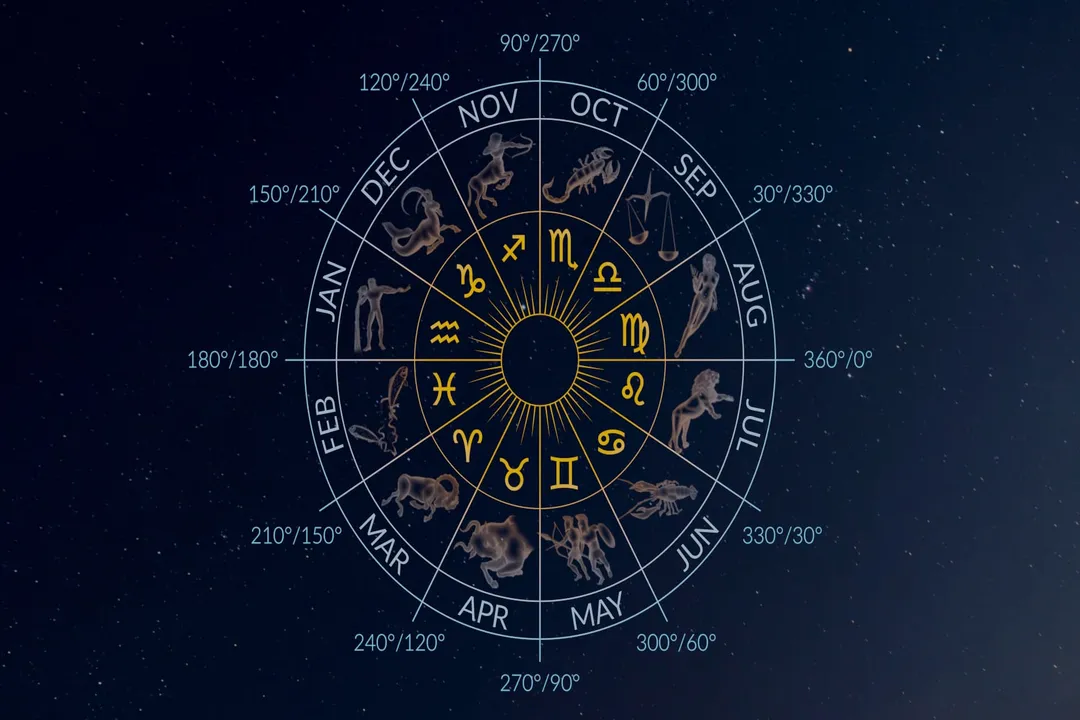
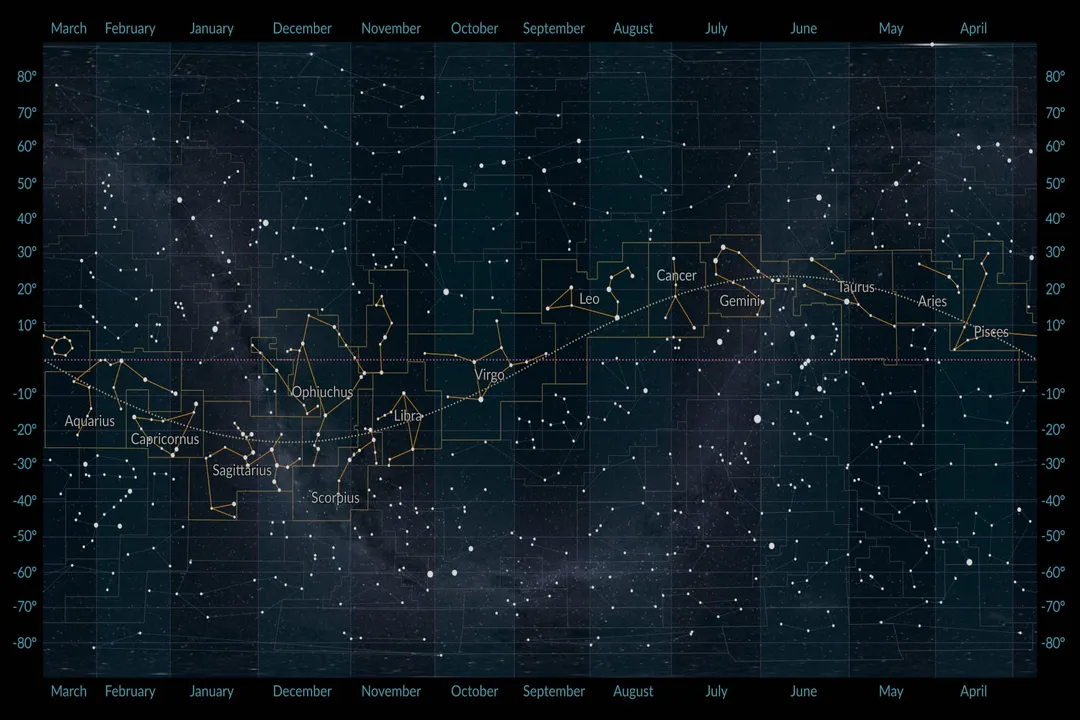
The ecliptic itself is essentially the plane of our solar system stretched across the stars. [7] Because all the major bodies in our solar system orbit roughly in the same plane, we see them—including the Sun during the day—moving along this specific celestial highway. [7] When you look at the zodiac constellations, you are looking at the stars that happen to fall into the general vicinity of this plane. [2]
If you imagine the sky as a globe, the ecliptic is a great circle painted around it. The constellations that constitute the traditional zodiac are those whose boundaries intersect with this painted line. [9] This path circles the entire celestial sphere, meaning that at some point during the year, the Sun passes directly in front of each of these constellations, temporarily blocking them from view during the day. [7]
# Twelve Figures
Traditionally, there are twelve zodiac constellations, each occupying roughly 30 degrees of arc along the ecliptic. [2] These figures—Aries the Ram, Taurus the Bull, Gemini the Twins, Cancer the Crab, Leo the Lion, Virgo the Maiden, Libra the Scales, Scorpius the Scorpion, Sagittarius the Archer, Capricornus the Sea-Goat, Aquarius the Water Bearer, and Pisces the Fish—are ancient markers used for navigation and timekeeping across many cultures. [2][9]
While these are often spoken of as signs in popular contexts, they are first and foremost recognized asterisms or constellations recognized by the International Astronomical Union (IAU). [1][2] In reality, the size of the actual constellations differs significantly. Virgo, for instance, covers a huge swath of the sky, while Scorpio is comparatively small. [6] It is important to note that the astrological division into twelve equal 30-degree segments does not match the actual, unequal physical boundaries of these star groups in the heavens. [6]

# Visibility Factors

What the zodiac looks like at any given moment depends entirely on when you are observing and where you are standing on Earth. [8] Because the zodiac follows the Sun's path, any constellation that is directly behind the Sun in its orbit will be visible only during the daytime, washed out by the Sun's glare, and therefore unseen at night. [7]
For example, if the Sun is currently "in" Sagittarius, that means Sagittarius is setting in the west as the Sun sets in the west, and it will rise in the east around sunrise. Therefore, Sagittarius is not observable at night. [8] Conversely, the constellation directly opposite Sagittarius on the celestial sphere—Gemini—will be rising in the east around sunset and will be high in the sky around midnight, making it the best time to view it. [8] To see the entire zodiac band, an observer would need to watch the sky over the course of an entire year. [2]
To effectively spot a particular zodiac constellation, a good rule of thumb is to look for it about six months after the Sun passes through it. If the Sun is moving through Leo in August, look for Leo around February or March, when it will be visible high in the night sky. [8]
# Astronomical Inclusion
A key difference between the traditional astronomical definition and the simplified astrological one concerns the number of constellations involved. When tracking the Sun's movement across the sky, the Sun physically passes through thirteen constellations along the ecliptic, not just twelve. [1][3]
The thirteenth constellation is Ophiuchus the Serpent Bearer. [1][3] The Sun spends roughly 18 days traveling through Ophiuchus, situated between the constellations of Scorpius and Sagittarius. [1] While the IAU officially recognizes Ophiuchus as a constellation, it is generally omitted from the traditional 12-sign zodiac used in astrology because the original system was established thousands of years ago, before the precession of the equinoxes significantly shifted the positions of the constellations relative to the tropical zodiac system. [3][5] When you look up, you will see the stars that form Ophiuchus rising and setting just like the others, even if it doesn't have a corresponding astrological sign. [1]

# Visualizing the Sky
The appearance of the zodiac is not uniform. Some constellations are visually rich, featuring bright, easily identifiable stars or distinct shapes. For instance, Scorpius is marked by the brilliant red giant star Antares, making it relatively easy to pick out when it is above the horizon. [8] On the other hand, some sections of the zodiac, like the area around Pisces, are much fainter and harder to identify without dark skies or optical aid, as they lack bright anchor stars. [8]
When examining the sky for these patterns, the actual visual experience is often a matter of tracing lines between recognizable stars within a defined area of the celestial sphere, rather than seeing a clear, distinct band of stars that looks markedly different from the surrounding field. [7] The recognition relies on knowing the general location and connecting the dots to form the recognized figure, whether it’s the horns of Taurus or the pincers of Cancer. [2]
If you were to plot the boundaries of the twelve astrological signs onto a modern sky map, you would see that the actual star fields of the constellations do not line up neatly with those equal 30-degree divisions. [6] For instance, the region of the sky designated as the "sign" of Aries might contain only a few faint stars belonging to the actual Aries constellation, while the rest of that 30-degree slice is technically empty sky or overlaps with the boundaries of Pisces or Taurus. [6] This illustrates the disconnect between the ancient, fixed segments used for timekeeping and the shifting reality of the stellar positions viewed from Earth today.
# Local Timing Insight
To truly appreciate the zodiac in the sky, one must reconcile the annual calendar with local time. If you live in the Northern Hemisphere and want to see the constellation corresponding to the winter months (like Taurus or Gemini), you should actually look for it during the summer months, high in the sky around midnight. Why? Because when the Sun is "in" a winter sign during the day, that sign is on the opposite side of the Earth, facing away from the Sun, making it perfectly positioned for nighttime viewing six months later when the Earth's orbit has carried us to the other side of the Sun. [7][8] This reversal of seasons and celestial placement is a direct consequence of our planet's orbit defining the ecliptic line.
#Videos
The Zodiac Constellations: Crash Course Kids #37.1 - YouTube
Related Questions
#Citations
Constellations of the Western zodiac - Space
Zodiac Signs & Constellations Names - Star Walk
The Zodiac Constellations: Crash Course Kids #37.1 - YouTube
Constellations and the Calendar – @nasa on Tumblr
Zodiac Sky Images – Browse 125575 Stock Photos, Vectors, and ...
Your REAL zodiac sign - INAOE
Seasons and the Zodiac - Motions of the Sun - NAAP - UNL Astronomy
Spotting the Zodiac Signs - Old Royal Naval College
Zodiac | Signs, Dates, Symbols, Months, Astrology, & Facts | Britannica