Is the sky actually blue or is it an illusion?

The question of the sky's color is deceptively simple. We grow up learning the sky is blue, a default setting for a clear day. Yet, pinning down why that specific hue dominates our upper view involves an elegant dance between physics, atmospheric composition, and even the biology of our own eyes. It’s less about the sky being a specific color and more about how our atmosphere processes the light hitting it. [2][7]
# White Light
Sunlight, before it ever touches our atmosphere, appears white to us. [3] This "white" light is not singular; it is actually a composite of all the colors visible to the human eye, comprising the entire spectrum of light waves, from the longest, like red, to the shortest, like violet. [1][3] When this mixture travels through the vacuum of space, it remains essentially unchanged. The moment it encounters the layer of gases surrounding Earth, however, the transformation begins. [3]
# Scattering Physics
The reason the sky is not white, yellow, or the color of the sun itself (which is also white) is due to a physical phenomenon called Rayleigh scattering. [1][4] As the beam of sunlight enters the atmosphere, it collides with the tiny molecules of gas—mostly nitrogen and oxygen—that make up the air around us. [3] These molecules are much smaller than the wavelengths of visible light. [1]
When light hits these tiny particles, it gets redirected, or scattered, in all directions. [3][7] Critically, not all colors scatter equally. The effectiveness of this scattering depends heavily on the wavelength of the light. [1] Shorter wavelengths are scattered much more efficiently than longer wavelengths. [1][4] Blue and violet light have the shortest wavelengths in the visible spectrum, while red and orange light have the longest. [1] Because blue light scatters about ten times more effectively than red light, it gets bounced around the sky repeatedly, filling the entire dome above us with this scattered blue light. [3][4] When we look up away from the sun, we are seeing this scattered blue light coming from every direction, making the entire expanse appear blue. [3][9]
# The Violet Conundrum
If violet light has an even shorter wavelength than blue light, shouldn't the sky be violet? This is a valid question that highlights the fine balance involved in our visual experience. [1][4] Indeed, violet light scatters slightly more than blue light does. [1][4]
However, two primary factors shift the perceived color away from violet and towards blue:
- Solar Output: The sun does not emit equal amounts of every color; its output spectrum contains less violet light than blue light to begin with. [1][4]
- Human Biology: Our eyes are simply less sensitive to violet light than they are to blue light. [1][4] The cones in our retinas that detect color are tuned more strongly to register blue. Therefore, even though there is some scattered violet light present, the overwhelming signal our brain receives is the highly scattered, abundant blue light. [4]
This interplay means the sky is the color it is because of what the sun emits, how the atmosphere scatters it, and how our nervous system interprets the resulting signal. [1]
# Contextual Hue
It is insightful to consider that the "blueness" is entirely contingent upon the medium through which we are viewing the light. [2] If you were an astronaut floating just above the Earth's atmosphere, looking toward the sunlit side of the planet, you would see a stark, black void above you, scattered only by the few air molecules you encountered near the craft. [6] The sky only appears blue because we are standing inside the scattering medium. [2] From the ground, the atmosphere acts like a massive, colorful filter, redirecting specific wavelengths toward our eyes. [7]
This realization helps explain why the perceived shade changes so dramatically throughout the day. While the fundamental mechanism—Rayleigh scattering—remains constant, the amount of atmosphere the light must traverse changes constantly. [1]
Consider a person living at sea level versus someone camping high in the Himalayas. At sea level, the column of air is thickest, meaning there are the maximum number of molecules to scatter light in all directions. This results in a deep, saturated blue sky. [1] When you ascend to a high altitude, the air density decreases significantly. With fewer atmospheric particles to interact with the sunlight, less blue light is scattered into your line of sight overall. Consequently, the sky appears a paler, lighter shade of blue, sometimes approaching a darker indigo near the zenith simply due to the shorter path length the light takes when viewed directly overhead compared to the horizon. [4] This difference in the perceived shade based on elevation is a direct, measurable consequence of the gas density affecting the scattering efficiency.
# Red Sunsets
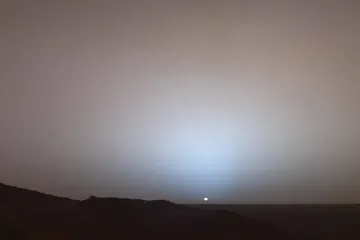
The same physics that paints the midday sky blue is responsible for the dramatic oranges and reds we see when the sun nears the horizon. [1][3] As the sun sets, its light must travel through a vastly greater amount of atmosphere to reach an observer on the ground than when it is overhead. [4]
During this long passage:
- Almost all of the short-wavelength light (blue and violet) is scattered away from the direct line of sight, contributing to the lingering blue glow across the rest of the sky. [3]
- What remains in the direct beam of light reaching your eyes are primarily the longer wavelengths: orange, red, and some yellow. [1]
This effect is amplified by larger particles like dust, smoke, or pollution near the horizon, which can scatter even more of the remaining intermediate colors, leaving behind only the deepest reds. [4] This is why volcanic eruptions or significant wildfires often lead to exceptionally vivid, prolonged red sunsets across continents.
# Seeing the Void
If the atmosphere scatters blue light everywhere, why is space black?[3] This simply reinforces the principle: space lacks the dense layer of gas molecules necessary to perform the scattering. [3] Without particles to redirect the shorter wavelengths, the light travels in a straight line from the sun to any object or observer. When you look away from the sun in space, you see nothing—no scattered light—hence, blackness. [3]
# Atmospheric Components
While the main scattering agents are nitrogen and oxygen, larger particles also play a part, though they follow different rules. If the particles in the atmosphere are larger than the wavelength of light—such as water droplets in clouds or large dust motes—they scatter all wavelengths of light more equally. [1] When all colors scatter equally, the result is white light. This is why clouds, being composed of relatively large water droplets, appear white or gray, rather than blue. [1][3]
The sky's color, therefore, isn't an inherent property of the empty space above us, nor is it a simple illusion in the sense of being unreal. It is the physical proof that light is interacting with matter in a predictable, measurable way. It is the appearance created by the atmosphere acting as a selective prism, constantly filtering and redirecting the sun's energy before it reaches our eyes. [2]
| Color | Wavelength Comparison | Scattering Efficiency | Result in Daytime Sky |
|---|---|---|---|
| Violet | Shortest | Highest | Mostly scattered away or filtered by eye sensitivity [1][4] |
| Blue | Short | High | Scattered extensively, dominating the visible sky [3][9] |
| Red/Orange | Longest | Lowest | Travels directly toward the observer [1][4] |
| White (Clouds) | All | Equal (by larger particles) | Appears white/gray due to non-selective scattering [1] |
This entire optical event is instantaneous and ongoing. Every second, uncountable photons are scattered by the atmosphere, creating the persistent blue backdrop we take for granted. [5][8] It is a demonstration of optics at a planetary scale, a constant emission of secondary light that defines our visual world. [2]
#Videos
The Sky Is NOT Blue. Eye doctor reveals the truth behind ... - YouTube
Related Questions
#Citations
Why is the sky blue? Do I understand it correctly: : r/askscience
The Sky is NOT Blue. How Understanding This Can Drastically…
Why Is the Sky Blue? | NASA Space Place – NASA Science for Kids
Is the colour of the sky, actually, blue or is it a mere illusion? - Quora
Understanding Why the Sky is Not Blue - TikTok
The Sky Is NOT Blue. Eye doctor reveals the truth behind ... - YouTube
Weather Fact Of The Day: The Sky Isn't Really Blue!? When we look ...
Why is the sky blue? - National Geographic Kids