Why is the sky blue and space is black?

The familiar azure overhead is one of nature's most constant, yet scientifically complex, phenomena. When we look up during the day, we are met with a bright blue canopy, but shift our gaze past the boundary of our world, and the view instantly plunges into an inky, star-filled blackness. This stark contrast—blue here, black there—stems from a fundamental difference between the environment surrounding us and the vast emptiness beyond: the presence or absence of air. [5][7] To understand this duality, we must examine the nature of sunlight and how it interacts with the gas molecules that make up Earth's atmosphere. [1][6]
# Light Waves
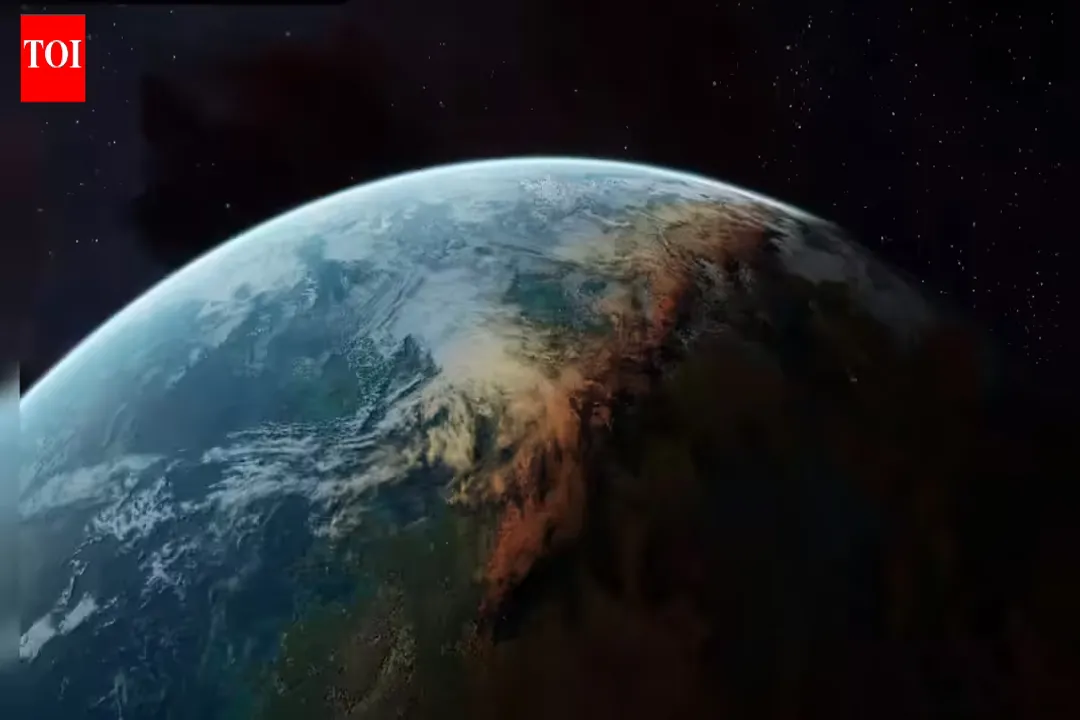
Sunlight, which appears white or yellowish to our eyes, is actually composed of electromagnetic waves spanning a range of different colors, forming the visible spectrum. [9] Think of this spectrum like a rainbow, containing red, orange, yellow, green, blue, indigo, and violet light. [9] Each color corresponds to a wave of a different length; red light has the longest wavelength, while violet and blue light possess the shortest wavelengths. [1][9] When all these colors mix equally, our eyes perceive white light. [9]
# Atmospheric Obstacles

The key to the blue sky lies in what happens to this mixture of light as it travels toward our eyes, a process heavily dependent on the intervening layer of gases we call the atmosphere. [5] The atmosphere is a dense collection of tiny particles, primarily nitrogen () and oxygen () molecules. [1][7] These molecules are significantly smaller than the wavelength of visible light. [1] This size relationship is critical because it dictates the specific way light gets redirected—a process known as Rayleigh scattering. [1][9]
# Wavelength Dependence
Rayleigh scattering dictates that shorter wavelengths of light are scattered far more effectively by small particles than longer wavelengths. [1][6][9] Specifically, the intensity of the scattered light is inversely proportional to the fourth power of the wavelength (). [9]
This mathematical relationship is not just a slight preference; it is a dramatic difference. Because blue and violet light have much shorter wavelengths compared to red or orange light, they are scattered in every direction across the sky by the atmospheric molecules roughly ten times more efficiently than the longer red wavelengths. [1][9]
When we look up at a point in the sky away from the sun, what we are seeing is this scattered light. [6] Since blue and violet are scattered the most, our sky is dominated by that color. [1][9] The light traveling directly from the Sun to our eyes has had much of its blue component scattered away, which is why the Sun itself appears slightly more yellow than pure white when viewed through the atmosphere. [9]
# Color Perception
It is worth noting that violet light is actually scattered more strongly than blue light. [1][9] So, why isn't the sky violet?
The answer involves both physics and human biology. [1] First, the Sun emits slightly less intense violet light compared to blue light in the visible spectrum. [1] More significantly, the human eye is less sensitive to violet light than it is to blue light. [1][9] Our cone cells, the receptors responsible for color vision, are most responsive to green and blue wavelengths, meaning the overwhelming amount of scattered blue light registers more strongly than the slightly greater amount of scattered violet light. [1] This blending results in the familiar, beautiful blue hue we perceive. [1]
If you could observe the sky from space, where the atmospheric filter is gone, the dominant scattered light would disappear, revealing the true color of the background. [7]
# Blackness of Space
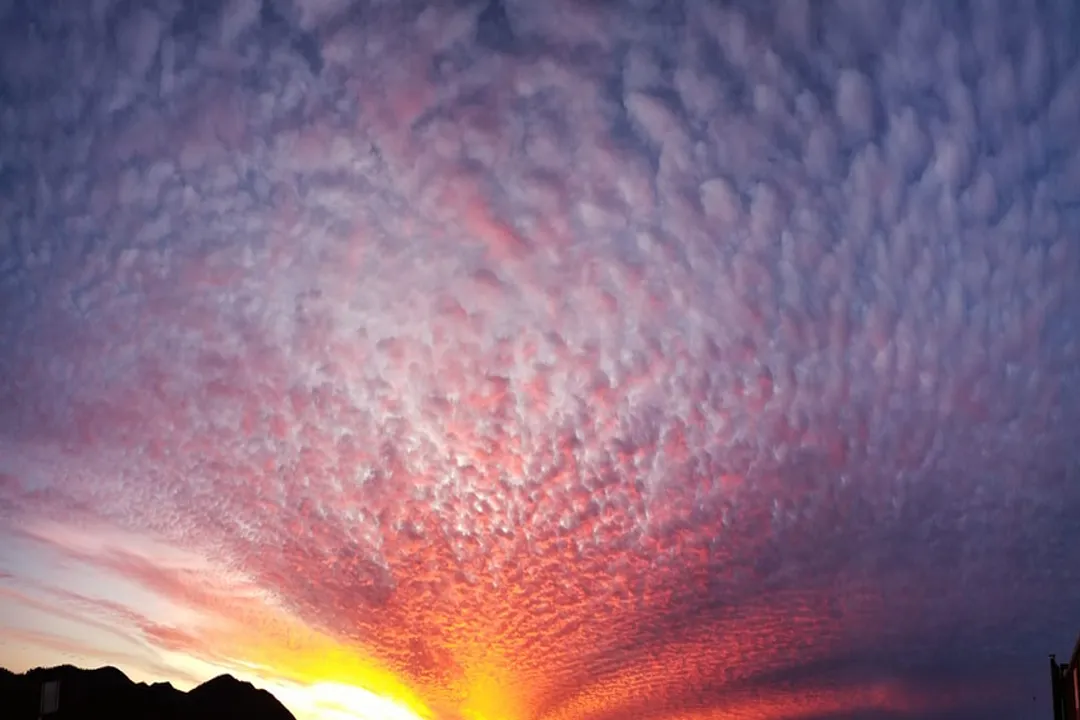
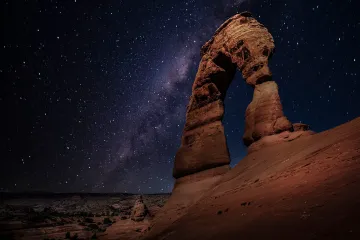
Contrast the complexity of Earth's atmosphere with the environment of space. Space, or the vacuum between celestial bodies, contains virtually no matter—it is essentially empty. [2][7]
# No Medium
The reason the sky is blue is entirely dependent on the medium of the atmosphere acting as a scattering agent. [5] In the vacuum of space, there are no gas molecules to intercept the sunlight and redirect it toward an observer’s eye. [2][7] Light travels through space in a straight line from its source, such as the Sun or a distant star. [2]
When an astronaut looks away from the Sun, there is no light being scattered into their eyes from empty space in front of them. [7] Therefore, the background remains perfectly dark, or black, punctuated only by the direct light sources like the Sun or stars. [2][5] This is the 'default' color of a region devoid of a scattering medium. [7]
# Direct Illumination
This absence of a visible background has an interesting effect on how we perceive things in space. When illuminated by the Sun, objects in space appear brightly lit, but the areas in shadow are intensely black because there is no atmosphere to bounce light into those shaded regions. [7] On Earth, even in deep shade, light reflected off the ground, buildings, and surrounding air scatters into the shadows, making them less severe. In space, the shadow transition is immediate and absolute. [7]
To help visualize this, consider a quick comparison: Imagine a perfectly clear day at a high altitude where the air is very thin versus sea level. [1] Even though the air is still present at altitude, the scattering effect is reduced, and the sky appears a deeper, darker blue—a precursor to the blackness of true vacuum. [1]
# Sunsets and Color Shifts
The same Rayleigh scattering principles that paint the daytime sky blue also dictate the dramatic colors seen during sunrise and sunset. [6] This phenomenon provides a tangible way to observe the wavelength-dependent nature of scattering.
# Increased Path Length
When the Sun is low on the horizon, its light has to travel through a much thicker section of the Earth's atmosphere to reach an observer than when it is directly overhead. [6] This increased path length means the light encounters vastly more nitrogen and oxygen molecules. [6]
As the light travels this longer route, almost all of the short-wavelength blue and green light gets scattered out of the direct line of sight. [6][9] This light is scattered so thoroughly that it eventually illuminates the entire upper atmosphere, creating the colorful backdrop we see, but it is no longer the dominant light reaching our eyes directly from the Sun's disk. [9]
What remains traveling straight to the observer are the longer wavelengths: yellows, oranges, and reds. [6][9] This is why the setting sun appears intensely red, and the surrounding clouds are often tinted with warm hues. [6]
# Observing the Shift
The transition from blue day to red evening is a continuous spectral demonstration. A thought experiment might involve tracking a single photon of blue light versus a single photon of red light at noon. The blue photon is likely to be redirected upward or sideways within the first few miles of the atmosphere, perhaps never reaching your eye directly, while the red photon has a far greater statistical chance of maintaining its original trajectory directly to you. [9] At sunset, this directional scattering is maximized.
This phenomenon also demonstrates that the Earth's atmosphere is not uniform. If you could instantly remove the atmosphere, both the midday sky and the sunset would instantly become black, with the Sun appearing as a blindingly bright white disk against the black backdrop of space. [7]
# Variations in Scattering
While Rayleigh scattering explains the general blue, other factors can influence the sky's appearance, particularly the presence of larger atmospheric particles.
# Mie Scattering
When particles in the atmosphere are larger than the wavelength of light—such as dust, smoke, or water droplets (clouds)—a different process called Mie scattering takes over. [9] Mie scattering is not strongly dependent on wavelength. [9] Instead, it tends to scatter all colors of visible light relatively equally. [9]
When Mie scattering dominates, such as on a hazy day, a foggy morning, or when looking at clouds, the scattered light appears white or grey, rather than blue. [9] Clouds, being composed of large water droplets, scatter all colors equally, resulting in their white appearance. [9] This contrasts sharply with the clear-sky blue caused by the wavelength-specific scattering of the tiny and molecules. [1]
If one were living on a planet with a very thick atmosphere dominated by much larger aerosols (e.g., dust storms), the sky might appear distinctly reddish or yellowish even at noon because the blue light would be scattered out over an enormous distance, leaving only the residual long-wavelength light to reach the surface. [1]
# Seeing the Stars
For those on Earth, even during the day, stars are still present in space, but the scattered blue light completely overwhelms their faint light. [4] Only when the atmosphere is entirely absent, as experienced by astronauts, can the stars be seen clearly against the black background at any time of day. [4] This emphasizes that space is filled with stars, but they are invisible from the surface when the scattering agent (the atmosphere) is present and illuminated by a nearby star (the Sun). [7]
To truly appreciate the blackness of space, one must observe it without the intermediary of an atmosphere, which acts as a constant, daytime illumination source for everything above our heads. [5] The Earth’s blue sky is a localized effect, a direct function of our planet’s gaseous shroud. [5]
#Videos
Why Does The Sky Change From Blue To Black? | Earth Science
Related Questions
#Citations
Why is the sky blue on Earth, but black in space or on the Moon?
My daughter just asked me “If outer space is black, how is the sky ...
Why Does The Sky Change From Blue To Black? | Earth Science
Why is space black? - StarChild - NASA
Why The Sky Is Blue - The Average Scientist
Why Is The Sky Blue? - National Weather Service
What causes the sky to appear blue if outer space is predominantly ...
Blue or black sky? | Causes of Color - Webexhibits
Did you know the real reason why the sky is blue and space is dark