Why does the sky appear black?

The simple observation that our sky transitions from a brilliant blue overhead during the day to a deep, star-pricked black at night is a fundamental aspect of our daily experience, yet the underlying physics is elegantly simple: it all comes down to the air we breathe. The color we perceive is entirely dependent on what is between our eyes and the Sun.
# Blue Light Scattering
During the day, the sky appears blue because of a process called scattering, specifically the scattering of sunlight by the molecules that make up our atmosphere, primarily nitrogen and oxygen. When sunlight—which contains all the colors of the rainbow—reaches Earth, these tiny atmospheric particles scatter the light in all directions. This scattering effect is not uniform across the visible spectrum; shorter wavelengths of light, such as blue and violet, are scattered much more efficiently than longer wavelengths like red and orange. Because blue light is scattered more vigorously and widely across the sky, our eyes perceive the entire dome overhead as blue. In fact, violet light is scattered even more than blue, but the sky doesn't look purple primarily because the Sun emits slightly less violet light, and our eyes are less sensitive to violet wavelengths.
# Absence of Atmosphere
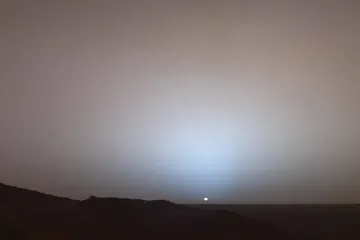
When you look up at the sky when the Sun is not shining on your location, such as during the terrestrial night, the blue scattering mechanism ceases locally, revealing the blackness of space beyond our atmosphere. The most dramatic example of this principle is viewing the sky from space or from a location like the Moon, which lacks a substantial atmosphere. In the vacuum of space, there are virtually no gas molecules to intercept and redirect the Sun's rays towards an observer. If there is no medium to scatter the light, the space between celestial bodies appears perfectly black. The stars, though constantly shining, are too far away for their light to illuminate the vast emptiness between them enough for our eyes to register anything other than darkness.
# Dim Starlight
The fact that space isn't illuminated by a perpetual wash of white or yellow light from the countless stars scattered throughout the universe touches upon a profound astronomical concept. If the universe were infinite in size, infinitely old, and uniformly filled with stars, then every line of sight should eventually end on the surface of a star, making the entire night sky blindingly bright. Since the sky is clearly dark, this deep blackness serves as a visual cue that the universe is not infinitely old, or perhaps that it is expanding, causing the light from the most distant stars to be too faint or redshifted to register. For the naked eye, the concentration of light from distant stars is simply too diffuse to overcome the darkness of the vacuum separating them. Light has to be scattered to you, or be bright enough when it travels straight to you, to overcome the perception of blackness.
# Night Versus Space
It is important to distinguish between the black sky we see on Earth at night and the blackness encountered in space. The darkness of the night sky on our planet is localized because the Sun is simply shining on the other side of the Earth, meaning that region of the atmosphere overhead is not illuminated by direct sunlight to scatter toward us. If you are an astronaut looking back at Earth from orbit, you see a sharp division: the atmosphere glows brilliantly blue where the Sun hits it, and the space beyond that is black. This contrast highlights that the atmosphere is the coloring agent during the day, and its absence or lack of illumination results in blackness.
Consider the experience of being on a very high mountain summit, like Everest. Even though you are still well within the bulk of the Earth's atmosphere, the air density above you is significantly lower than at sea level. This reduced density means less scattering occurs, which is why the sky at extremely high altitudes begins to appear darker, shifting from a deep blue toward a black that reveals stars even during the day, though the effect is still less pronounced than in a true vacuum. This altitude gradient provides a tangible, human-scale demonstration of the transition from a dense scattering medium to near-vacuum.
We can quantify this relative lack of light in space by thinking about the energy distribution. The brightness of the sky is fundamentally related to the energy density of the surrounding electromagnetic radiation. In Earth’s atmosphere, the volume of scattered light dominates our perception. In space, the only significant radiation comes from point sources—the stars and galaxies—and the energy density drops off quickly with distance, leaving the majority of the view as a dark void.
# Perception Threshold
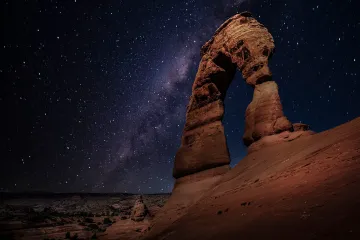
The human eye has an astonishing capacity to perceive light, yet there is an absolute threshold below which we perceive nothing at all—blackness. The faint, scattered light from billions of stars that manage to cross the gulf of space and reach our atmosphere, even at night, is often just below the level required for our rods and cones to register a distinct color or illumination when the direct, bright light of the Sun is absent. Even if the faint starlight is slightly above this threshold, the contrast created by the preceding brightness of the day makes the night appear infinitely darker. Imagine stepping out of a brightly lit room into the night; the darkness seems profound because your pupils have contracted to handle the intense indoor light, exaggerating the perceived lack of external photons for a few moments. The sky itself is not actively black; it is simply the absence of sufficient light to stimulate our vision against the background of the cosmos.
This points to a subtle but important distinction: the daytime sky is blue because the atmosphere is the light source in that context, scattering the Sun's energy toward us. The nighttime sky is black because, locally, nothing is scattering enough energy to overcome the darkness of the intervening vacuum between us and the distant, dim light sources. The appearance of blackness is a state of minimal photon arrival, an observational limit defined by the lack of a local, dense radiator like our atmosphere during the day.
#Videos
Why Does The Sky Change From Blue To Black? | Earth Science
Related Questions
#Citations
Why is space black? - StarChild - NASA
Blue or black sky? | Causes of Color - Webexhibits
My daughter just asked me “If outer space is black, how is the sky ...
What causes space and the night sky to appear dark - Britannica
Why does the color of the sky appear black at night?
Why does the sky look black in pictures taken from the summit of ...
Why does outer space look black? - Live Science
Why Does The Sky Change From Blue To Black? | Earth Science