What is the bright line in the sky?
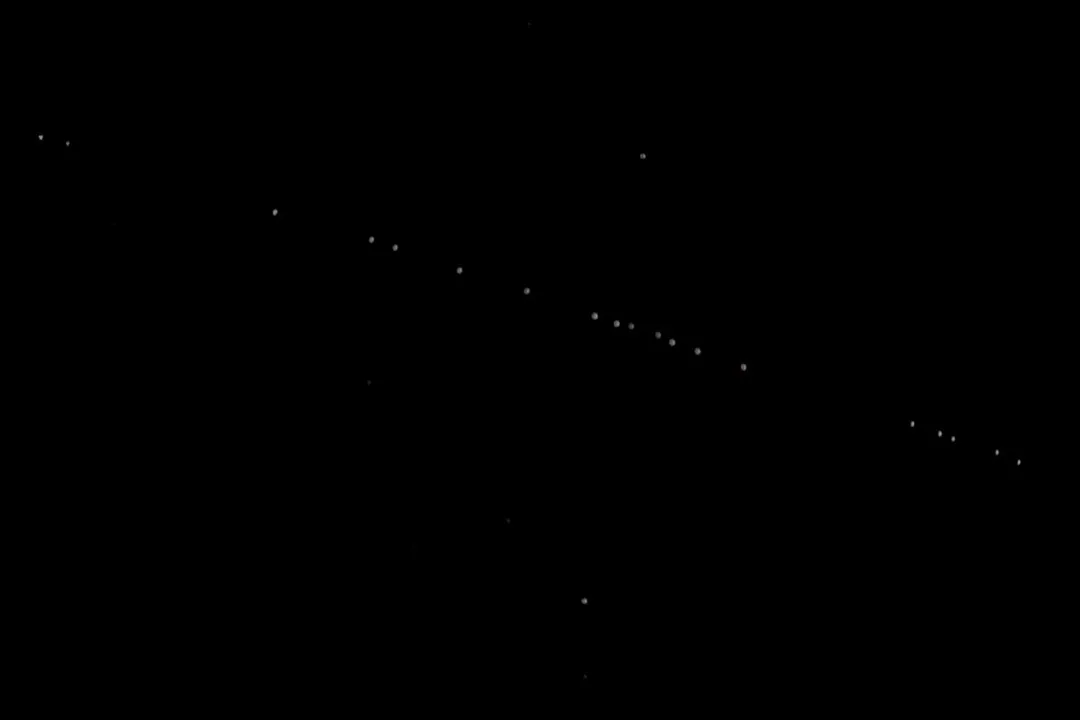
Seeing a perfect, straight line of identical, moving lights marching across the night sky can certainly cause a moment of pause, perhaps even a quick search on your phone to make sure you aren't missing the start of a major astronomical event or something more unusual. This sighting, often described as a “string of pearls” or a continuous “train” of stars where there should only be darkness, has become increasingly common for observers worldwide [cite: reddit, wgal, quora]. For most people in recent years, this bright line isn't a natural phenomenon or secret military hardware; it is a highly visible testament to the rapid expansion of commercial space endeavors, specifically the Starlink satellite constellation launched by SpaceX [cite: forbes, wgal].
# Identifying the Lights
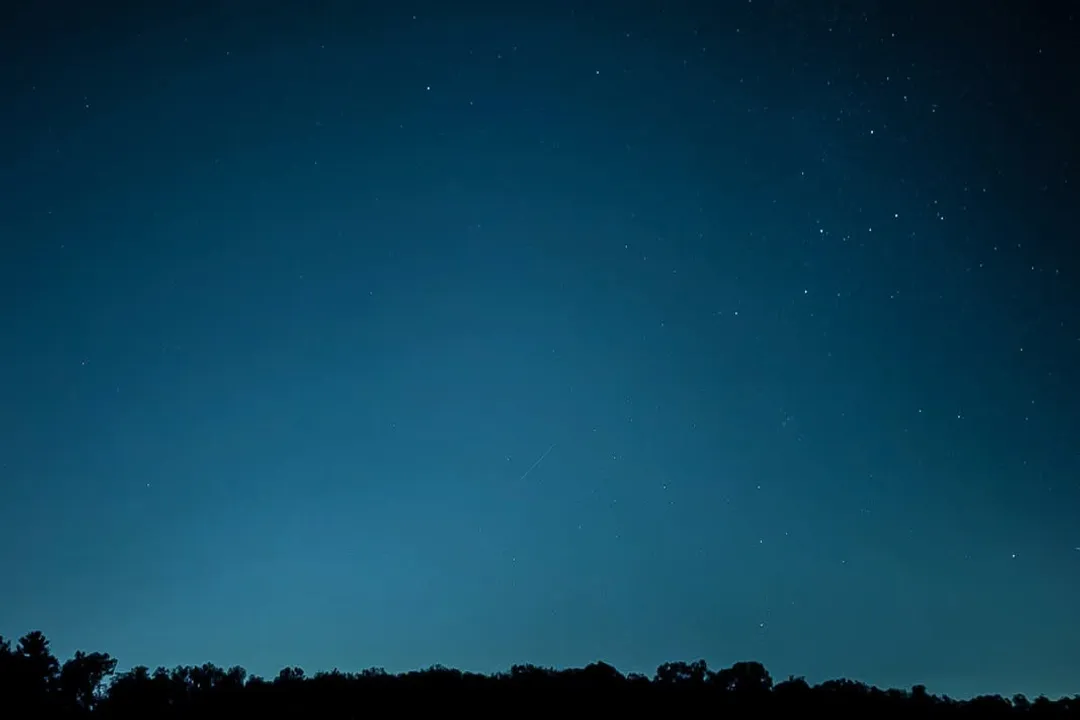
The visual signature of this event is quite distinct. People often report seeing anywhere from a handful to dozens of bright, white or slightly blue-ish dots moving in lockstep across the celestial dome [cite: facebook]. They maintain a very uniform spacing and speed, unlike typical aircraft which usually blink or have varying separation between lights [cite: quora]. This orderly procession moves quickly—often traversing the sky from horizon to horizon in just a few minutes—before disappearing into the Earth's shadow or simply moving out of view [cite: space.com]. The appearance is one of manufactured precision; they look like an artificial comet tail or a string being pulled across the darkness [cite: reddit, youtube].
When these satellites are first deployed, they are grouped closely together in what is aptly named a "satellite train." This initial phase is when they are most striking and most often reported by surprised observers [cite: forbes]. After this initial launch phase, the individual satellites quickly maneuver into their final, operational orbital slots, causing the "line" to stretch out, disperse, and become less noticeable over several weeks or months [cite: space.com]. An observer might see a dense line one week, and the next week, the same group might appear as several smaller, more separated clusters, or perhaps just a few isolated bright spots moving along a similar path.
# Understanding Starlink
To truly understand what you are seeing, you need to understand the mission behind those moving lights. Starlink is a massive satellite internet constellation project by SpaceX, Elon Musk’s aerospace company [cite: forbes]. The goal is to provide high-speed, low-latency internet access across the globe, especially to underserved and remote areas [cite: forbes].
These satellites orbit the Earth in Low Earth Orbit, or LEO, which is significantly closer to our planet than traditional communications satellites. The altitude for these Starlink units is typically around 550 kilometers (about 340 miles) [cite: space.com]. Because they are so much closer than, say, geosynchronous satellites, they reflect sunlight down to Earth much more brightly and appear to move much faster across the sky [cite: forbes].
Each satellite itself is relatively small, about the size of a large desk or a small car. However, when they are first launched and still clustered, they present a much larger target for sunlight to reflect off of, which is why they can appear brighter than many stars or even planets like Venus, especially to the naked eye [cite: space.com]. They are equipped with solar panels which, when angled toward the sun, catch the light and beam it down to ground observers during twilight hours [cite: forbes]. This dependence on the sun's angle is key to when and why we see them.
# The Visibility Window
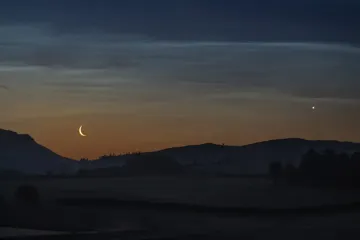
The reason the Starlink train is visible as a "bright line" is entirely dependent on orbital mechanics and the time of day. You won't see this line during the middle of the night, nor will you see it during the day. The best time to spot them is during civil or nautical twilight—the period shortly after sunset or just before sunrise [cite: space.com].
During these twilight periods:
- The observer on the ground is experiencing darkness or deep dusk.
- The satellites, orbiting far above the Earth, are still high enough in the sky to be directly illuminated by the Sun, which has already set or has not yet risen from the observer’s perspective [cite: space.com].
This coincidence creates the ideal visual contrast: dark ground viewing very bright objects. As the Earth rotates, the satellites continue their path until they pass over the terminator—the line separating day and night on Earth—and enter the Earth's shadow, at which point they abruptly disappear from view [cite: space.com]. If you watch a train long enough, you will see this happen; one moment they are there, the next they are simply gone, which can be quite startling for the uninitiated observer [cite: cloudynights].
# Ruling Out Other Objects
While the Starlink train is the most frequent culprit for this specific sighting, it is always good practice to consider other possibilities when observing the night sky. The visual description of a moving line is what helps differentiate the cause.
If you see a single, very bright light moving slowly and steadily, it might be a high-altitude aircraft, but these lights usually blink, often with red or green navigation lights, and their flight paths tend to be lower and less predictable than a satellite pass [cite: wgal]. Meteor showers, while spectacular, are defined by streaks of light that appear briefly and burn up, not a continuous, orderly procession of distinct, separate points of light [cite: quora].
What about other satellites? Older generations of large satellites, like the Iridium constellation (before they were de-orbited), were famous for causing brilliant, brief flashes called "flares" when a specific mirrored panel perfectly caught the sun and focused the light like a giant magnifying glass onto the ground [cite: youtube]. This Iridium flare was a single, extremely bright point that would fade. The Starlink sighting, by contrast, is a line of lights that maintain a relatively consistent, though still bright, magnitude throughout the pass [cite: cloudynights]. The fact that you are seeing a row of objects, rather than one big flash or a random scattering, is the strongest evidence pointing toward a recently launched Starlink batch.
# Tracking Sightings
Confirmation is easy if you know where to look. Since these passes are predictable based on orbital mechanics, several online resources have been developed to help sky-watchers locate them [cite: space.com]. Websites and mobile applications can input your location and tell you the exact time, direction (azimuth and elevation), and magnitude (brightness) of the next visible Starlink pass overhead [cite: space.com]. This shifts the experience from accidental discovery to scheduled viewing.
For instance, one might use a service to learn that a train of 20 satellites will cross from the western horizon (azimuth 270 degrees) at an elevation of 15 degrees above the horizon at 9:17 PM local time, reaching its peak altitude of 60 degrees overhead at 9:22 PM before disappearing toward the northeast [cite: space.com]. Having this specific itinerary transforms the event from an unexplained mystery into an anticipated, observable demonstration of modern space technology.
An important consideration for the amateur astronomer is the light pollution this proliferation causes. While these daytime-visible launches are a fascinating visual event, the sheer number of LEO satellites now in orbit presents challenges for ground-based telescopic astronomy, as their trails can ruin long-exposure photographs of deep-sky objects [cite: facebook]. It is interesting to note that the visual impact of these early, dense trains is a somewhat transient problem; as the satellites spread out into their operational orbits, the effect is lessened, though the overall number of visible, fast-moving dots in the night sky remains much higher than a decade ago [cite: forbes].
We can look at the sheer scale of this deployment versus historical context. Before Starlink, the majority of visible "man-made" objects were often the International Space Station (ISS) or perhaps a single, older communications satellite, both appearing as one extremely bright, slow-moving star. Now, with thousands of Starlink units planned, the sky is fundamentally different. If we compare the expected visual magnitude of a single, high-orbit ISS pass—often around magnitude -4—with a dense Starlink train of 50 satellites, each at magnitude +3 or +4, the combined visual presence is significant, though spread out [cite: forbes]. This rapid saturation is a visual change that observers have to adjust to, moving from expecting one bright object to expecting a potential line of objects.
# Actionable Viewing Tips
If you are keen on catching one of these trains, timing is everything, but preparation helps, too. A simple but often overlooked tip is to look away from the satellite's approach path initially. Because the satellites are still catching the sun's light, they often appear brightest when they are low on the horizon, just as they become visible. Looking directly toward the horizon can be difficult for your eyes, especially if you are looking west after sunset. Instead, try looking about 45 degrees up in the direction opposite the train's path; your eyes will have better dark adaptation, allowing you to see the line more clearly as it develops before it reaches its zenith. Furthermore, remember that these are reflections, not self-illuminated points like navigation lights. On nights with extremely high, thin cirrus clouds, the cloud layer can scatter the sunlight reflecting off the satellites, making the line appear fuzzy or diffused rather than a sharp row of dots. In those cases, waiting for a perfectly clear night will yield the best, crispest view of that manufactured procession.
The bright line in the sky is rarely a cause for alarm, though it is certainly a cause for wonder. It is a direct, visible consequence of our increasing capability to place technology into orbit. What was once the domain of government agencies and singular scientific missions is now an active commercial front, and the temporary, dazzling launch phase of these new constellations provides a fleeting, high-visibility show for anyone looking up at the right time [cite: wgal, forbes].
#Videos
Starlink satellites, the string of lights in the night sky. - YouTube
Related Questions
#Citations
Starlink satellite train: how to see and track it in the night sky - Space
People report line of lights in the night sky - WGAL
Anyone else notice a line of lights across the sky? : r/bullcity - Reddit
what is the line across the sky tonight? - Facebook
Starlink satellites, the string of lights in the night sky. - YouTube
I saw a line in the sky at night like a star line. Many stars go ... - Quora
Bright Line in Morning Sky - General Observing and Astronomy
What Are Those Strange Moving Lights In The Night Sky? Elon ...