What causes earthquakes along fault lines?
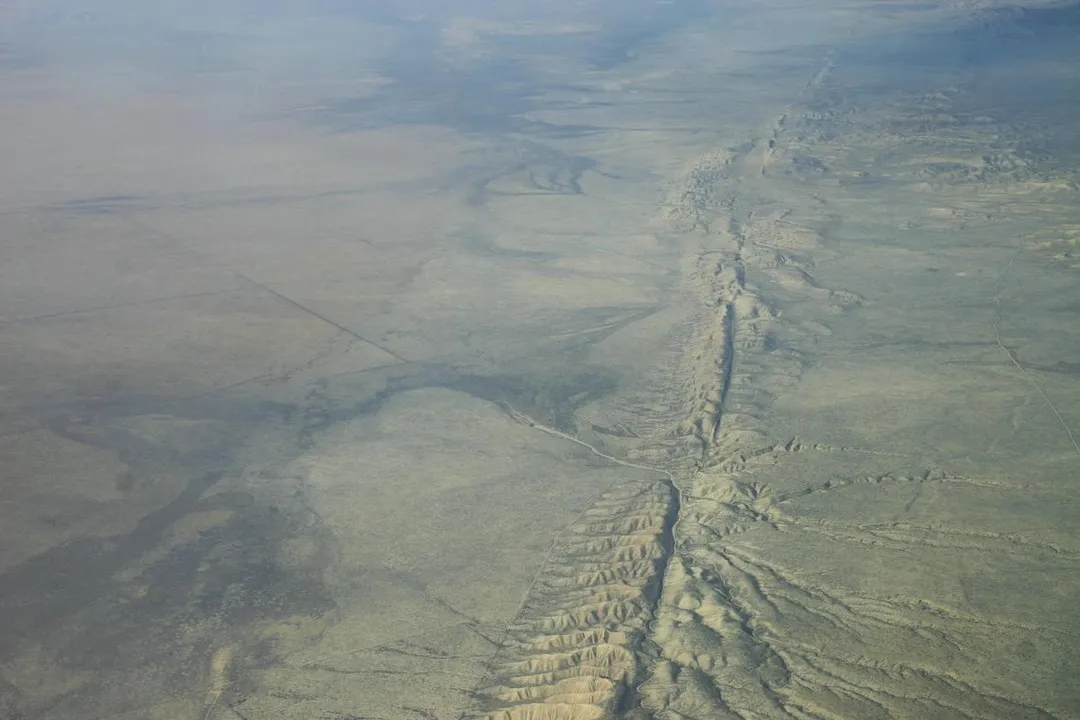
The grinding movement of the Earth's outer shell is the fundamental driver behind seismic activity. Earthquakes are essentially the result of rock masses moving suddenly relative to one another along fractures in the crust known as faults. This process is not a single, instantaneous event but the culmination of immense pressures building up over long periods.
# Stress Accumulation

The planet's surface is divided into massive, interlocking pieces called tectonic plates, which are constantly in motion relative to each other—diverging, converging, or sliding past one another. This relentless motion generates significant stress, or strain, within the Earth's crust and upper mantle. As the plates attempt to move, friction and resistance often cause the adjacent rock masses along a fault line to lock up. Even though the plates themselves keep moving on a geological timescale, the rocks at the boundary remain temporarily fixed, accumulating the strain energy generated by that movement.
It is easy to visualize this process by imagining trying to slide two heavy, rough blocks past each other on a flat surface; initially, they resist movement until enough force overcomes their static friction. The difference in the Earth's crust is the sheer scale and the duration; the stress can build up for decades, centuries, or even millennia across large sections of a fault zone before giving way.
# Tectonic Interaction
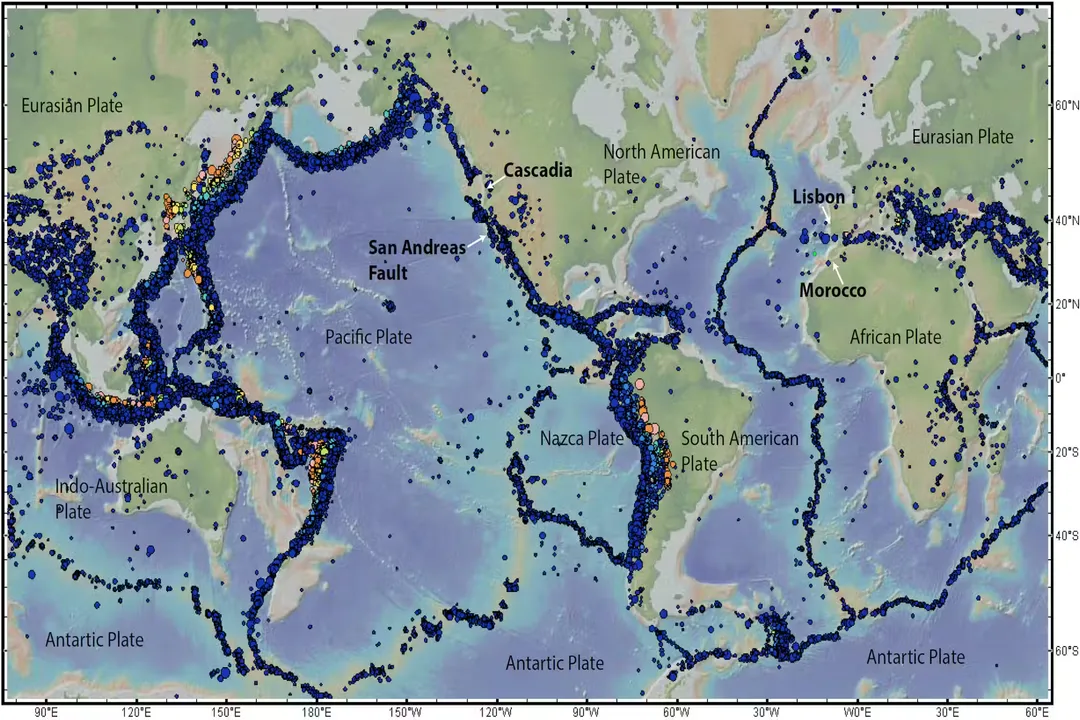
The overwhelming majority of powerful earthquakes occur near the boundaries where these major tectonic plates meet. These boundaries are zones of concentrated stress where the Earth’s crust is actively being pulled apart, pushed together, or ground sideways.
There are several ways these plates interact, each producing characteristic fault systems:
- Convergent Boundaries: Where plates collide, one plate often slides beneath the other (subduction), creating massive thrust faults capable of generating the largest earthquakes.
- Divergent Boundaries: Where plates pull apart, crust is created, often resulting in shallower, less powerful earthquakes along normal faults.
- Transform Boundaries: Where plates slide horizontally past one another, such as along the San Andreas Fault, the movement is accommodated by strike-slip faults.
While these boundaries are the global hotspots for seismic release, it is important to remember that movement is often distributed across a zone of faulting rather than occurring only on one perfectly defined line.
# Elastic Release
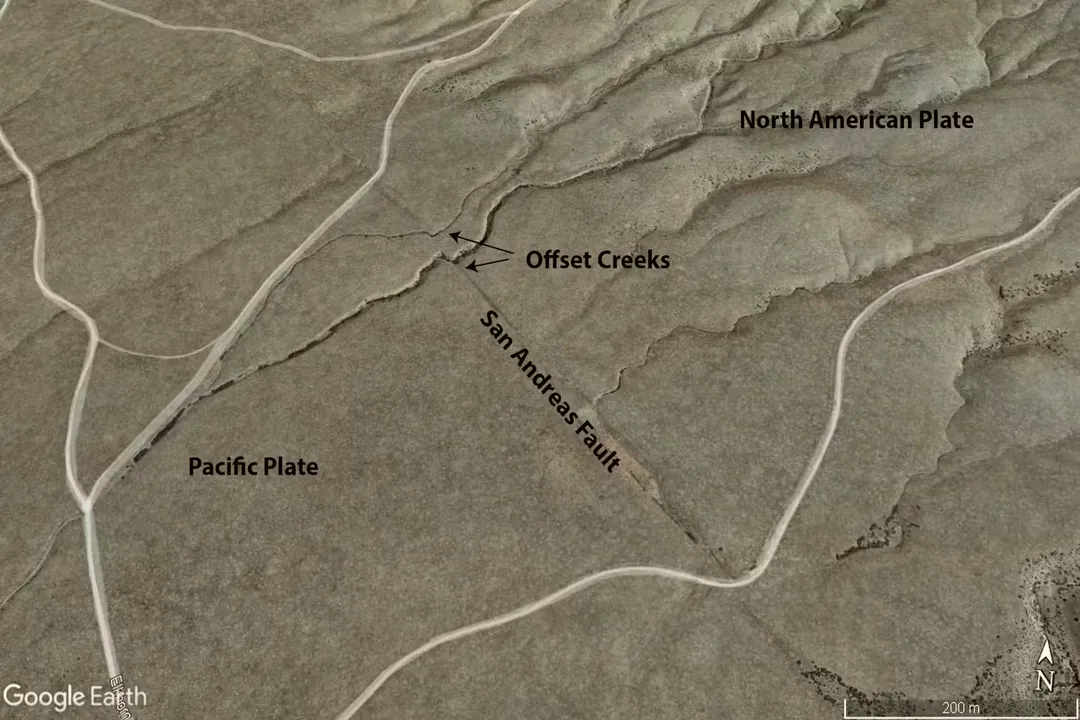
When the accumulated strain within the locked rock masses finally exceeds the strength of the rock or the friction holding the fault together, the rock suddenly ruptures or slips, releasing the stored energy. This sudden snap is the earthquake itself. This mechanism is described by the elastic-rebound theory.
The rock behaves elastically during this buildup phase; it deforms under stress but returns to its original shape once the stress is removed, much like stretching a rubber band. When the fault finally breaks, the rocks immediately spring back toward their undeformed state, sending out waves of energy that travel through the Earth. Consider that the stress might take a century to accumulate, causing perhaps a few meters of total crustal deformation, yet the entire rupture can complete itself in mere seconds, demonstrating an incredibly concentrated release of potential energy.
The point where the rupture begins underground is called the hypocenter or focus, and the point on the Earth's surface directly above it is the epicenter. The size of the earthquake—its magnitude—is a measure of the total energy released during this sudden slip event.
# Fault Mechanics
A fault is simply a fracture or zone of fractures between two blocks of rock. These structures are not always simple breaks; they can be complex, multi-branched systems that may extend deep into the crust. The way rocks move relative to each other across the fault plane defines the fault type.
For general readers seeking to understand the physical nature of the break, recognizing that the ground doesn't just move but rather slides along a defined plane is key. Different types of fault movement—where the blocks move up, down, or sideways relative to each other—dictate the type of strain being released.
# Intraplate Events
While plate boundaries account for the vast majority of seismic activity, earthquakes are sometimes recorded far from these active margins. These are known as intraplate earthquakes. They are less frequent but can be highly damaging because populations in these areas are often unprepared for significant shaking.
The cause of these interior quakes is often attributed to forces transmitted across the entire tectonic plate from the boundary stress zones. Imagine a rigid sheet of metal being pushed unevenly at its edges; the center might still buckle or crack where a pre-existing weakness exists. In the Earth’s crust, these weaknesses are ancient faults that may have formed millions of years ago during past tectonic events but have remained buried and locked until the current, transmitted stresses reactivate them. These ancient, dormant structures act as planes of weakness that are marginally weaker than the surrounding rock, causing them to slip when subjected to regional stress fields. Geological surveys and mapping are essential tools in identifying where these buried, ancient faults lie within continental interiors.
# Energy Spreads
Once the fault slips, the sudden release of stored elastic energy propagates outward in the form of seismic waves. These waves travel through the Earth’s interior and along the surface, causing the ground shaking we experience. The energy release rate, and thus the type of wave generated, is directly related to how quickly and completely the fault moves.
If an earthquake occurs beneath the ocean floor, and the movement along the fault is primarily vertical (i.e., a significant vertical displacement of the seafloor rather than just horizontal sliding), it can displace the entire column of water above it. This sudden water displacement generates a series of waves that propagate outward, creating a tsunami. While not all submarine earthquakes cause tsunamis, the combination of underwater location and vertical motion is the critical trigger.
Understanding the physics of friction, strain build-up, and elastic rebound provides a clear picture of why these seemingly random ground shudders are, in fact, inevitable consequences of a dynamic, moving planet.
Related Questions
#Citations
What causes earthquakes? - British Geological Survey
What is an earthquake and what causes them to happen? - USGS.gov
Where Do Earthquakes Happen? | UPSeis
How do earthquakes occur far away from plate boundaries? - Reddit
What causes earthquakes, and why they're more common in some ...
What makes an earthquake start at one place and then travel along ...
Earthquakes - National Geographic Education
Tsunami Generation: Earthquakes - NOAA
Why do earthquakes happen far away from plate boundaries?