What causes stellar nucleosynthesis?
The foundation of the elements that constitute our world, from the calcium in our bones to the oxygen we breathe, rests entirely within the nuclear furnaces of stars. [1][4] This cosmic alchemy, known as stellar nucleosynthesis, is the process where stars generate heavier atomic nuclei from lighter ones through sustained nuclear fusion, provided the conditions—intense heat and pressure—are met within their cores. [1][3][4] It is the mechanism that transforms primordial hydrogen and helium into virtually every other element on the periodic table, making stars the universe's true element factories. [1][4]
# Core Conditions
The primary barrier to fusion is the Coulomb barrier. [1] Atomic nuclei are all positively charged, meaning they naturally repel one another due to electromagnetic forces. [3] For fusion to occur, nuclei must collide with enough kinetic energy to overcome this repulsion and get close enough for the strong nuclear force to bind them together. [1][3]
This necessary high energy translates directly into extreme temperature and pressure requirements, which are found only deep within a star's core. [1][3] In our Sun, for example, the core temperature needs to reach millions of degrees Celsius to initiate fusion. [1] The greater the mass of a star, the stronger the gravitational compression, leading to higher core temperatures and pressures, which in turn dictate the types of fusion reactions that can proceed. [6] A star's entire life and subsequent elemental output are thus determined by its initial mass. [1]
# Hydrogen Fusion
The longest phase of a star's life, the main sequence, is powered by fusing hydrogen nuclei (protons) into helium nuclei. [1][6] Two primary reaction pathways manage this process, depending on the star's mass and internal temperature profile. [1]
# Proton Chain
For stars with masses similar to or less than the Sun, the Proton-Proton (p-p) chain reaction is the dominant mechanism for hydrogen burning. [1] This process involves a series of steps where individual protons are fused sequentially to build up a helium-4 nucleus. [1] It is a relatively slow process, perfectly suited to the lower temperature environments of low-mass stars, providing a steady, long-term energy source. [6]
# CNO Cycle
In stars significantly more massive than the Sun—stars that are hotter and possess more gravitational compression—the Carbon-Nitrogen-Oxygen (CNO) cycle takes over as the primary engine. [1][6] This cycle uses carbon, nitrogen, and oxygen isotopes as catalysts to convert hydrogen into helium. [1] Because the catalysts are recycled, the cycle achieves a much higher rate of energy generation at higher core temperatures compared to the p-p chain. [1] This efficiency explains why massive stars burn through their hydrogen fuel much faster than smaller stars. [6]
An analytical note on stellar mass and time: The difference in fusion rate between these two cycles fundamentally governs stellar lifespan. A star roughly twenty times the mass of the Sun might only last a few million years, while the Sun is expected to shine for about ten billion years. This vast discrepancy highlights that even small increases in core temperature—driven by mass—lead to exponentially shorter lifespans because the fusion rate is so steeply dependent on overcoming that initial electrostatic repulsion, a sensitivity that is more pronounced in the temperature-sensitive CNO cycle.
# Helium Ignition

Once a star exhausts the hydrogen fuel in its core, the core contracts and heats up dramatically until the temperature is high enough (around $100$ million Kelvin) to ignite helium fusion. [1]
# Triple Alpha
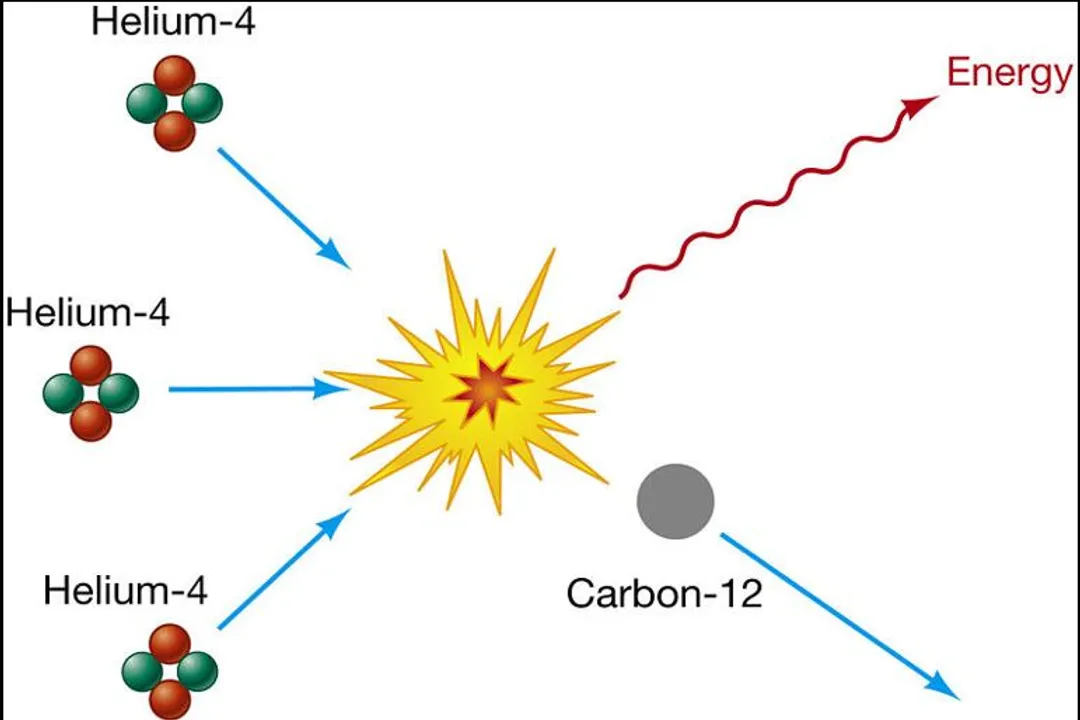
The main mechanism for helium conversion is the Triple-Alpha Process. [1][6] This process requires fusing three helium nuclei (, also known as alpha particles) together to form a single carbon nucleus (). [1] Because it is difficult to get three particles to collide simultaneously, this reaction proceeds via a two-step process involving the unstable beryllium-8 nucleus (). [1] If the star is massive enough to reach this stage, it enriches the interstellar medium with carbon, a vital component for life. [6] In larger stars, helium burning can also proceed to create oxygen. [1]
# Advanced Burning
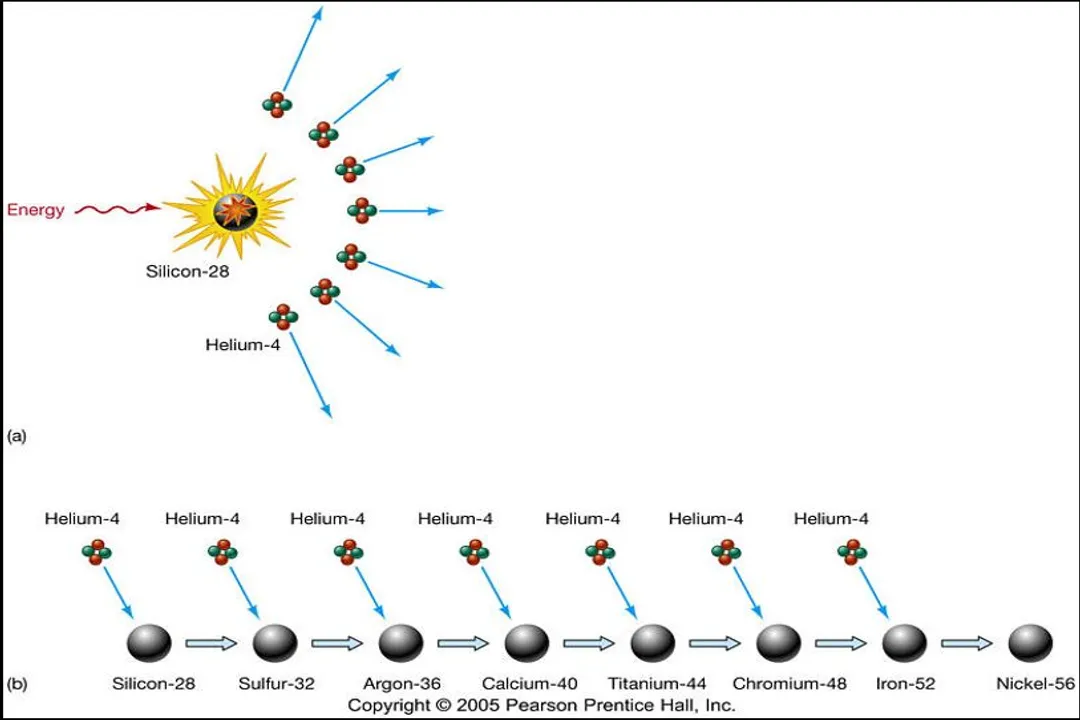
For stars considerably more massive than the Sun—those perhaps eight times the Sun's mass or greater—the gravitational pressure is sufficient to continue heating the core even after helium is consumed. [1] These giants proceed through multiple, successively faster stages of core burning, fusing progressively heavier elements. [1][6]
The fusion sequences proceed in layers, with heavier elements forming in shells around an inert core. For instance, after helium burning ceases, the core heats enough to initiate carbon burning, followed by neon, oxygen, and finally, silicon burning. [1] Each subsequent stage requires significantly higher temperatures and lasts for a much shorter time than the previous one. [1]
| Fuel Consumed | Primary Product | Approximate Core Temperature | Duration (in Massive Star) |
|---|---|---|---|
| Hydrogen () | Helium () | million K | Millions of years |
| Helium () | Carbon (), Oxygen () | million K | year |
| Carbon () | Neon (), Magnesium () | million K | year |
| Silicon () | Iron (), Nickel () | billion K | day |
| [1][6] |
# The Iron Limit
This cascade of fusion reactions comes to an abrupt halt when the core produces isotopes of Iron () or Nickel (). [1][6] Iron-56 is particularly significant because it has the highest nuclear binding energy per nucleon of all elements. [1]
This means that fusing elements lighter than iron releases energy (exothermic), which supports the star against gravity. [1] However, fusing iron or elements heavier than iron requires an input of energy (endothermic). [1][6] Once the core is primarily iron, the star has lost its energy source; it can no longer generate the outward thermal pressure needed to counteract its immense gravity. [1][6] This iron core collapse marks the end of hydrostatic equilibrium and triggers the star's final, cataclysmic event. [1]
An editor's observation on elemental distribution: If you examine the elemental composition of a massive star just before collapse, you would find a distinct onion-like structure, with hydrogen and helium on the outside, and the iron/nickel core at the center, as detailed in the table above. [1] The fact that the fusion chain stops precisely at iron, rather than proceeding all the way to uranium, is a direct thermodynamic consequence of nuclear physics, not a failure of stellar conditions.
# Explosive Creation
The creation of elements heavier than iron, which are essential for life and geology, cannot happen in a stable stellar core. These elements are forged in the violent aftermath of a massive star's death, an event known as a supernova. [1][3][8] The core collapse drives immense shockwaves outward, creating temperatures and neutron densities unattainable during normal burning stages. [1][3]
# Neutron Capture
Elements heavier than iron are primarily built through neutron capture processes. [8] These processes involve capturing free neutrons released during the explosion. [3]
- The s-process (Slow Neutron Capture): This process occurs mainly during the later life stages of intermediate-mass stars, such as asymptotic giant branch (AGB) stars. [1] Neutrons are captured slowly enough that any unstable, neutron-rich isotopes have time to undergo beta decay into a more stable element before capturing another neutron. [1] This process is responsible for producing about half of the elements heavier than iron, up to and including Bismuth. [1]
- The r-process (Rapid Neutron Capture): This is the realm of the supernova explosion itself. [3] In the extreme conditions, a nucleus is bombarded with so many neutrons so quickly that it cannot beta decay fast enough to keep up. [1][3] The nucleus becomes highly unstable and neutron-rich before eventually decaying into stable, very heavy elements like gold, platinum, and uranium. [1][3] Understanding the precise environments that create the r-process remains an active area of astrophysics research, though core-collapse supernovae are considered a prime candidate. [3]

# Post-Stellar Enrichment
When a star dies, the newly synthesized elements are ejected into the interstellar medium (ISM). [6] Low-mass stars like the Sun gently shed their outer layers as planetary nebulae, enriching the ISM mostly with the lighter elements created during hydrogen and helium burning, like carbon and nitrogen. [1][6]
Massive stars, however, distribute their entire repertoire of elements—from carbon up to iron from the core, and elements heavier than iron from the explosive phase—via a supernova explosion. [1][3] This enriched gas mixes with existing interstellar clouds, forming the raw material for the next generation of stars and planetary systems. [6] Without this recycling process driven by stellar nucleosynthesis, subsequent stellar generations, including our own Solar System, would be composed almost entirely of just hydrogen and helium. [9] Every atom in your body heavier than helium was, at some point, forged inside a star that lived and died long ago. [4][9]
Related Questions
#Citations
Stellar nucleosynthesis - Wikipedia
Stellar Nucleosynthesis: How Stars Make All of the Elements
Origin of the Chemical Elements - T. Rauscher & A. Patkos
DOE Explains...Nucleosynthesis - Department of Energy
Stars dissolve into neutrons to forge heavy elements | LANL
Cosmic Evolution - Stellar
How does the process of nuclear fusion end up producing iron in a ...
Stellar nucleosynthesis
[PDF] Journal of Physics Research and Applications - SciTechnol