What causes optical illusions?
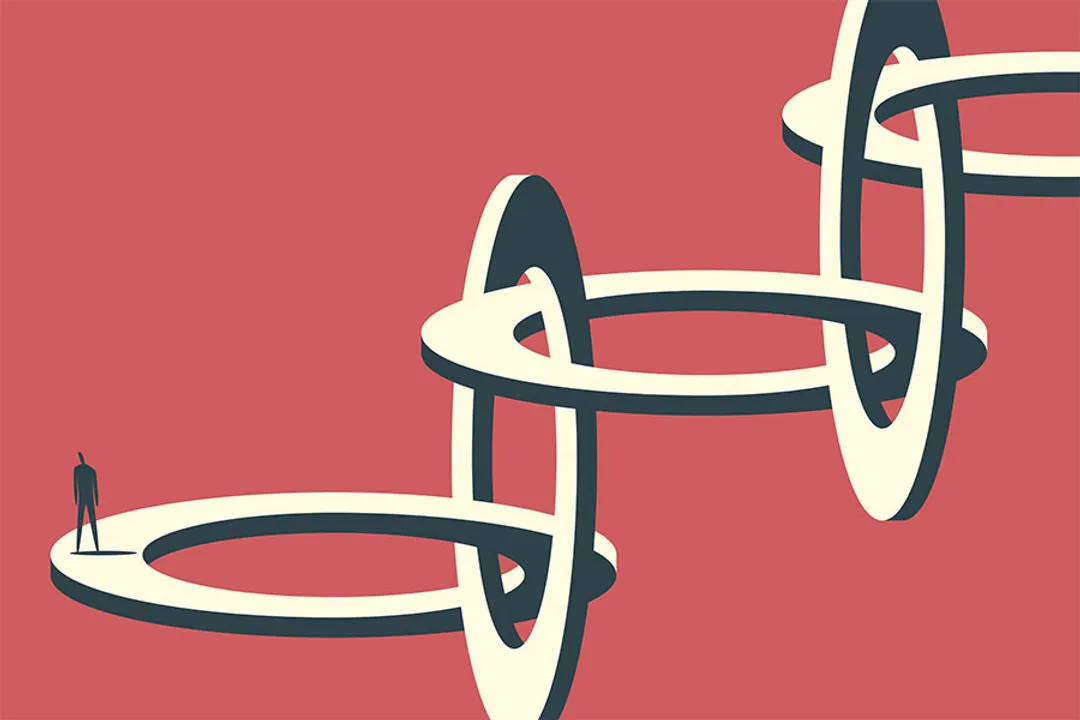
The experience of seeing an optical illusion is fundamentally the experience of being tricked by your own mind. It’s that moment where your eyes clearly report one thing—a set of lines is different lengths, two patches of color are unequal, or a static image appears to move—but your brain insists on telling you something else entirely. Far from being a simple malfunction of the eye, these visual discrepancies reveal the complex, assumption-driven nature of perception itself. [2][9] Seeing isn't merely recording light; it is an active process of interpretation, a quick-fire guessing game based on millions of years of evolutionary necessity. [1]
# The System
What we often call sight is actually a dialogue between the eyes and the brain’s visual cortex. [5] Light enters the eye and strikes the retina, where specialized cells called photoreceptors—rods and cones—convert that light energy into electrical signals. [5] These signals travel along the optic nerve to the brain for processing. [5] The entire system, from the initial light capture to the final conscious perception, works incredibly fast, and speed often necessitates making educated guesses. [10]
The cause of an optical illusion, therefore, rarely rests with a single component. Instead, it usually arises from a mismatch: either the physical sensory input overwhelms or fatigues the eye, or the brain applies an incorrect context or assumption when interpreting the incoming data. [4] The brain is designed to construct a stable, three-dimensional model of the world based on two-dimensional retinal images, which is an inherently ambiguous task. [2] When presented with information that clashes with its established rules, the resulting perception is the illusion. [9]
# Illusion Categories
Scientists typically divide optical illusions into two major, though sometimes overlapping, categories based on where the "error" originates: physiological and cognitive. [1][9] Understanding this split helps explain why the trick works. [5]
# Physiological Effects
These illusions are a direct result of the physical stimulation or subsequent fatigue of the sensory receptors in the eye. [5][9] They are often temporary and linked to the immediate response of the retina or the initial nerve pathways leading to the brain. [5]
A prime example is the negative afterimage. If you stare intensely at a brightly colored image for thirty seconds and then look at a white wall, you will see the complementary color staring back at you. [1][5] This occurs because the photoreceptors responsible for detecting the original color become temporarily exhausted or "bleached out". [5] When you shift your gaze to a neutral background, the fatigued cells under-fire their signals, causing the healthy, un-fatigued cells to dominate the signal, thus showing you the opposite color combination. [5] This demonstrates the visual system’s need to adapt to sustained stimulation, much like your ears adjust to a loud room after you leave it. [9]
# Cognitive Errors
In contrast, cognitive illusions stem from the brain's higher-level processing and unconscious inferences. [9] These tricks occur after the visual signal has been successfully transmitted; the error is in the interpretation, not the initial reception. [1] These illusions highlight the brain's reliance on past experience to make sense of the present visual scene. [2]

# Brain Shortcuts

Cognitive illusions reveal the mental shortcuts, or heuristics, that the brain employs daily to make vision efficient rather than perfectly accurate. [2] We cannot process every piece of light data separately; we must group and infer.
One common heuristic involves judging size and distance. In the real world, we have learned that objects that cast a smaller image on the retina are usually farther away. When viewing a drawing that uses depth cues—like converging lines suggesting perspective—the brain automatically applies this learned rule. [2][9]
Consider illusions involving size constancy. If two identical shapes are drawn on a page, but one is surrounded by lines that converge inward (suggesting the shape is farther away), the brain assumes the "farther" shape must be physically larger to cast the same size image on the retina. [2][9] The result is that the farther-appearing shape looks enormous, even though the objective measurement of the two shapes on the page is the same—this is the essence of illusions like the Müller-Lyer illusion. [9]
Think about how often we encounter flat representations in modern life—photographs, movies, and digital screens are everywhere. Our modern reliance on projected and flattened media trains our brains to over-rely on these 2D depth markers, potentially making us more susceptible to certain perspective illusions today than people centuries ago who relied purely on real-world depth perception to navigate their environment.
# Perception Context
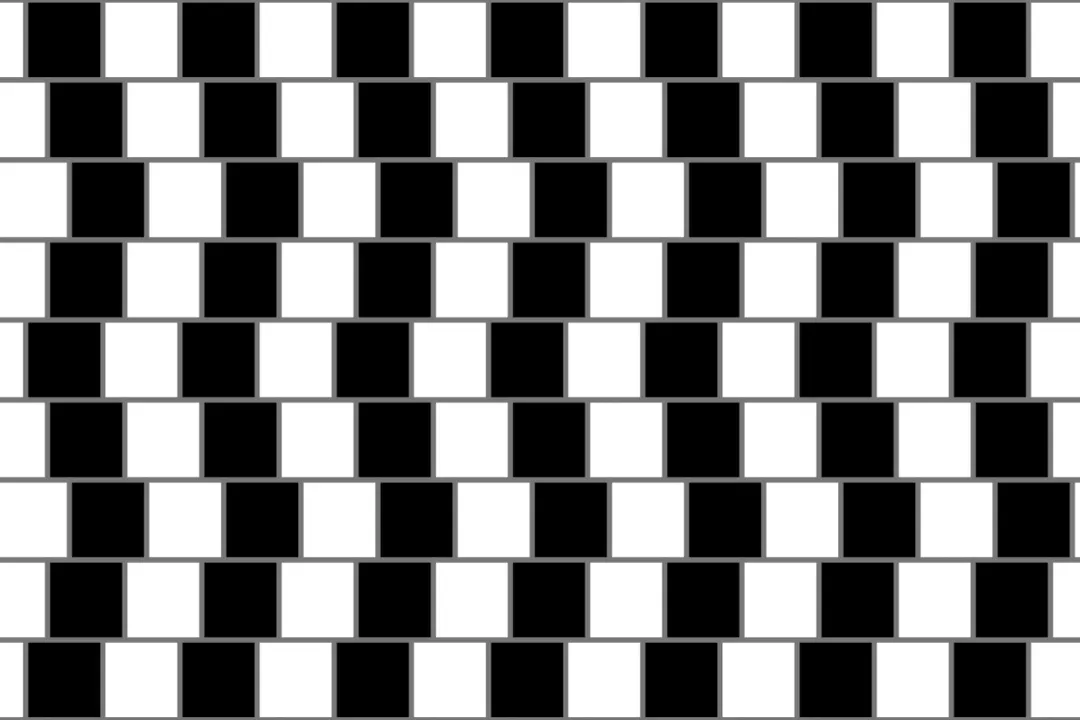
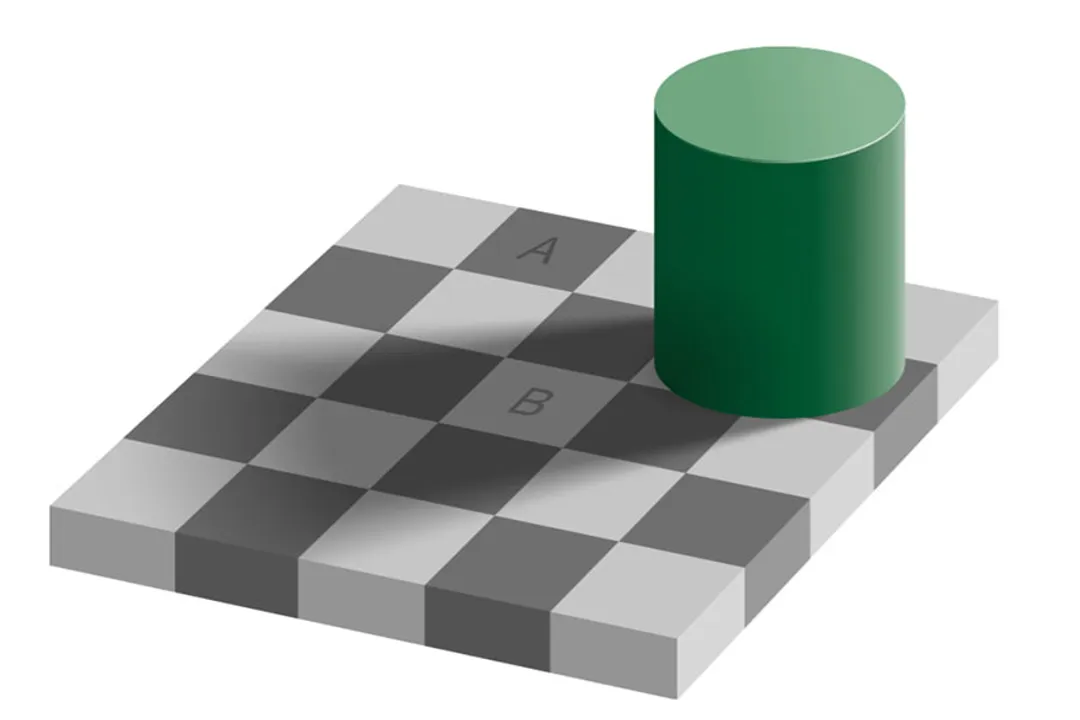
The immediate visual surroundings play a massive role in how individual elements are interpreted. [4] The visual system appears to process information relatively, comparing adjacent elements rather than assessing absolute values. [4] This comparative processing is critical to understanding several illusion types.
The Simultaneous Contrast Effect perfectly illustrates this relativity. If you have a medium-gray square and place it next to a patch of pure white, the gray square will appear darker than it actually is. Conversely, placing the exact same medium-gray square next to a patch of pure black will make the gray square appear lighter. [4] The physical reality of the gray square has not changed, but its perceived lightness is entirely dictated by the context of its background. [4] This relational processing is essential for distinguishing objects in varied lighting conditions in the real world, though it leads to predictable errors in controlled visual settings. [10]
Consider the implication for design: if an object's perceived size is highly dependent on the surrounding negative space, graphic designers and architects effectively "paint" the perception of an object by simply manipulating the canvas around it. A small piece of art in a vast white gallery feels less significant than the same piece surrounded by densely packed furniture, regardless of the art's intrinsic merit, because the visual system defaults to comparison over absolute measurement [Self-Analysis].
# Unconscious Inference
Another powerful cognitive trick involves filling in missing information, a process sometimes referred to as completion. [4] When lines or shapes are incomplete, our brains often 'see' the completed form rather than the disjointed pieces. [4] This is particularly evident in illusions that rely on the Gestalt principles—the brain preferring whole, simple, and organized figures over disconnected elements. [9]
For instance, in the Kanizsa Triangle illusion, three Pac-Man-like shapes arranged in a specific way cause us to perceive a bright white triangle lying on top of them, even though no lines define the triangle’s edges. [4] The brain infers the existence of the triangle because that interpretation creates a simpler, more coherent scene than seeing three oddly placed discs. [9] The visual system prioritizes closure and simplicity in its interpretation of ambiguous data.
# Analyzing Visual Interpretation
Studying these phenomena allows researchers to map out the operations of the visual cortex. [7] Neuroscientists often use techniques like functional magnetic resonance imaging (fMRI) to observe which areas of the brain activate when a person perceives an illusion, thereby identifying the specific cognitive machinery involved in making the interpretive 'mistake'. [7] The timing difference between the initial visual input and the conscious realization of the illusion can also be measured, providing insight into the speed of these cognitive fixes. [10]
It is fascinating to compare how different people experience the same illusion. While many cognitive illusions are universal due to shared human biology, cultural context can alter interpretation. [3] Studies sometimes compare individuals raised in different environments—for example, those accustomed to navigating highly rectilinear, built environments versus those raised in less structured, more organic settings—to see if their learned assumptions about perspective and depth affect how they resolve ambiguous images. [3] This reinforces the idea that perception is not just hardwired but is also heavily conditioned by lifelong visual experience. [2]
Ultimately, optical illusions are not flaws in our biology; they are fascinating side effects of a highly efficient, evolved system designed for survival. The brain’s constant need to reconstruct reality from incomplete information, while usually successful, occasionally stumbles when presented with cleverly constructed, static stimuli that intentionally violate the rules of the real world it has learned to expect. [1][9]
Related Questions
#Citations
What Causes Optical Illusions? - Ask A Biologist
Optical Illusions and How They Work | AMNH
How does an optical illusion work? - Queensland Brain Institute
Optical, Perception, Phenomena - Illusion - Britannica
How Does the Human Eye Interpret Optical Illusions?
How Does an Optical Illusion Work? - Dean McGee Eye Institute
How do illusions trick the brain? - MIT McGovern Institute
Optical Illusions: What Causes Them? Try Some Out! - Mind Matters
Optical illusion - Wikipedia
14 Optical Illusions and How They Work - The Science of Perception