What causes cosmic background radiation?
The radiation permeating the cosmos, known as the Cosmic Microwave Background (CMB), represents the oldest light we can possibly observe, acting as a direct echo from the universe when it was only about 380,000 years old. [5][10] This omnipresent glow, detectable today across the entire sky, is the lingering thermal energy from the Big Bang itself, stretched and cooled by the expansion of space over nearly 13.8 billion years. [1][6] Understanding what caused this radiation requires us to rewind the clock to a time before stars, galaxies, or even neutral atoms existed.
# Opaque Plasma
In the very early universe, the cosmos was incredibly hot and dense, far denser and hotter than anything we experience today. [5][6] Matter existed not as the familiar atoms we know, but as a superheated, ionized fog—a plasma consisting primarily of free-roaming electrons and atomic nuclei, such as protons. [1][5] In this environment, the conditions were too energetic for electrons to settle into orbits around nuclei to form stable, neutral atoms. [6]
The critical consequence of this plasma state was that photons, the particles of light, could not travel freely across space. [1][5] Instead, any light attempting to propagate would almost immediately collide with one of the abundant free electrons, scattering it in a random direction. [5][10] This constant interaction meant the universe was optically thick—opaque—to radiation, much like sunlight cannot pass through a dense fog or the interior of a star. [1] The entire universe was filled with this high-energy, trapped light, constantly interacting with the matter.
# Cosmic Clearing
This state of opacity could not last forever because the universe was expanding, and with expansion came cooling. [5] As the universe grew larger, the energy density dropped, and the average temperature steadily decreased. [10] Eventually, after hundreds of thousands of years, the temperature dropped to a critical threshold, estimated to be around . [5][6]
At this temperature, the kinetic energy of the particles was low enough for the positively charged nuclei (mostly hydrogen and helium) to finally capture the negatively charged electrons, forming the first stable, electrically neutral atoms. [1][5] This event is often called Recombination, though that name is slightly misleading, as atoms had never truly formed before this point. [6] This process is also known as decoupling, because it separated the photons from the matter. [1][5]
Once the free electrons were bound up in neutral atoms, the primary mechanism for scattering light vanished. [5][10] Suddenly, the photons, which had been bouncing around for eons, were free to stream outwards unimpeded through the now-transparent space. [10] This moment—the instant the universe transitioned from an opaque plasma to a transparent gas—is the specific cause of the Cosmic Microwave Background. [5] If we could have been present at that time, we would have seen a brilliant, uniform flash of light illuminating the entire horizon, similar in color to the surface of a very dim, cool red star. [1][5]

# Redshift Effect
The light that decoupled at was initially in the visible/infrared part of the spectrum. [1][5] However, the light we detect today is not visible; it is in the microwave band. [10] This dramatic shift is a direct consequence of the expansion of the universe itself. [1][6]
As space stretches over billions of years, the wavelength of the light traveling through it also stretches. [5] This stretching shifts the light toward the red end of the spectrum, a phenomenon called cosmological redshift. [1][10] For the CMB, this stretching has been so extreme that the original visible light photons have been redshifted across most of the electromagnetic spectrum until their wavelengths correspond to microwaves. [10]
We can calculate the current temperature based on this stretching. The original light has been stretched by a factor of about 1100. [5] This cooling effect results in the temperature we measure today, which is astonishingly close to above absolute zero. [1][6] This value is remarkably consistent across the sky, representing the universe's average thermal equilibrium temperature today. [1]
To put that change in perspective, imagine the initial radiation as roughly equivalent to the temperature of a standard light bulb filament when it just begins to glow. Now, consider that this exact same thermal energy is currently filling all of space, yet it is so diluted and stretched that its corresponding temperature registers as less than three degrees above the coldest theoretically possible temperature, a vast difference that speaks to the immense scale of cosmic expansion. [1][5]
# Current Signature
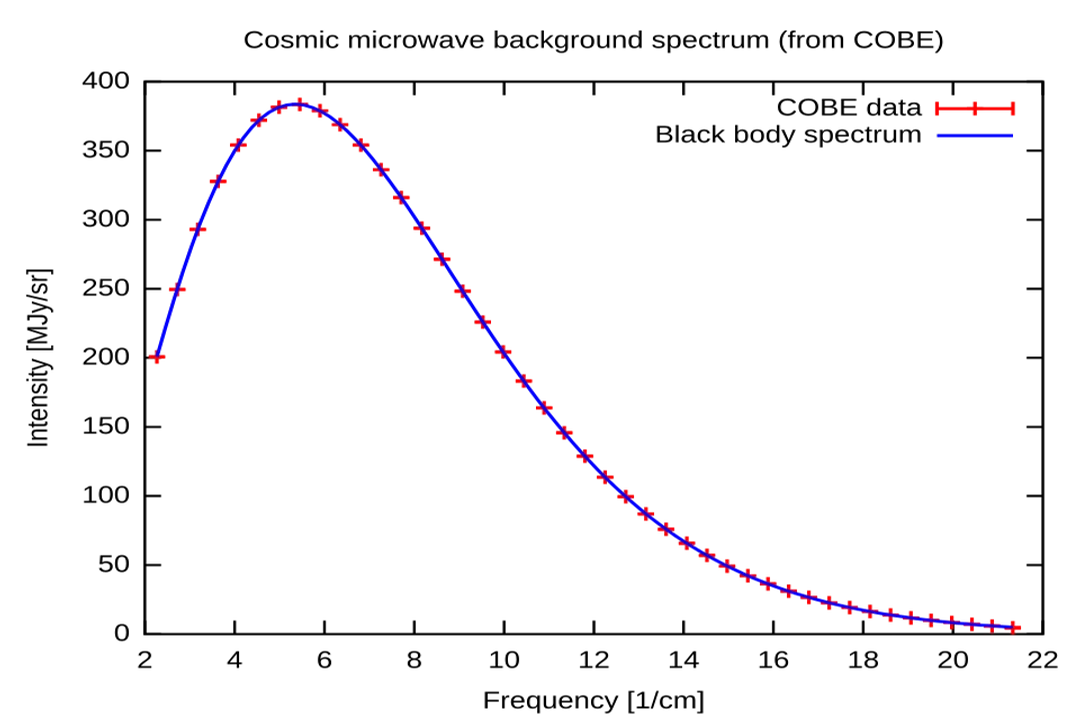
One of the most compelling aspects of the CMB is its spectral quality. [1] It is not just random background noise; it closely follows a perfect black-body spectrum. [5] A black body is an idealized object that absorbs all incident electromagnetic radiation and then re-emits radiation purely based on its temperature. [1] The precision with which the measured CMB matches this theoretical curve is one of the strongest pieces of evidence supporting the standard Big Bang model. [5][10]
The extreme uniformity of this temperature—the near-perfect everywhere you look—presents a fascinating puzzle to cosmologists. [6] While the expansion and cooling explain the temperature value, the fact that widely separated regions of the early universe (regions that could not have been in causal contact before decoupling) reached the same temperature is a profound observational constraint that early models struggled with. [6] This uniformity suggests that something happened very early on to equalize the temperatures before the plasma phase ended.
# Discovery Map
The existence of the CMB was predicted theoretically based on the Big Bang model, but its accidental discovery in 1964 provided observational confirmation. [5] Arno Penzias and Robert Wilson, working at Bell Labs with a sensitive microwave antenna, detected persistent, isotropic background noise that they could not eliminate, mistaking it initially for pigeon droppings or equipment faults. [5][10] This noise corresponded precisely to the expected residual temperature from the cooling Big Bang. [5] They were awarded the Nobel Prize for this work. [5]
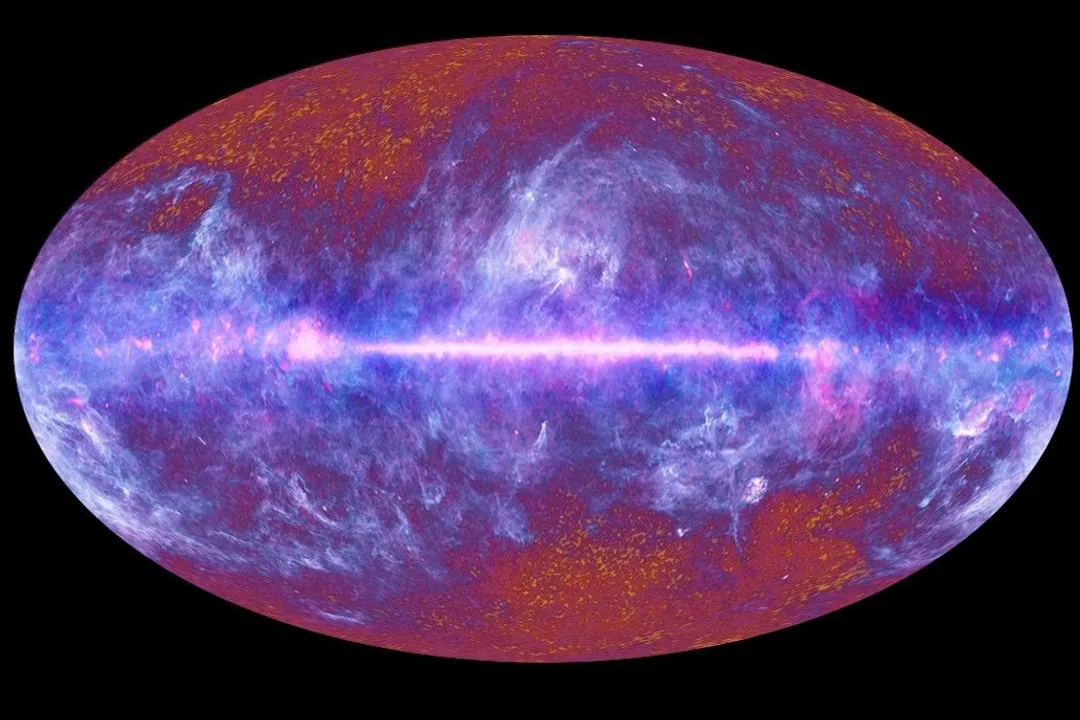
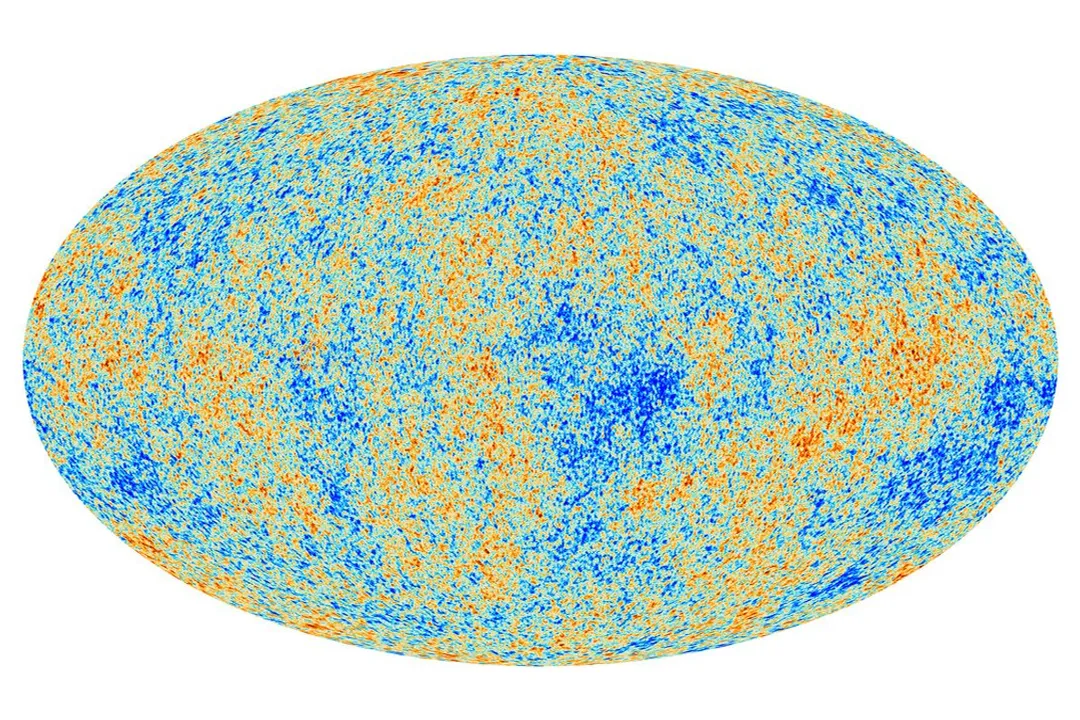
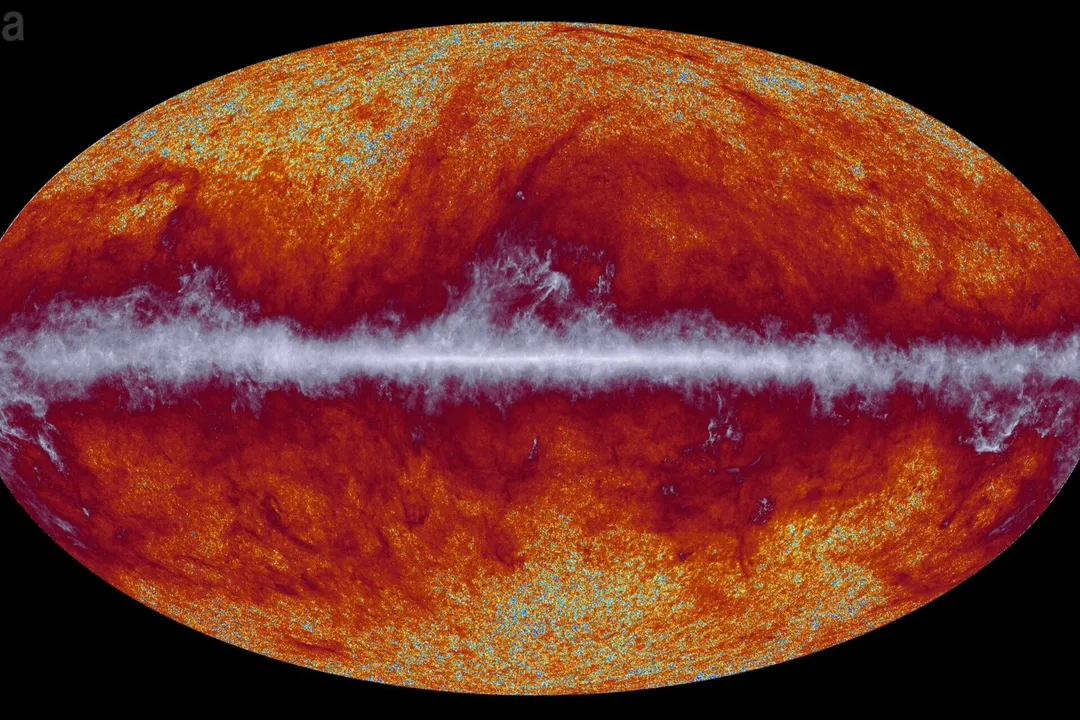
Subsequent space-based missions have moved past simply confirming the existence of the background glow to meticulously mapping its subtle variations. [6] The Cosmic Background Explorer (COBE) satellite provided the first detailed measurements, followed by the Wilkinson Microwave Anisotropy Probe (WMAP), and finally the Planck satellite. [1][6] These satellites search for anisotropies—tiny variations in temperature across the sky—that are only on the order of one part in $100,000$. [1][5]
# Early Seeds
These minor temperature variations are not defects; they are the imprints of density fluctuations present in the primordial plasma before decoupling. [1][6] Where the gas was slightly denser, the temperature was slightly hotter; where it was slightly less dense, the temperature was slightly cooler. [5]
These slight over-densities were the gravitational seeds that would eventually grow over cosmic time, attracting more matter through gravity until they collapsed to form the large-scale structure of the universe we observe today: galaxies, clusters, and superclusters. [1][5][6] The CMB map is thus a blueprint of the universe's structure before any stars even ignited. [5] By analyzing the statistical patterns and angular scale of these fluctuations mapped by Planck and WMAP, cosmologists can precisely determine key cosmological parameters, such as the geometry of the universe, the proportions of dark matter and dark energy, and the rate of expansion. [6]
| Satellite Mission | Key Contribution | Timeframe (Approximate) |
|---|---|---|
| COBE | First detection of anisotropy | Early 1990s |
| WMAP | High-resolution temperature maps | Early 2000s |
| Planck | Highest resolution polarization and temperature maps | Early 2010s |
The CMB, therefore, isn't just a leftover glow; it is the foundational data set that anchors our entire modern understanding of cosmology, linking the universe's initial conditions directly to its current structure through the physics of expansion and gravity. [6]
#Videos
Cosmic Microwave Background Explained - YouTube
Related Questions
#Citations
Cosmic microwave background - Wikipedia
Can someone please explain CMB (Cosmic Microwave Background ...
Cosmic Microwave Background (CMB) radiation - ESA
What is the cosmic microwave background? - Space
Cosmic Microwave Background Radiation | AMNH
Cosmic Microwave Background | Harvard & Smithsonian
The Cosmic Microwave Background Radiation - E. Gawiser & J. Silk
Cosmic Microwave Background Explained - YouTube
Why can we see the cosmic microwave background (CMB)?