How does gravity cause a star to collapse?
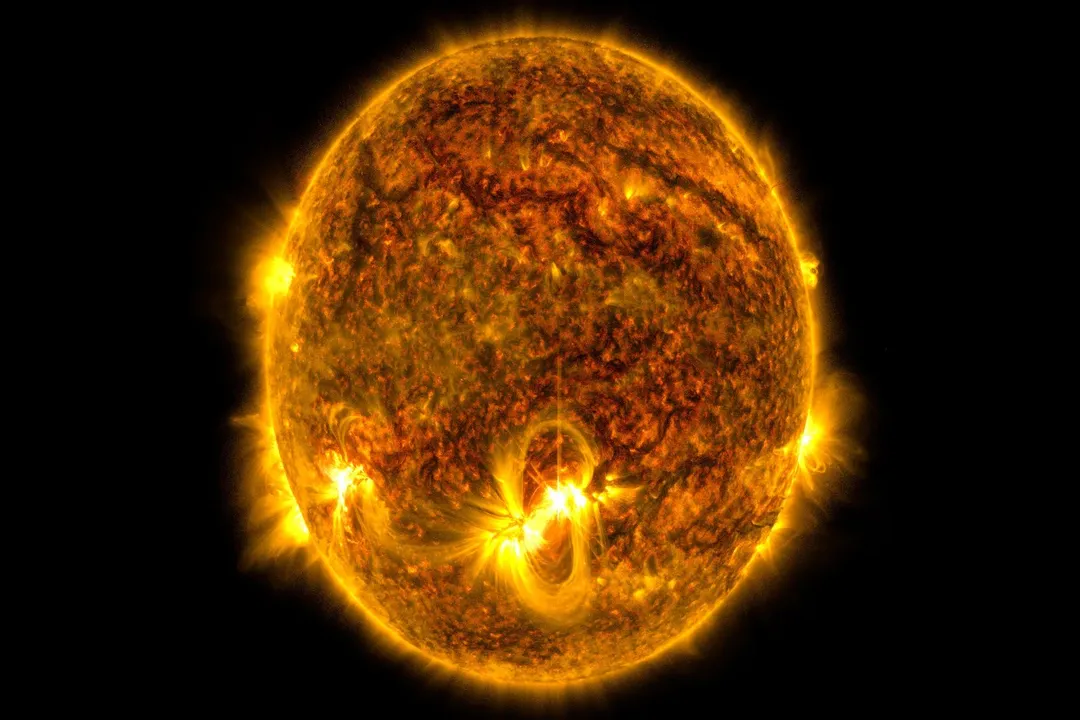
A star spends the vast majority of its existence engaged in a silent, colossal war with itself. It is a constant, nearly perfect balancing act where the relentless inward squeeze of its own immense gravity is met, and usually held in check, by an equally powerful outward push generated deep within its core. [4][10] This state of balance, known in astronomy as hydrostatic equilibrium, is what keeps a star stable, shining for billions of years. [9] The secret to this outward force lies in nuclear fusion—the process where lighter elements, primarily hydrogen, are slammed together under extreme heat and pressure to form heavier ones, releasing tremendous amounts of energy. [4] This energy creates a thermal and radiation pressure that pushes outward, preventing the star from collapsing into a single, unimaginably dense point under its own weight. [2][3]
# Stellar Balance
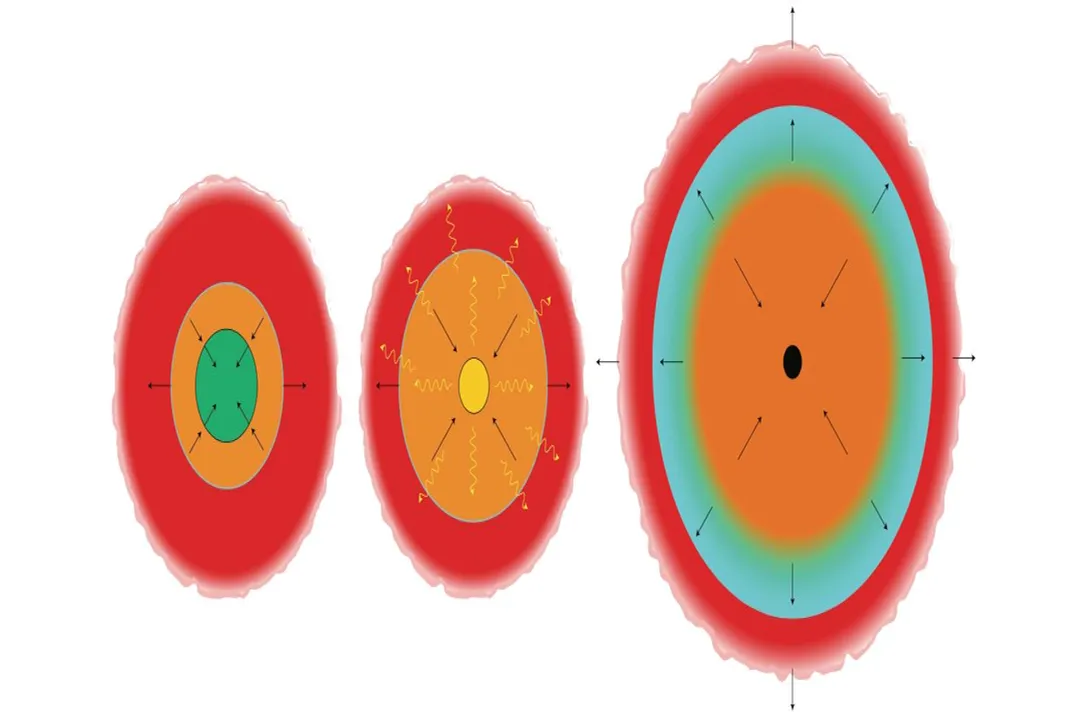
The architecture of a star is defined by this duality. Gravity, which scales with the total mass of the star, attempts to compress every atom toward the center. [10] For a star like our Sun, this inward pull is immense, but the outward pressure generated by hydrogen fusion in the core—which is hot enough to sustain fusion—is sufficient to counteract it. [4] When a star is in its main-sequence phase, this equilibrium is maintained, and the star remains relatively stable in size and temperature. [9]
However, this outward pressure is entirely dependent on the ongoing fuel supply for fusion. The hotter the core, the stronger the pressure; conversely, if the core cools, the pressure drops, and gravity gains the upper hand. [2]
# Center Pressure
It is a common point of confusion to wonder why a star collapses when the gravity is actually strongest at the center. [3] The key concept here is not the absolute strength of gravity at one point, but the net force acting on the stellar material. While gravity is strongest at the core, the surrounding layers are providing a massive, crushing load, and the outward pressure is the only thing holding that load up. [3] When the source of that outward pressure—the energy generation from fusion—ceases or significantly diminishes, there is nothing left to resist the cumulative gravitational pull from all the mass above any given point, leading to collapse. [2][3] The collapse is initiated when the core's temperature drops below the threshold needed to sustain the fusion that was counteracting gravity. [1]
# Fuel Ends
The fate of a star is sealed when its primary fuel source runs out, which always happens first in the core. [1] For stars similar in mass to the Sun, this typically means running out of hydrogen and beginning to fuse helium into heavier elements. This process can continue, building up layers of heavier and heavier elements in concentric shells, until the core is predominantly iron. [1] Iron is the critical turning point because fusing iron consumes energy rather than releasing it. [1][7] Once the core turns to iron, the energy generation that provided the vital outward pressure stops abruptly, and the star loses its primary internal support mechanism. [2][7]
For smaller stars, the collapse might stop well before this catastrophic point. When a Sun-like star exhausts its core fuel, it will expand into a red giant, shed its outer layers, and leave behind a dense remnant known as a white dwarf. [1] This remnant is supported not by fusion pressure, but by a quantum mechanical effect called electron degeneracy pressure, which is strong enough to resist gravity for stars up to a certain mass limit (the Chandrasekhar limit). [1]
# Gravity Takes Over
When the core is made of iron or when the star is so massive that even fusion into carbon or oxygen is insufficient to hold it up, gravity immediately begins to win the battle. [1][5] The core begins to shrink rapidly because there is no internal mechanism left to push back against the crush of the outer stellar layers. [2] This inward acceleration of mass is the gravitational collapse itself. [1]
Think of the star’s structure as a massive Jenga tower. As long as the internal pieces (fusion energy) are actively being replaced, the tower stands firm against the weight pressing down from above. The moment the energy production halts, the structure becomes unstable, and gravity exploits that instability instantly. If you consider the sheer scale, when the Sun ends its life, the gravitational force that will ultimately crush its core is equivalent to the weight of approximately one billion Earths pressing inward simultaneously. [2] The speed at which this collapse occurs in massive stars is astonishing; the core can fall inward at speeds reaching nearly a quarter of the speed of light. [7]
# Collapse Paths
The ultimate destination of the collapsing material depends entirely on the mass contained within that shrinking core. [7] This threshold dependency is one of the most fascinating aspects of stellar death, as a small difference in initial mass leads to vastly different final products.
# Neutron Stars
If the star is massive enough for its core to exceed the electron degeneracy pressure limit (about $1.4$ times the Sun's mass), the gravitational pressure forces electrons and protons to combine into neutrons, releasing a flood of neutrinos. [1][7] This process is called inverse beta decay. The collapse continues until the core reaches the density of an atomic nucleus, where the newly formed neutrons resist further compression through neutron degeneracy pressure. [1] This stopping point results in a neutron star, an object incredibly dense—a spoonful would weigh billions of tons—but stabilized against total gravitational defeat. [1][7]
# Black Holes
If the remnant core mass is even greater than the limit that neutron degeneracy pressure can support (roughly $2$ to $3$ solar masses, the Tolman-Oppenheimer-Volkoff limit), then there is no known physical force capable of halting the gravitational implosion. [1][7] Gravity overcomes all known resistance, and the core collapses completely inward, shrinking to an infinitely dense point called a singularity, forming a black hole. [1] The boundary around this singularity, where the escape velocity exceeds the speed of light, is the event horizon. [1]

# Supernova Shock
For the most massive stars (those usually starting with more than about $8$ solar masses), the core collapse leading to a neutron star or black hole triggers one of the universe’s most dramatic events: a core-collapse supernova. [6]
When the inner core impacts the point where neutron degeneracy pressure finally halts the freefall—the "nuclear density wall"—the outer layers of the collapsing core suddenly bounce back. [7] This rebound generates an outward-moving shock wave. [6] Initially, this shock wave stalls due to energy loss, but it is quickly re-energized by the vast torrent of neutrinos streaming out from the newly formed neutron star. [6][7] This surge of energy drives the shock wave violently outward, blasting the star’s outer layers into space at incredible speeds, creating a supernova explosion that briefly outshines entire galaxies. [6] The fate of the core—neutron star or black hole—determines the initial conditions for the explosion's aftermath, but the collapse itself is the trigger. [7]
It is interesting to consider the scale of energy transfer during this event. While the star lives for eons by converting mass to energy via fusion at a steady rate, the entire process of core collapse and bounce, from initial halt to full explosion, can occur in less than a second. [7] This rapid transformation from an ordered, pressurized star to a violent, expanding shell demonstrates the terrifying efficiency of gravity when unopposed by quantum forces.
When observing the remnants, we see clear differentiation based on the initial stellar mass, which dictated the collapse outcome. A star that was initially just above the mass threshold for a supernova might leave behind a neutron star, detectable by its powerful magnetic field and rapid rotation if it happens to emit beams of radiation toward us. [1] If the star was significantly more massive, the collapse bypasses the neutron star stage entirely, leading directly to a black hole, a region of spacetime from which nothing can return. [1] This stark contrast in outcomes based on the mass differential—often only a fraction of a solar mass difference in the core—highlights the fine tuning of the physics governing stellar endpoints. The event serves as a powerful reminder that gravity, in the absence of sufficient countervailing pressure, is the final arbiter of a star's destiny. [10]
Related Questions
#Citations
Gravitational collapse - Wikipedia
ELI5: Can someone explain how a star can collapse in on itself, and ...
black holes - Why does a star collapse under its own gravity when ...
Star Basics - NASA Science
The Gravitational Collapse of Stars - The Astrophysics Spectator
Core Collapse Supernovae - gravitationalwaves – Syracuse University
What causes a star's core to collapse under its own gravity ... - Quora
I have what would probably be considered a rooky question on ...
Gravitational Collapse of Star
Gravitational Collapse Facts For Kids | AstroSafe Search - DIY.ORG