What is created when a star collapses?

The spectacular, final act of a massive star is not merely an ending; it is a violent, energetic rebirth that scatters the building blocks of the cosmos and creates some of the most extreme objects known to physics. When a star exhausts its nuclear fuel and can no longer support its own immense weight against gravity, the core undergoes a catastrophic implosion. This event, often resulting in a brilliant supernova explosion, decides the final form of the stellar corpse left behind. [2][1]
The journey to collapse begins deep within the star's heart. For stars significantly more massive than our Sun, the life cycle involves fusing lighter elements into heavier ones—hydrogen into helium, then helium into carbon, and so on, all the way up to iron. [2] The fusion of iron is the turning point because, unlike the previous steps, fusing iron consumes energy instead of releasing it. [2] With the energy production suddenly ceasing, the outward pressure vanishes, and gravity wins the ultimate tug-of-war. The core collapses inward at incredible speed, creating a shockwave that tears the star apart in a supernova. [2]
# Core Remnants

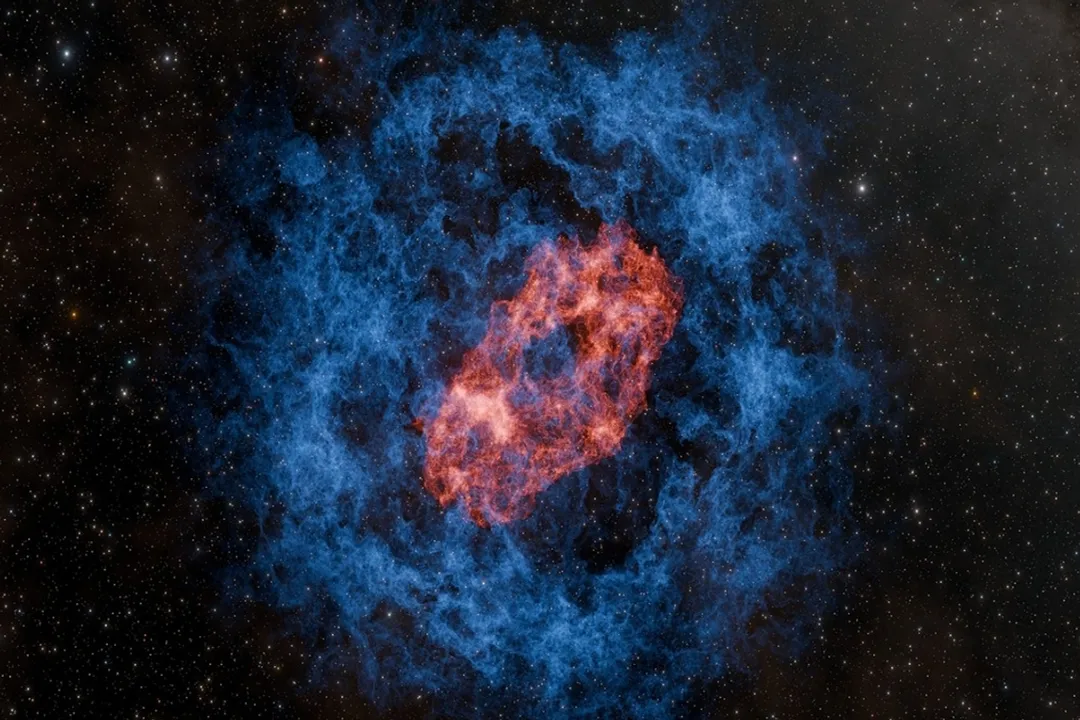
What actually survives this cosmic demolition depends entirely on the mass of the remaining core after the outer layers have been blasted into space. [1] Think of it like a cosmic weighing scale tipping based on how much material is left behind after the explosion’s initial violence subsides. If the core remnant falls below a certain critical mass limit, one type of stellar object forms; if it exceeds it, the result is far more exotic. [1]
The aftermath generally leads to one of three primary outcomes: a neutron star, a black hole, or, in the case of less massive stars, the star simply ceases fusion and shrinks to become a white dwarf (though the context here is the collapse of massive stars leading to supernovae). [1] The difference between a neutron star and a black hole is determined by a narrow margin of mass, often cited around the three solar mass mark for the remnant core. [1][4]
# Neutron Stars
When the collapsed core settles into a stable state between roughly 1.4 and 3 solar masses, the result is a neutron star. [1] The pressure during the collapse is so extreme that it forces protons and electrons to merge, creating a dense sea of neutrons. [2] These objects are mind-bogglingly compact. Imagine taking a mass equivalent to more than the Sun and squeezing it down into a sphere roughly only 12 miles (about 20 kilometers) across. [2] To put that density into perspective, a single teaspoon of neutron star material would weigh about a billion tons on Earth. [2]
The internal structure of a neutron star is fascinatingly strange, often described as having a solid, crystalline crust over a superfluid core, though our current understanding is still developing. [1] While they are incredibly small in diameter, their gravity is immense—billions of times stronger than Earth's gravity. [2] Even light struggles to escape this pull, though not completely, as it does for a black hole. [4] Sometimes, these rapidly spinning neutron stars emit beams of radiation, which we observe as pulsars. [2] If you were lucky enough to watch one of these cores form during a supernova, the immense strength of the degeneracy pressure holding it up against gravity is what stops the continued compression. [1]
It is useful to visualize the scale difference when considering stellar remnants. Consider a typical star, like our Sun, which has a radius of about 700,000 kilometers. A neutron star shrinks that scale down to just 10 kilometers. If you were to compare the initial mass of the star that collapses to the final mass of the remnant core, you would see that the supernova explosion itself carries away a substantial fraction of the star's original material, often over 90 percent, transforming that ejected matter into the heavy elements found throughout the universe. [2]
# Black Holes
When the remnant core’s mass exceeds that critical threshold, usually cited as being greater than about three times the Sun’s mass, even the degeneracy pressure provided by neutrons is insufficient to halt the collapse. [1] In this scenario, gravity overwhelms all known forces, and the core collapses indefinitely, creating a black hole. [4]
A black hole is not an object in the traditional sense; it is defined as a region of spacetime where gravity is so intense that nothing, including light, can escape once it crosses the boundary known as the event horizon. [4] Anything falling into a black hole is compressed toward an infinitely dense point called the singularity at its center. [4] This singularity represents a breakdown in our current understanding of physics, as density becomes infinite. [4] While the term for the product when the center of a very massive star collapses is a black hole, [4] the defining characteristic is the event horizon—the point of no return—which is what we can actually measure or observe indirectly. [4]
# Exotic Mergers

The story doesn't always end with a single remnant. Sometimes, two neutron stars, formed from previous supernova events, end up orbiting each other. Over eons, these orbits decay, leading to a direct collision—a process that creates an event far grander than a standard supernova: a kilonova. [10]
The merger of two neutron stars is theorized to be a prime source for creating the heaviest elements in the universe, such as gold and platinum. [10] Observations of a potential kilonova event in 2017 provided strong evidence for this, showing a transient optical emission following a burst of gravitational waves—ripples in spacetime caused by the collision itself. [10] This event demonstrated that when dense stellar objects merge, the resulting explosion not only creates heavy elements but also sends shockwaves through spacetime, confirming predictions made decades prior about the physics of extreme gravity. [10]
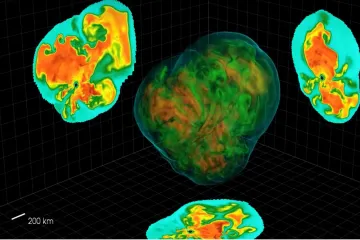
# Stellar Material Ejection
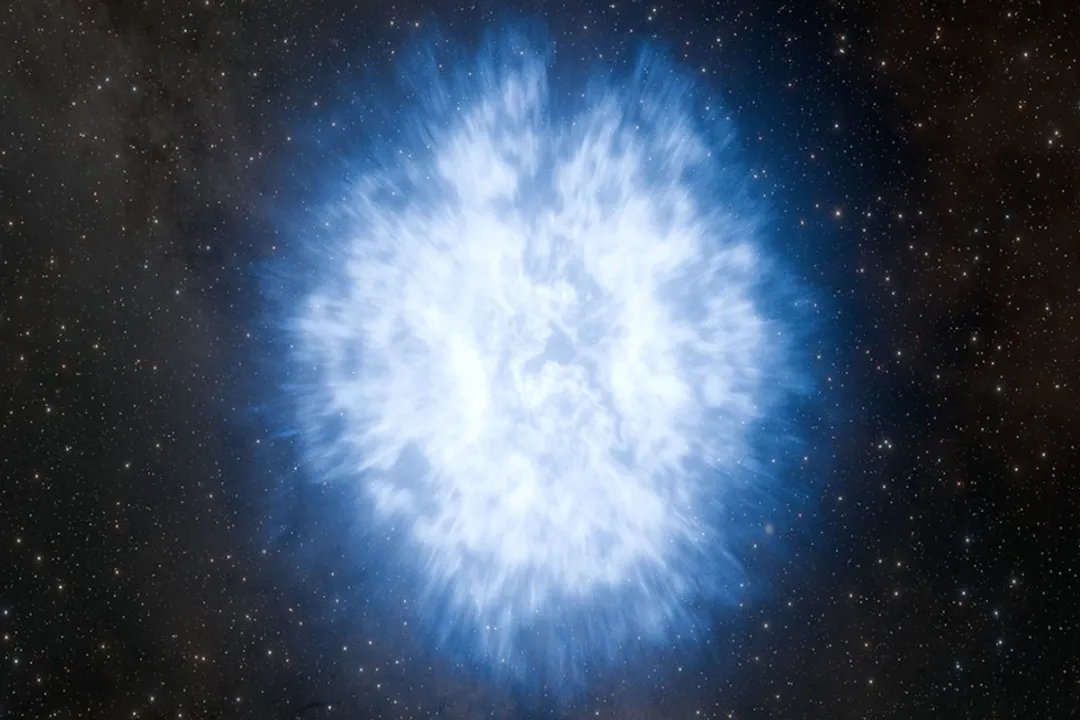
Beyond the collapsed remnants, the most visible creation from a star’s death is the matter ejected during the supernova. This explosion acts as a cosmic factory, synthesizing elements heavier than iron and broadcasting them throughout the galaxy. [2] This ejected material is what enriches the interstellar medium, providing the necessary ingredients—carbon, oxygen, silicon, and all the metals—for the formation of future stars, planets, and life itself. [2]
We can categorize the general outcome based on the star's initial mass, which guides the final state of the core. While exact boundaries are subject to refinement, the general trend suggests a clear progression in the afterlife of these stellar giants:
| Initial Core Mass (Solar Masses) | Remnant Object | Key Physics |
|---|---|---|
| Very Low | White Dwarf | Electron degeneracy pressure halts collapse |
| to $3$ | Neutron Star | Neutron degeneracy pressure halts collapse |
| $> 3$ | Black Hole | Gravity overcomes all pressure forces |
This transition, particularly across the solar mass threshold for the remnant core, is where our standard models are truly tested. A slight change in the initial conditions or the physics of the explosion can push a core just below or just above this line, resulting in an ultra-dense neutron star versus an inescapable black hole. [1]
The sheer energy released during the core-collapse supernova is astounding. It is the largest explosion that takes place in space. [2] When comparing the energy released in a supernova to the total energy output of the Sun over its entire 10-billion-year lifespan, the supernova explosion can release more energy in a matter of seconds. [2] This staggering output is what powers the expulsion of the star's outer layers, scattering the newly forged elements across vast interstellar distances, ensuring that the next generation of stars is chemically richer than the last. [2]
Related Questions
#Citations
Supernova - Wikipedia
DOE Explains...Supernovae - Department of Energy
ELI5 : what does it mean when someone says that " Star collapsing ...
Collapsing stars, supernovae, and gamma-ray bursts - MPA Garching
Star Basics - NASA Science
Core Collapse Supernovae - gravitationalwaves – Syracuse University
What forms when a massive star collapses? - Facebook
What does it mean 'black holes is created when center of a very ...
What is the term given to the product when a star collapses ... - Quora
First-Ever Superkilonova May Have Been Spotted in Bizarre Star ...