Object articles
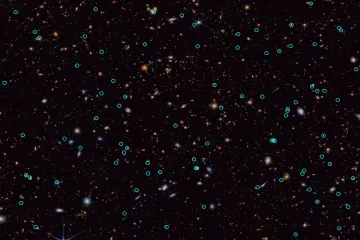
What physical event marks the turning point causing a massive star's core to collapse?
What is the typical mass range for a collapsed core to stabilize as a neutron star?
What physical force is insufficient to halt the collapse when a core remnant becomes a black hole?
What is the defining characteristic used to identify a black hole?
What extreme object is formed by the merger of two neutron stars?
What specific elements are theorized to be prime products of a neutron star merger?
How dense is a teaspoon of neutron star material when weighed on Earth?
What process generates the shockwave that tears the star apart in a supernova explosion?
What is the fate of the matter ejected during a supernova explosion?
How does the energy released by a supernova compare to the Sun's total output?
What is the term for the infinitely dense point at the center of a black hole?
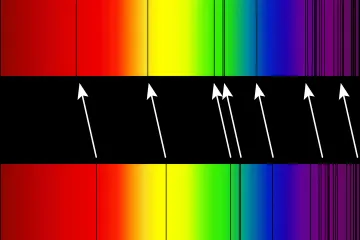
What is the primary tool astronomers use to gauge the distance to distant cosmic sources?
What physically defines a redshift ($z$)?
How is the mathematical definition of redshift ($z$) calculated?
What are the three primary causes listed for the stretching or shifting of light?
What fundamentally causes the cosmological redshift observed in distant galaxies?
What does a greater measured redshift ($z$) directly correlate with for an observed object?
What relationship does Hubble’s Law formalize for relatively nearby galaxies?
What physical quantity does the proportionality constant, $H_0$, in Hubble’s Law represent?
For small redshifts ($z ext{ less than 1}$), how is the recession velocity ($v$) approximated?
Why does the simple linear form of Hubble’s Law fail for high-redshift objects?
What is required to accurately determine the physical distance to an object with a very high redshift ($z$)?
What is typically observed for local objects like the Andromeda Galaxy, contrasting with distant receding galaxies?

What is the defining sustained fusion reaction for main-sequence stars?
What nickname is often given to brown dwarfs?
What is the consequence of a massive star's core turning into iron (Fe)?
Which specific fuel source can many brown dwarfs fuse briefly?
What fundamentally supports a true star against its own gravity?
Approximately how many Jupiter masses must an object exceed to initiate brief deuterium fusion?
Besides mass, what intrinsically links an object to the term "star"?
What is the temporary, inefficient energy source generated by slow gravitational shrinking?
What solar mass boundary defines the point where a true star is born?