What is typically observed for local objects like the Andromeda Galaxy, contrasting with distant receding galaxies?
Answer
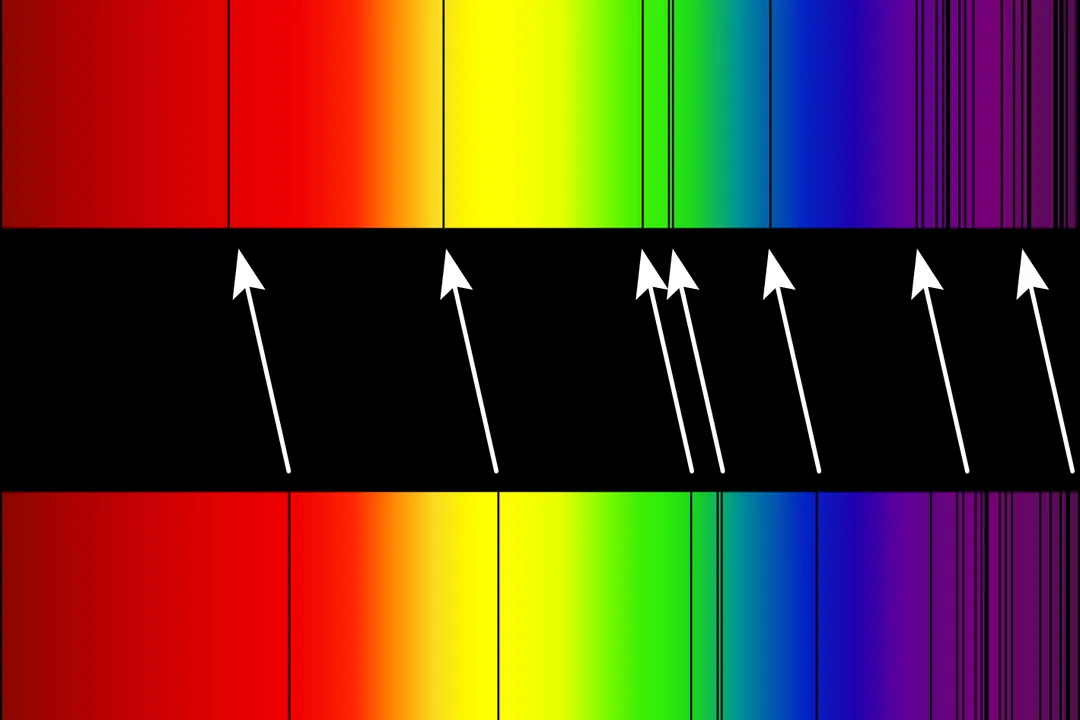
A blueshift.
For objects within our local group, local gravitational or bulk motion effects override the slight uniform expansion, often resulting in a blueshift, meaning the observed wavelength is shorter than emitted.
Related Questions
What is the primary tool astronomers use to gauge the distance to distant cosmic sources?What physically defines a redshift ($z$)?How is the mathematical definition of redshift ($z$) calculated?What are the three primary causes listed for the stretching or shifting of light?What fundamentally causes the cosmological redshift observed in distant galaxies?What does a greater measured redshift ($z$) directly correlate with for an observed object?What relationship does Hubble’s Law formalize for relatively nearby galaxies?What physical quantity does the proportionality constant, $H_0$, in Hubble’s Law represent?For small redshifts ($z ext{ less than 1}$), how is the recession velocity ($v$) approximated?Why does the simple linear form of Hubble’s Law fail for high-redshift objects?What is required to accurately determine the physical distance to an object with a very high redshift ($z$)?What is typically observed for local objects like the Andromeda Galaxy, contrasting with distant receding galaxies?