What does a greater measured redshift ($z$) directly correlate with for an observed object?
Answer
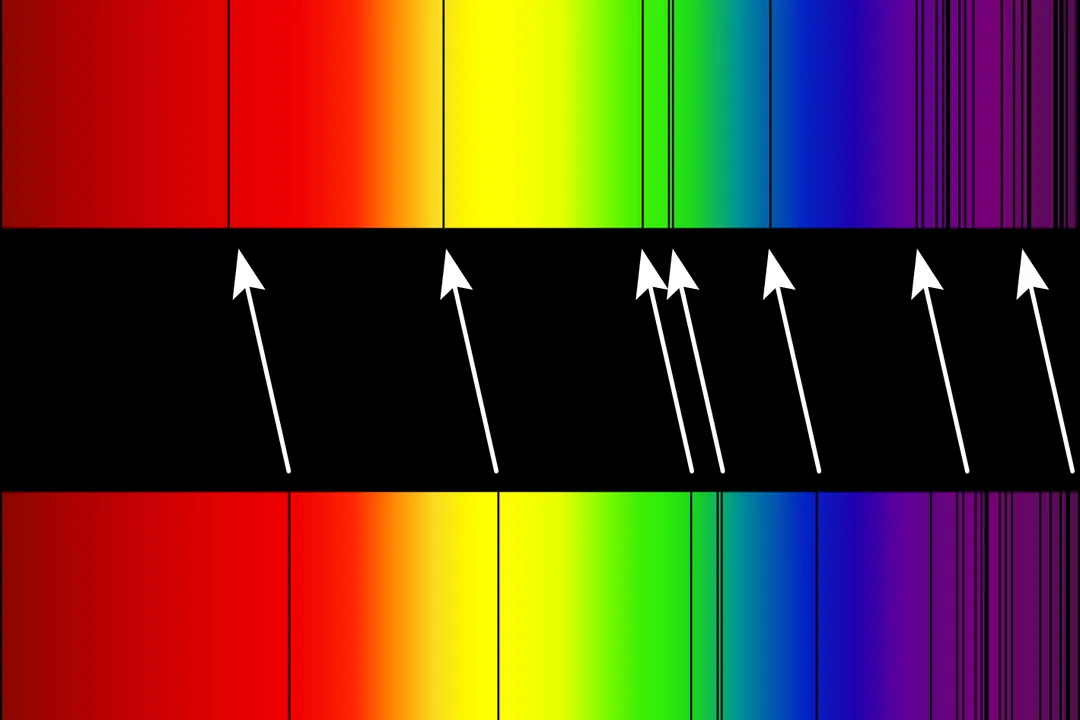
Greater distance and emission further back in cosmic time.
Since the expansion stretches the light during its journey, the farther away an object is, the longer its light has traveled, resulting in a greater expansion factor, or redshift.
Related Questions
What is the primary tool astronomers use to gauge the distance to distant cosmic sources?What physically defines a redshift ($z$)?How is the mathematical definition of redshift ($z$) calculated?What are the three primary causes listed for the stretching or shifting of light?What fundamentally causes the cosmological redshift observed in distant galaxies?What does a greater measured redshift ($z$) directly correlate with for an observed object?What relationship does Hubble’s Law formalize for relatively nearby galaxies?What physical quantity does the proportionality constant, $H_0$, in Hubble’s Law represent?For small redshifts ($z ext{ less than 1}$), how is the recession velocity ($v$) approximated?Why does the simple linear form of Hubble’s Law fail for high-redshift objects?What is required to accurately determine the physical distance to an object with a very high redshift ($z$)?What is typically observed for local objects like the Andromeda Galaxy, contrasting with distant receding galaxies?