Why does redshift increase with distance?
When we look out into the vastness of space, the light reaching us from distant galaxies carries a fundamental signature: it is systematically shifted toward the red end of the visible spectrum. This phenomenon, known as redshift, is not merely an interesting quirk of observation; it is the primary evidence for the expansion of our universe, and crucially, it scales directly with how far away an object lies. [2][9]
The reason redshift increases with distance lies in the nature of the space between us and the distant source. Imagine the light wave traveling across the cosmos. As space itself expands, it effectively stretches the wavelength of that light during its long voyage to our telescopes. [3][4] A light wave emitted billions of years ago as, say, blue light, might start its journey with a specific wavelength. If the universe expands significantly while that photon crosses the intervening distance, the wavelength gets pulled longer, shifting it toward the red end of the spectrum—hence, redshift. [1][9]
# Light Stretching
To grasp this concept, it helps to draw an analogy from everyday experience, specifically the Doppler effect observed with sound. [2] When an ambulance siren moves away from you, the sound waves get stretched out, causing the pitch to drop—this is a redshift in sound waves. Similarly, if a galaxy were simply moving through static space away from us, its light would be Doppler-shifted toward the red. [2][7]
However, the dominant mechanism for very distant objects is different and more profound: cosmological redshift. [2] This isn't about the galaxy rushing through space like a car on a highway; it's about the space itself acting like an expanding rubber sheet upon which the light wave is laid out. [1][3] The farther away a galaxy is, the longer the path its light must travel, and consequently, the more time the fabric of space has had to expand and stretch that light wave. [3][4]
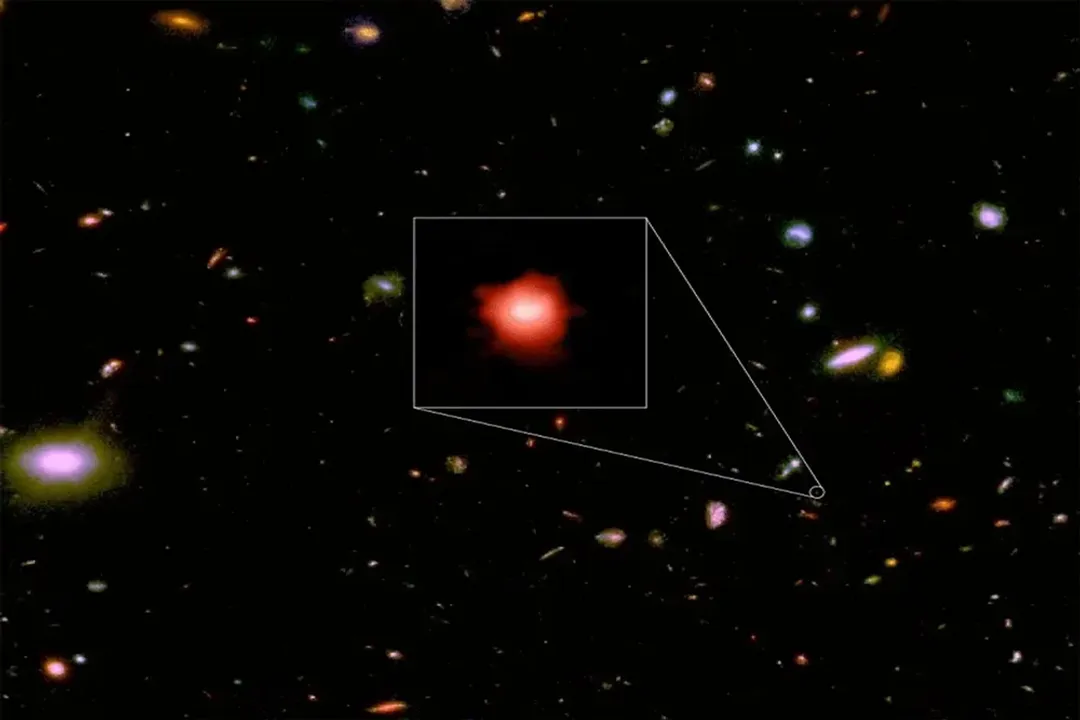
If we consider two galaxies, one at 1 billion light-years and another at 10 billion light-years, the light from the farther galaxy has been propagating through an expanding medium for a much longer time. This longer exposure to cosmic stretching results in a greater accumulated shift toward the red end of the spectrum. [1] For the very distant objects, the observed redshift () can be substantial, sometimes exceeding , meaning the light has been stretched by more than its original wavelength. [2]
# Distance Relation
The direct correlation between redshift and distance is what transformed astronomy in the early 20th century. Astronomers like Edwin Hubble observed a pattern: the farther a galaxy appeared, the greater its measured redshift. [5] This empirical observation is codified in what is generally known as Hubble's Law, which states that a galaxy's recessional velocity () is proportional to its distance (), often written as , where is the Hubble constant. [1]
For objects that are not excessively distant—where the expansion rate has remained relatively constant over the light travel time—the recessional velocity inferred from the redshift is a good proxy for calculating distance. [5][8] This relationship allows astronomers to use redshift as a cosmic yardstick. [3] If we can precisely measure the redshift (), we can infer the velocity, and from that, estimate the distance to the object, assuming a model for the universe's expansion history. [5]
Consider a hypothetical scenario in a universe that wasn't expanding. If galaxies had random motions, we would expect a scatter plot of velocity versus distance, with some objects moving toward us (blueshift) and others moving away, all without a clear linear correlation. [4] The actual observation—a clean, linear relationship where every distant galaxy is redshifted and the shift increases steadily with distance—is a powerful indicator that the underlying cause is a uniform, systematic expansion of space itself, rather than just individual galaxies moving within a static void. [1]
This is a key distinction. If redshift were only due to peculiar motions (galaxies moving relative to each other through space), we would see a mix of redshifts and blueshifts at all distances, with no strict scaling factor connecting and universally. [7] The uniformity of the observed redshift-distance relationship points directly to the cosmological expansion as the governing factor for large-scale structure observations. [3][8]
# Spectral Fingerprints
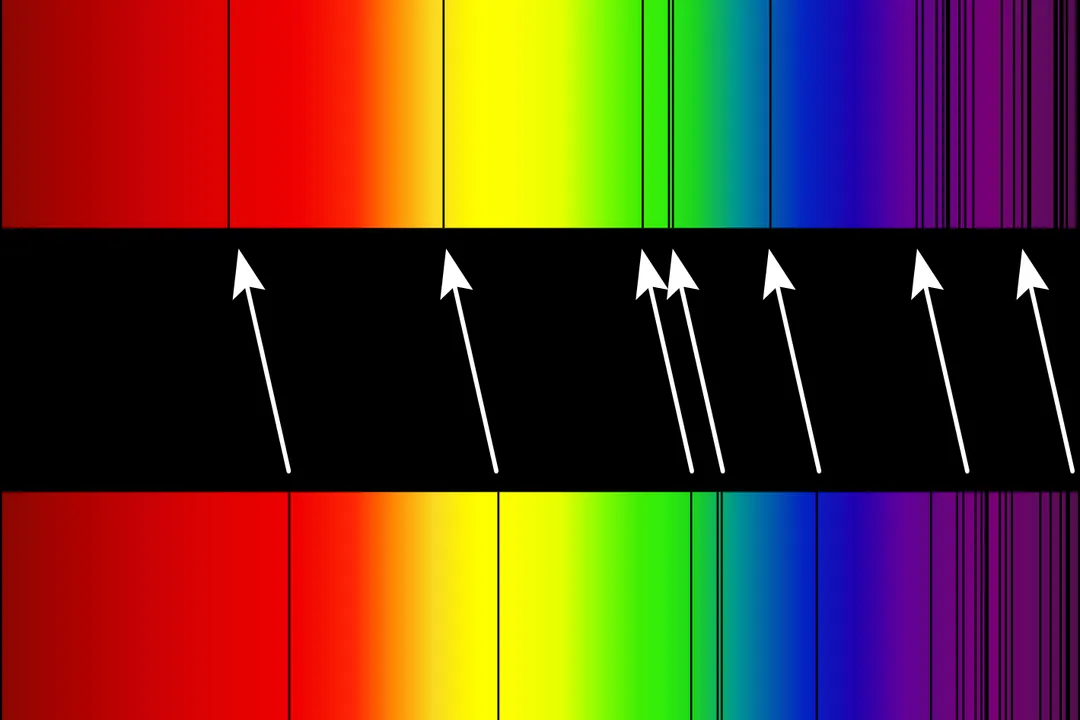
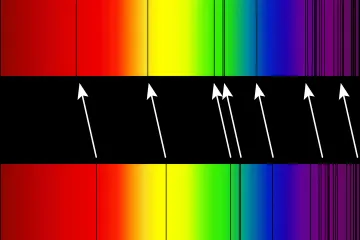
To put this into practice, astronomers need a precise way to measure the stretching. They do this by analyzing the light's spectrum, looking for characteristic absorption or emission lines created by specific elements like hydrogen or calcium. [2][6] These elements absorb or emit light at very specific, known wavelengths when measured in a laboratory here on Earth (the "rest frame"). [6]
When observing a distant galaxy, these same spectral lines appear, but they are all shifted together toward longer, redder wavelengths. [2] The amount of this shift—how far the observed wavelength () differs from the known rest wavelength ()—is quantified by the redshift parameter, :
If a hydrogen line that should appear at 656.3 nanometers (the red H-alpha line) is observed at 787.56 nanometers, the redshift is calculated, and that value of is then used in cosmological models to infer the distance. [2] The consistency across all observed spectral lines in a galaxy's spectrum confirms that the entire emission is being stretched uniformly. [6]
# Other Causes
While cosmological redshift explains the distance relationship, it is important to recognize that it isn't the only way light can be shifted. Understanding the other forms helps solidify why the cosmological component dominates for distant galaxies. [2]
The three main categories of observed redshift are:
- Cosmological Redshift: Caused by the expansion of space between the source and observer. [2][7] This is the primary factor increasing with distance for galaxies billions of light-years away.
- Doppler Redshift: Caused by the peculiar motion of the source through space, whether moving toward or away from the observer. [2] For nearby galaxies, this component can sometimes dominate over the cosmological stretching. For example, the Andromeda galaxy is actually blueshifted because its localized motion toward the Milky Way overcomes the slight cosmic expansion over that relatively short distance. [7]
- Gravitational Redshift: Caused by light escaping a strong gravitational field, such as near a massive star or black hole. [2] The light loses energy as it climbs out of the gravity well, leading to a longer wavelength.
For objects like nearby stars or galaxies gravitationally bound to our own local group, the Doppler and gravitational effects might be more relevant or comparable to the expansion effect. [7] However, when examining objects millions or billions of light-years away, the cumulative effect of billions of years of cosmic expansion overwhelms these local motions, making the cosmological redshift the overwhelming driver that links distance and the observed shift. [3][8]
To help illustrate the difference in scale, imagine a local event versus a distant one. A galaxy moving away from us due to its own inertia within our Local Group might have a Doppler redshift of . In contrast, a galaxy observed at a redshift of has seen its light stretched by a factor of two, indicating it is incredibly far away and its light has been subject to the expansion of space for a significant fraction of the universe's history. [2]
# Cosmic Yardstick
The ability to link distance and redshift is fundamental to building a timeline of the universe. [5] By compiling a large catalog of galaxies and measuring their redshifts, astronomers create a three-dimensional map of the cosmos, revealing its structure and evolution. [8]
The measured redshift allows scientists to determine the lookback time—how long ago the light was actually emitted—which is crucial for understanding the early universe. [3] If a galaxy is found with a redshift of , it means we are seeing it as it existed when the universe was only about a billion years old, vastly different from the objects in our immediate vicinity. [2]
This process enables the measurement of key cosmological parameters, such as the rate of acceleration of the universe. By comparing the distance inferred from redshift against another, independent distance indicator (like Type Ia supernovae), astronomers can test whether the rate of expansion is constant, increasing, or decreasing over time. [3] The fact that redshift continues to increase for the most distant objects we can detect is the direct observational proof that the expansion of the universe is accelerating, a major discovery tied directly to these redshift measurements. [1] Without the precise, distance-dependent increase in redshift, our understanding of cosmic dynamics would remain speculative.
#Videos
Why Do Galaxies have a Redshift Proportional to Distance? - YouTube
Related Questions
#Citations
How does a higher redshift of increasingly distant objects imply an ...
Redshift - Wikipedia
Why Do Galaxies have a Redshift Proportional to Distance? - YouTube
Redshift: Why Does Distance Matter to CTA? - CTAO
I always thought that redshift was used to determine how fast objects ...
Why galaxies look redder, the further away they are
Is it possible that galaxies' redshift is caused by something else than ...
redshifts and distance - Dark Energy Spectroscopic Instrument (DESI)
Redshift - Las Cumbres Observatory