Who determined the distance to the Andromeda galaxy?
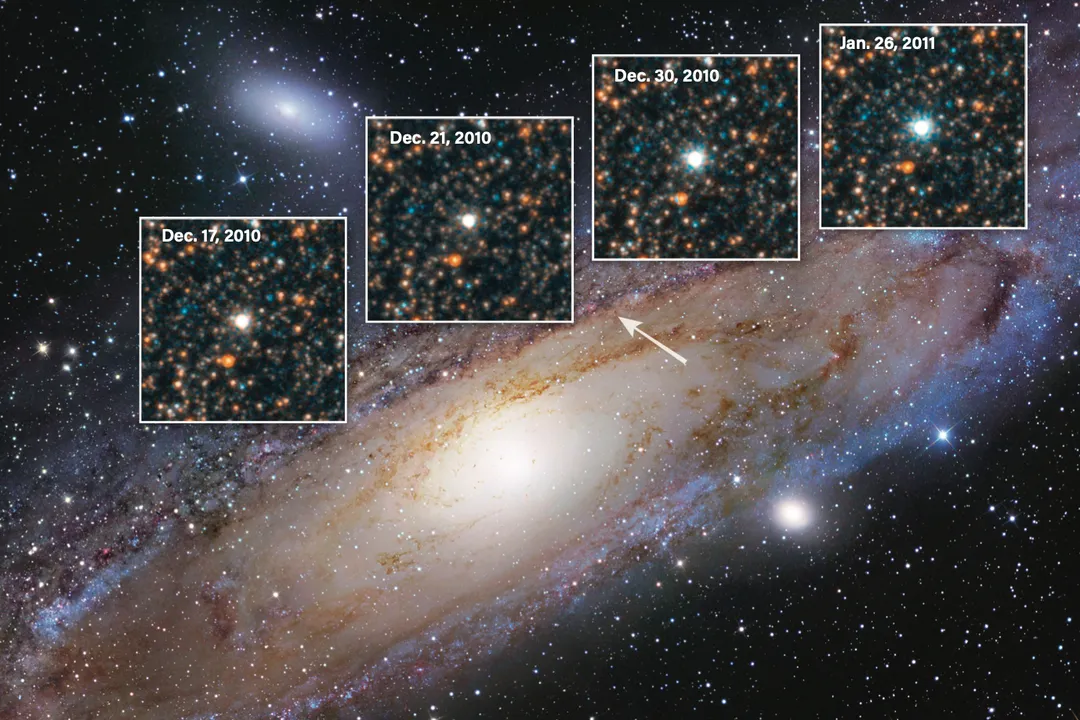
The monumental task of determining the true distance to the Andromeda Galaxy, M31, was not the work of a single calculation but rather the culmination of decades of painstaking observation, culminating in a breakthrough made by astronomer Edwin Hubble in the early 1920s. [1][3] Before Hubble’s definitive measurements, Andromeda existed in a scientific limbo; it was known as a "spiral nebula," and whether it was a small cluster of stars near our own Milky Way or an entirely separate star system beyond our own—an "island universe"—was the subject of the great astronomical debate of the era. [1][2][6]
# Nebula Puzzle
At the turn of the 20th century, our understanding of the cosmos stopped just beyond the stars of our immediate neighborhood. The Milky Way was generally assumed to encompass everything there was to see. [1] Objects like the Andromeda Nebula were visible through telescopes, appearing as faint, fuzzy smudges, leading many astronomers, including Harlow Shapley, to believe they were relatively close gas clouds or star systems residing within the boundaries of the Milky Way. [1]
The central problem was scale. If Andromeda was within the Milky Way, its distance might be measured in the thousands of light-years. If it was truly an independent galaxy, its distance had to be measured in millions of light-years, a scale almost incomprehensible at the time. [5] To measure such an immense gap, astronomers needed a standard candle: a type of star whose true, intrinsic brightness (luminosity) is known, allowing its observed faintness to reveal its distance. [4][9]
# Standard Candle Key
The essential key to unlocking the universe's scale had been discovered decades earlier by Henrietta Swan Leavitt while studying the Magellanic Clouds. [4] Leavitt observed a specific class of pulsating stars called Cepheid variables. [4] She established a profound link between how long it took a Cepheid to cycle from bright to dim and back again (its period) and its true average brightness (its absolute magnitude). [3][4] This relationship, known as the Period-Luminosity Relationship, meant that if an astronomer could find a Cepheid in a distant object, measure its period, and then measure how dim it appeared from Earth, they could calculate the distance with relative accuracy. [4][9]
What made this technique so revolutionary was its power across vast cosmic distances. While measuring the distance to a star in our own galaxy using parallax involved measuring tiny angular shifts over months, the Cepheid method provided a direct, scale-independent distance marker, provided one could resolve individual stars within the nebula. [4]
# Hubble’s Observation
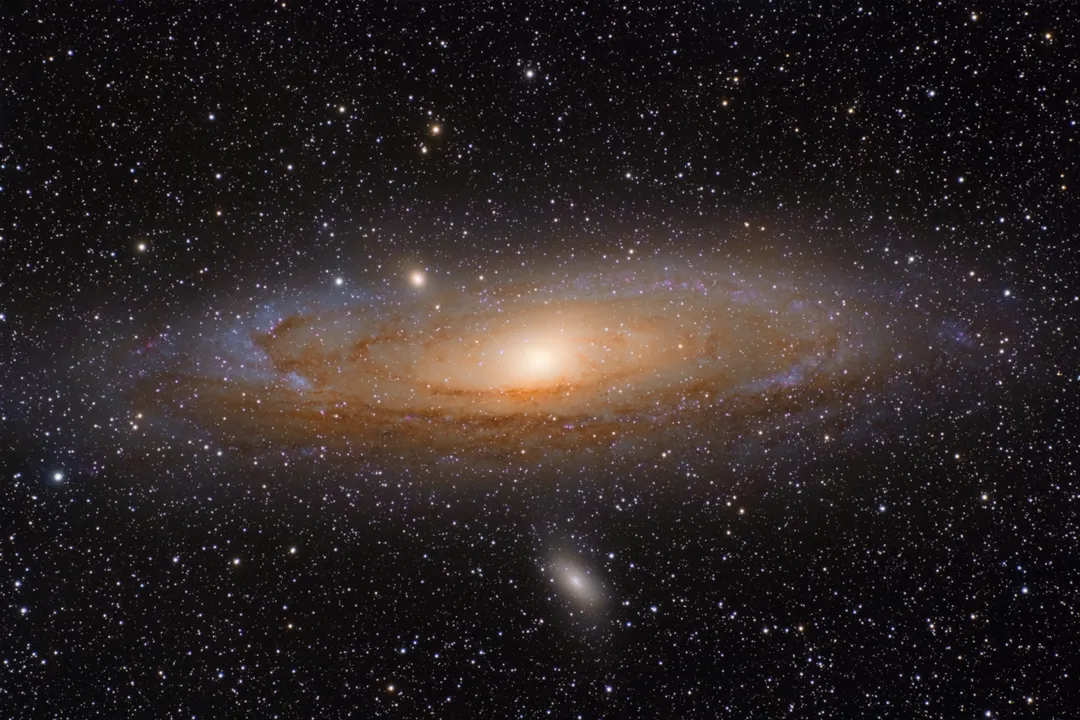
Edwin Hubble, working with the immense 100-inch Hooker Telescope at Mount Wilson Observatory in California, turned his attention to the Andromeda Nebula. [1][3] This telescope represented the cutting edge of light-gathering power, making it possible to resolve individual stars within M31, something previous instruments could not achieve. [3]
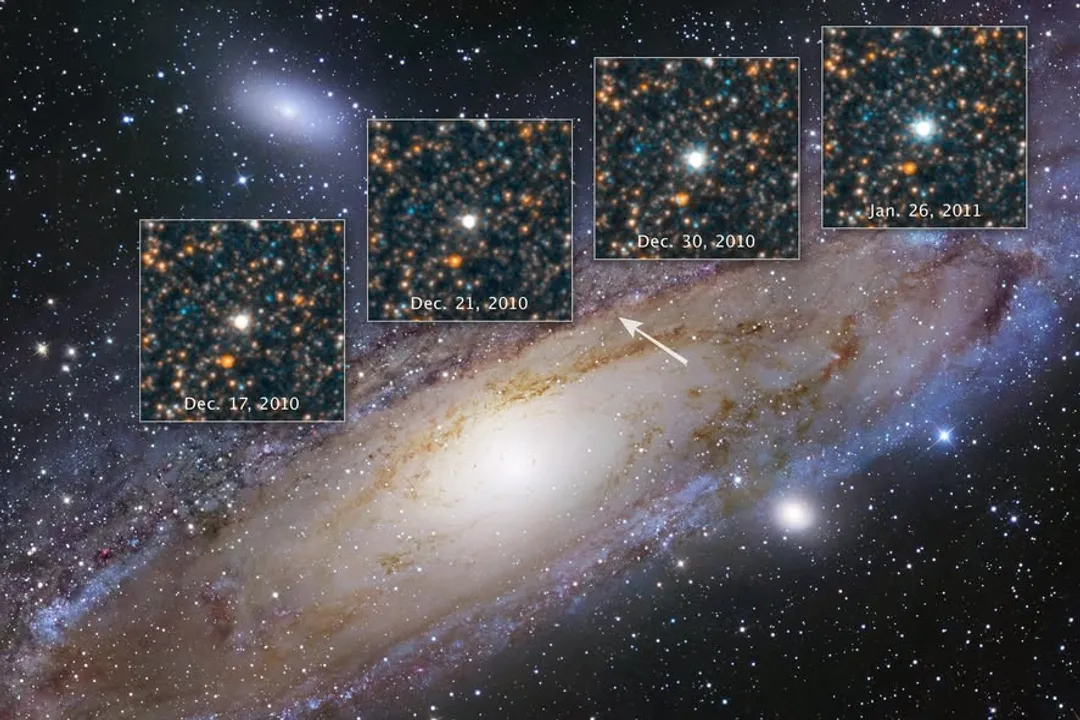
In late 1923, Hubble succeeded in finding a variable star within the spiral arms of Andromeda. [6] Specifically, he identified a star that showed consistent, measurable changes in brightness over time, consistent with a Cepheid variable. [1][3] It was a challenging observation; these stars are intrinsically luminous, but in a system millions of light-years away, they appear incredibly faint. [6] The fact that Hubble could isolate and track the variations of a single star in that fog of light is a testament to the technological capability of the time and his own persistent observational skill. [1][5]
The star Hubble identified was later cataloged as V1, a Cepheid variable. [6] When he tracked its pulsation cycle, he could finally apply Leavitt’s law. [4]
# Distance Calculation
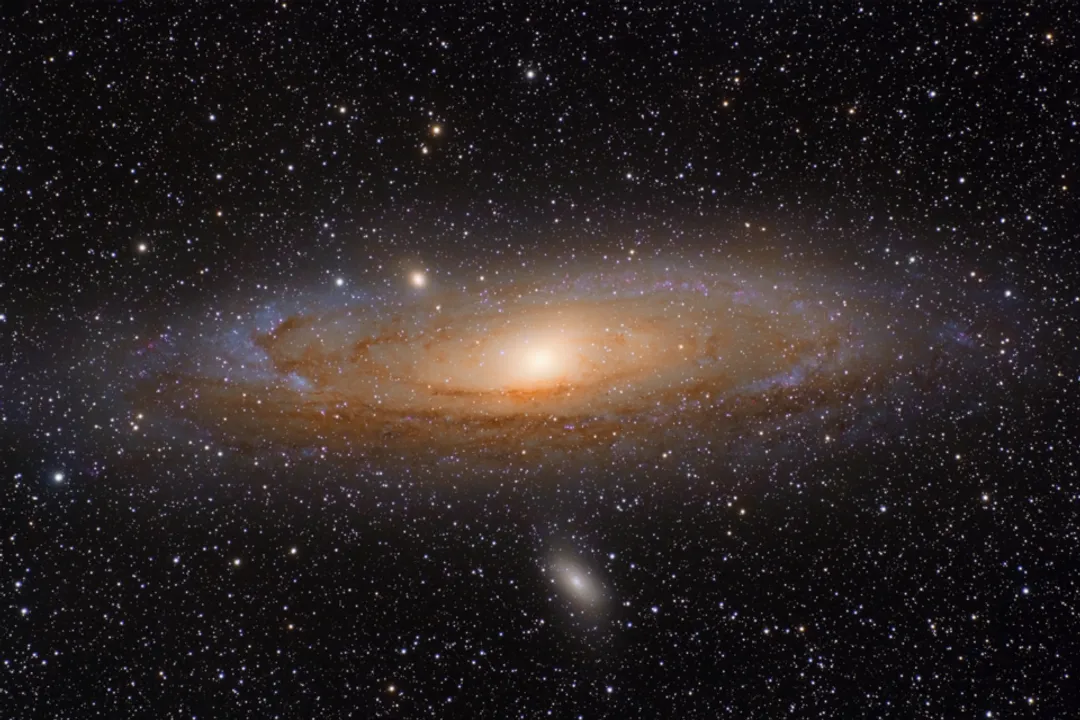
The process Hubble followed, which we still use conceptually today, required two critical measurements for V1: its period of variation and its apparent brightness. [4]
- Period Measurement: Hubble tracked the star over many nights, meticulously recording the time it took for the light curve to repeat. This gave him the period.
- Absolute Luminosity Determination: Using the established Period-Luminosity graph derived from nearby Cepheids whose distances were already known by parallax, he converted the measured period into the star's actual energy output (its absolute magnitude). [4][9]
- Distance Modulus: Finally, he compared this known absolute magnitude to the incredibly faint magnitude he actually observed from Earth. The difference between what the star should be putting out and what we see reveals how much the light has been diminished by distance. This allowed him to calculate the distance modulus, yielding the final distance estimate. [4][9]
Hubble's initial calculation, based on his measurements and the accepted constants of the day, placed Andromeda approximately 900,000 light-years away. [1][5] Considering the prevailing belief was that the Milky Way spanned perhaps 100,000 light-years, this result meant Andromeda was outside the entirety of our known universe, making it the first definitive proof that other galaxies existed. [1][2]
It is fascinating to consider the inherent uncertainty baked into this monumental result. While Hubble correctly identified the object as a separate galaxy, the constant used to convert the period of V1 into its absolute luminosity was later refined. [5] Early calibrations of Cepheids were incomplete, meaning the initial distance of 900,000 light-years was a significant underestimate of the actual separation. Modern measurements, utilizing newer and more precise standard candles and corrections for dust, place Andromeda at about 2.537 million light-years. [5] Yet, the critical conceptual leap—that distance could be measured across intergalactic space using a variable star—was secured by Hubble’s 1920s work. [1][9] The initial error in the final number underscores how intertwined measurement in astronomy is; a small error in the calibration of a nearby star can translate into an error of a million light-years when applied to an object like Andromeda. [1]
# Galactic Proof
The implication of Hubble's distance measurement was staggering, effectively settling the Great Debate. [1] If M31 were merely a small cloud inside the Milky Way, it should have been about 30,000 light-years away, based on the then-accepted diameter of the Milky Way. [1] Finding it nearly a million light-years away meant it had to be its own entity, an immense collection of stars equal in scale to our own system. [2]
This realization forced a complete revision of the cosmological map. Suddenly, the universe was not just a single stellar island but a vast archipelago of countless "island universes" stretching far beyond what anyone had previously imagined. [2] The sheer technical difficulty involved in moving from measuring the diameter of our own galaxy (a local problem) to measuring the distance to another galaxy (an extragalactic problem) highlights the breakthrough Hubble achieved; it was less a measurement and more an entirely new dimension of physics unlocked. [4]
# Modern Refinements
While Hubble established the method and proved the existence of other galaxies, modern astronomy continues to refine that distance using improved techniques and calibration methods for Cepheids, as well as other distance indicators like Tip of the Red Giant Branch (TRGB) stars. [5] Contemporary observations confirm the Andromeda Galaxy is approaching the Milky Way at roughly 110 kilometers per second, showing that the two systems are gravitationally bound relatives. [2]
Hubble's initial success remains foundational. He did not just measure a distance; he defined the cosmic distance ladder, providing the crucial first rung that allows astronomers to measure everything from nearby stars to the most distant quasars we observe today. [9] The story of measuring Andromeda is, therefore, the story of Edwin Hubble successfully bridging the gap between our local stellar neighborhood and the truly immense scale of the observable universe. [1][3]
Related Questions
#Citations
How did Edwin Hubble prove Andromeda was a galaxy?
Andromeda Galaxy - Wikipedia
A century ago, astronomer Edwin Hubble pointed a telescope at the ...
How did Hubble determine that the Cepheid was actually located ...
Distance to Andromeda - Universe Today
How do we know the Andromeda Galaxy is roughly 2.57 million light ...
The distance to the Andromeda galaxy from eclipsing binaries
How did Hubble determine the distance to the Andromeda Galaxy?