How did Edwin Hubble measure the distance to Andromeda?
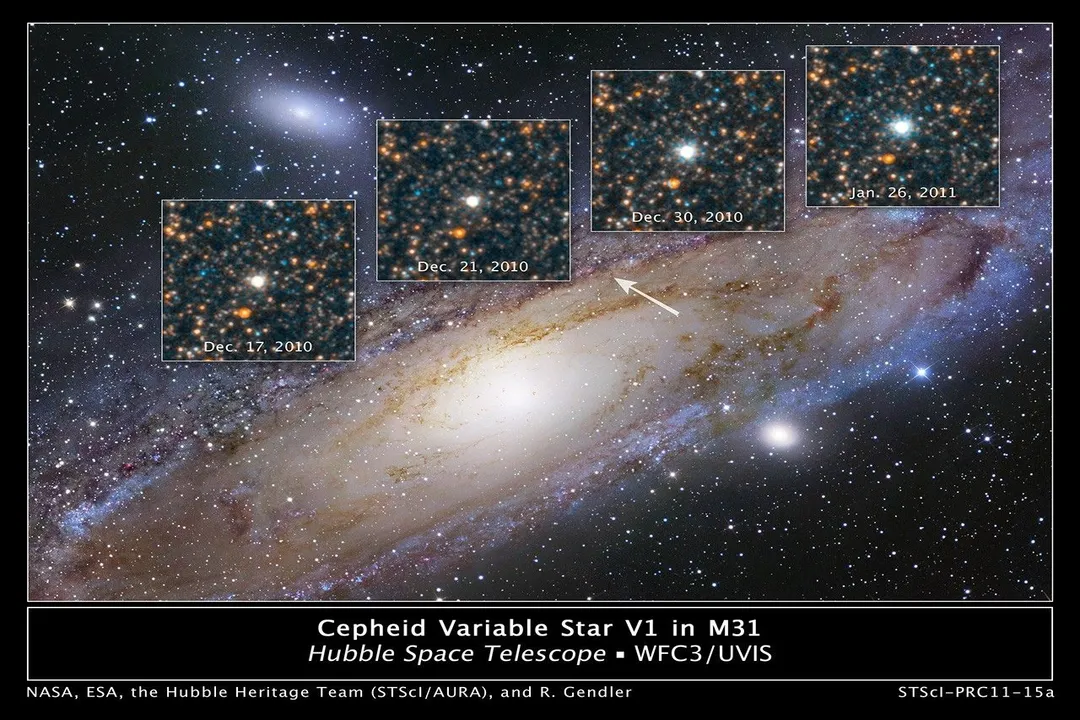
The question of how far away the vast, hazy patch known as the Andromeda Nebula truly was remained one of the most profound cosmological puzzles of the early 20th century. At the time, the prevailing view, often referred to as the "Great Debate," centered on whether this object was a relatively nearby gas cloud within our own Milky Way system or an entirely separate, distant "island universe" composed of billions of stars. [2][4] Edwin Hubble, working at the Mount Wilson Observatory, was the astronomer who finally resolved this by developing a method to precisely gauge its staggering distance, effectively redrawing the boundaries of the known universe. [2][3]
His solution did not come from a single new invention, but rather from the brilliant application of a recently understood stellar phenomenon to an object millions of light-years away. It was a feat of observation requiring unprecedented telescopic power combined with the application of fundamental physics.
# Nebula Status
Before Hubble could measure the distance, he had to prove what Andromeda was. For many astronomers, the "spiral nebulae," including Andromeda (M31), were structures suspended within the confines of the Milky Way. [4] Measuring the distance was essential because if the nebula was close, its apparent brightness indicated it was small; if it was far, its brightness implied it must be enormous—larger than the entire known galaxy. Hubble sought definitive evidence for the latter case. [2]
The breakthrough required finding a specific type of star whose intrinsic brightness was known or could be determined.
# Variable Stars
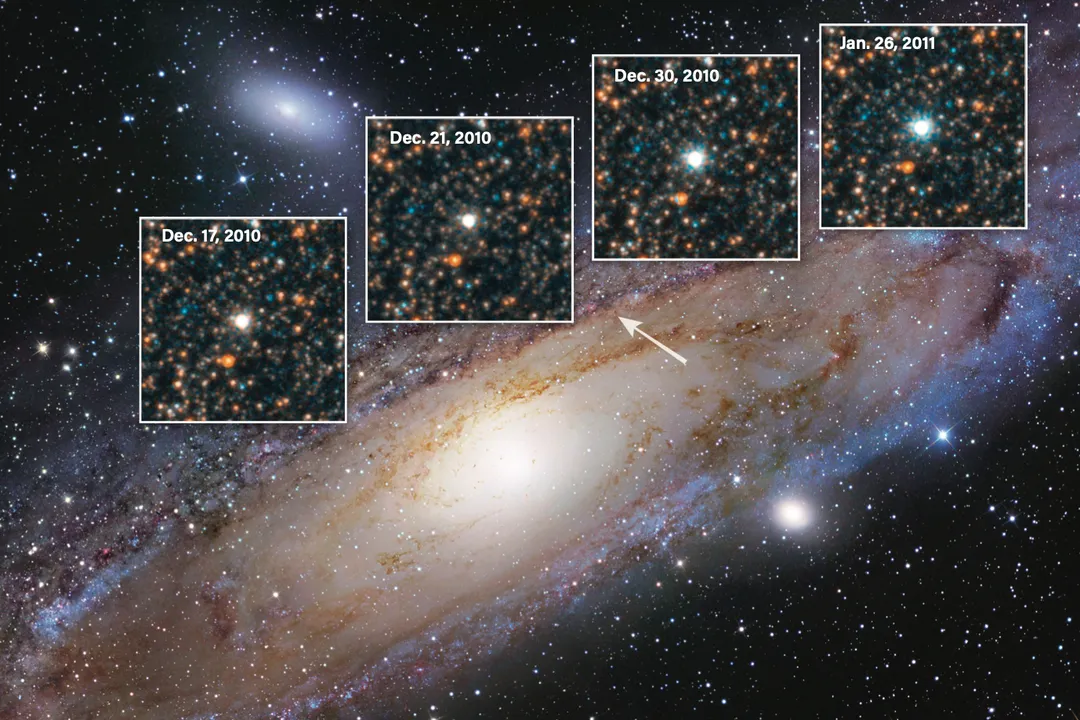
The critical piece of the puzzle came from the work of Henrietta Swan Leavitt, who discovered a crucial relationship among a class of pulsating stars known as Cepheid variables. [2][10] These stars brighten and dim in a regular, predictable cycle. Leavitt found that the period of this pulsation—the time it took to go from bright to dim and back again—was directly related to the star's absolute luminosity (its true, intrinsic brightness). [2][10]
This relationship, known as the period-luminosity relation, provided a cosmic yardstick. [10] If an astronomer could find a Cepheid variable in a distant object, measure its period, and thus determine its true brightness, they could compare this to how dim the star appeared from Earth. The difference between true brightness and apparent brightness allows for a straightforward calculation of distance using the inverse-square law of light. [2]
The challenge, however, lay in finding one of these faint, flickering stars in the distant smudge of Andromeda. [4] It was one thing to find a Cepheid in the Magellanic Clouds, which orbit the Milky Way, but another entirely to isolate one in M31. [10]
The requirement to positively identify one of these specific stars within Andromeda necessitated observation time on the most powerful instrument available at the time: the 100-inch Hooker Telescope at Mount Wilson Observatory. [2][4]
The difficulty of this task cannot be overstated. Imagine trying to spot a single, dim firefly flickering with a distinct rhythm while looking at a distant mountain range through a hazy veil. Hubble had to spend countless hours examining photographic plates, hoping to catch one of Andromeda's potential Cepheids in the act of variation. [7] When he finally succeeded in identifying a star that behaved exactly like a known Cepheid variable, he had essentially found the first "mile marker" placed outside the boundaries of our own galaxy. [4][7]

# Calculation Bridge
Once Hubble confirmed the presence of a Cepheid variable, the measurement process became a systematic, albeit lengthy, set of steps that connected the nearby universe to the far reaches of Andromeda:
- Identify the Star: Confirm the suspected star in the Andromeda Nebula was indeed a genuine Cepheid variable, not a foreground star within the Milky Way. [4][6]
- Measure the Period: Observe the star over many nights, recording the time it took to complete one full cycle of brightening and dimming. This established the period, .
- Determine Absolute Magnitude (): Using Leavitt's established Period-Luminosity relationship, the measured period () allowed Hubble to calculate the star's absolute magnitude (), its true energy output. [2][10]
- Measure Apparent Magnitude (): The telescope provided the apparent magnitude (), which is how bright the star looked from Earth. [2]
- Calculate Distance (): By comparing and , the distance modulus equation could be applied to solve for the distance ().
The comparison between the apparent magnitude () and the absolute magnitude () directly yields the distance. The fundamental equation governing this relationship is:
Where is the distance in parsecs (pc). [2] Solving for provided the distance to that specific Cepheid, and by extension, the distance to the entire Andromeda Nebula in which it resided.
It is a fascinating point of historical context that while Hubble established the method and proved Andromeda was external, the initial results, based on the calibration constants available at the time, placed Andromeda at a distance of about 2 million light-years. [2] Interestingly, modern measurements, benefiting from refined calibrations of the period-luminosity law (thanks to later space-based observations and better understanding of Cepheid physics), place it closer to 2.5 million light-years. [10] This initial discrepancy highlights that even when the technique is sound, the accuracy of the final distance relies entirely on the precision of the cosmic yardstick used for calibration—a yardstick that has been steadily refined since Hubble's first calculation. [4]
# Galactic Distance
Hubble’s final calculation, published in 1925, was revolutionary. His finding that Andromeda was hundreds of thousands of light-years away—far exceeding the estimated diameter of the Milky Way—settled the Great Debate: Andromeda was not a nebula; it was an independent galaxy. [2][4] This realization fundamentally changed the scale of the cosmos. The universe expanded from being one large galaxy populated by dimmer nebulae to a vast expanse filled with countless galaxies. [2][3]
This measurement effort was arguably the single most important piece of observational evidence in 20th-century astronomy because it established the existence of other galaxies, setting the stage for Hubble's later discovery of the expansion of the universe (Hubble's Law). [2]
The key difficulty Hubble faced was not just locating a Cepheid, but recognizing its true nature. Many faint, distant stars might appear to vary slightly due to observational noise or atmospheric effects. Hubble had to be certain the observed variation matched the specific, consistent periodic cycle characteristic of a true Cepheid variable, distinguishing it from intrinsic stellar variability or chance alignments. [6] This required painstaking verification across multiple photographic plates taken over significant spans of time.
The table below summarizes the essential components that transformed a fuzzy patch into a quantifiable island universe:
| Component | Discoverer/Source | Role in Distance Measurement |
|---|---|---|
| Cepheid Variable Star | Observed by Hubble | The object used as the standard candle. |
| Period-Luminosity Relation | Henrietta Leavitt | Established the link between period and true brightness (). |
| 100-inch Telescope | Mount Wilson Observatory | Provided the necessary light-gathering power to resolve the faint star. |
| Distance Modulus Equation | Standard Physics | Used the difference between (observed) and (true) to find distance . [2] |
Hubble’s triumph was not just a single number, but the successful demonstration of the cosmic distance ladder, proving that astronomers could reliably measure distances far outside our immediate stellar neighborhood. The Cepheid variable, once an astronomical curiosity, became the essential rung that allowed humanity to step out of its own galactic confines and begin mapping the true scale of creation. [10]
Related Questions
#Citations
Astronomy Quiz 10 Flashcards - Quizlet
Hubble Determines the Distance to the Andromeda Nebula - EBSCO
How did Edwin Hubble prove Andromeda was a galaxy?
How did Hubble determine that the Cepheid was actually located ...
[FREE] How did Edwin Hubble measure the distance to the ... - Brainly
Edwin Hubble's “VAR!” plate of Andromeda which showed us the ...
[PDF] The Distance to M31 - NOIRLab
Hubble Views the Star that Changed the Universe - NASA Science
How did Hubble determine the distance to the Andromeda Galaxy?