What did Edwin Hubble notice?

The universe, as understood by most scientists at the beginning of the 20th century, was a vast but essentially static place, with our Milky Way galaxy comprising the entirety of observable creation. This perspective was heavily challenged by lingering questions about fuzzy patches of light visible in the night sky—the so-called "spiral nebulae." The central scientific puzzle was whether these nebulae were merely clouds of gas residing within our own stellar neighborhood or, as some speculated, entire stellar systems lying far outside the boundaries of the known cosmos. [7][10] Edwin Hubble, an astronomer working at the Mount Wilson Observatory, was positioned perfectly to settle this debate using the world's most powerful instrument of the time, the 100-inch Hooker Telescope. [4][5]
# Settling the Debate
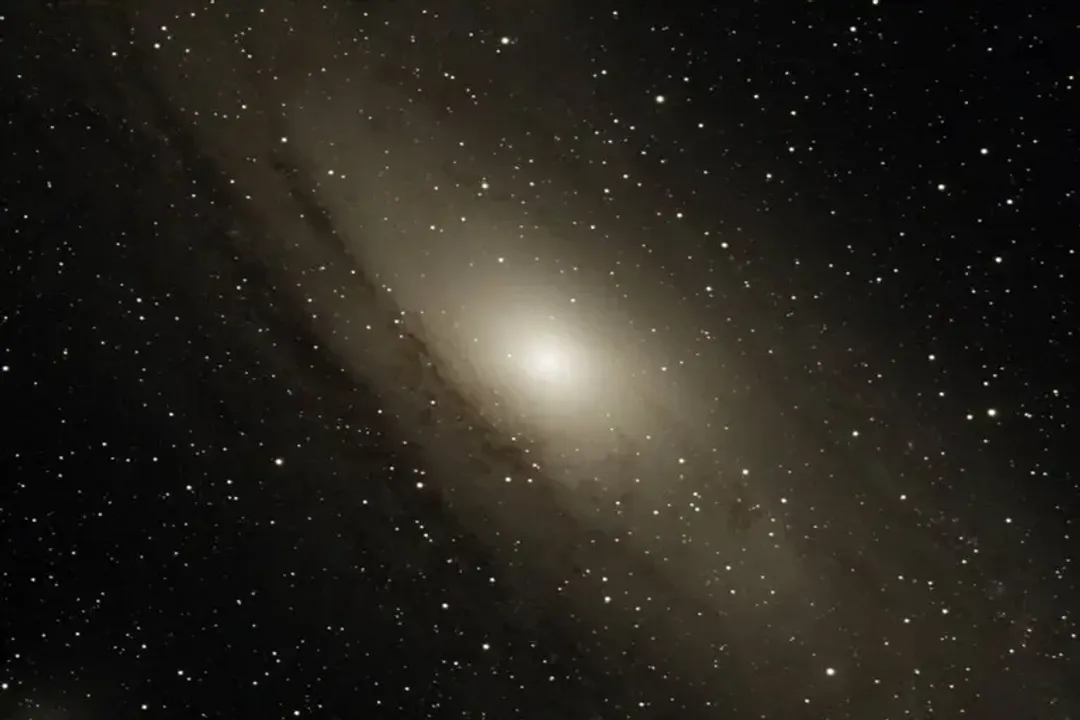
Hubble’s first critical observation centered on confirming the true nature of these spiral structures. It was not enough to just see that they looked different; he needed concrete proof of their immense distance. [5] The key to unlocking this distance lay in a specific type of star: the Cepheid variable. [2][7]
Henrietta Leavitt had previously established a crucial relationship: the period of a Cepheid variable star's pulsation is directly related to its true intrinsic brightness, or luminosity. [2] If an astronomer could find a Cepheid variable in a distant nebula, measure how long it took to brighten and dim, determine its absolute luminosity, and then compare that to how dim it appeared from Earth, they could calculate its distance using the inverse-square law of light. [5][7]
Hubble, with the aid of his assistant Milton Humason, painstakingly searched through photographic plates taken with the massive 100-inch telescope. [7] His target was the Andromeda Nebula (M31). [5] In 1923, he identified a Cepheid variable star within the spiral arms of Andromeda. [6][7] The subsequent measurement of this star’s period confirmed it was millions of light-years away, far beyond the established limits of the Milky Way. [2][5][6] This single, painstaking observation provided the definitive evidence: the spiral nebulae were not clouds in our backyard; they were island universes—other galaxies. [10] This realization fundamentally expanded the scale of reality recognized by humanity. [8] It marked a transition from a philosophical argument about the size of creation to one settled by rigorous, measurable data derived from analyzing a single class of pulsating star.
# Velocity Mapping
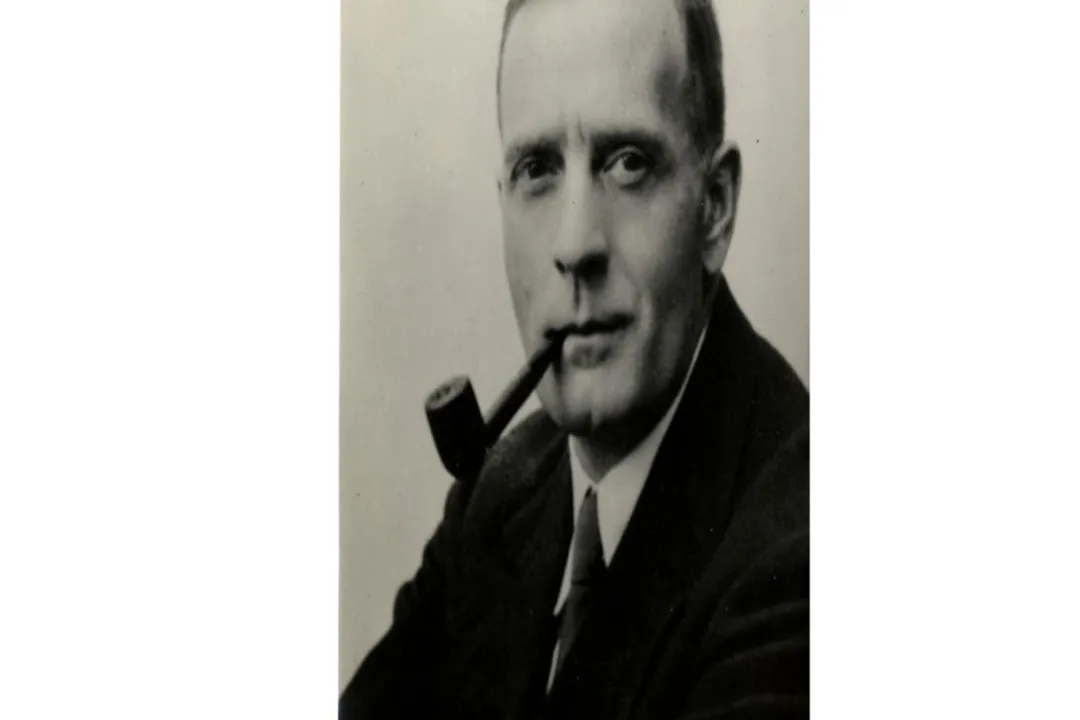
Once Hubble established that these "extragalactic nebulae" were indeed separate systems, his next focus shifted to understanding their behavior. Did they simply drift randomly in space, or was there a larger cosmic motion at play? This investigation required moving beyond measuring distance to measuring motion, specifically the radial velocity—how fast an object is moving toward or away from an observer. [4]
This was achieved through the analysis of spectroscopy. Light from distant objects, when passed through a prism or diffraction grating, spreads into a spectrum, revealing characteristic dark lines (absorption lines) produced by specific elements in the source’s atmosphere. [4] If a light source is moving away from the observer, the entire spectrum appears shifted toward the red end—this is the Doppler effect, resulting in a redshift. [4][6] Conversely, motion toward the observer causes a blueshift.
Hubble and Humason meticulously measured the spectral shifts for dozens of these new galaxies. [4][5] Humason did much of the tedious work of obtaining and analyzing the faint spectra, while Hubble handled the interpretation and distance calculations. [4] They observed a striking pattern: nearly all of the galaxies they measured exhibited a redshift, meaning they were moving away from us. [6]
# The Law Unveiled
The culmination of Hubble’s distance measurements and Humason’s velocity measurements led to the formulation of what is now known as Hubble’s Law. [4][10] Around 1929, Hubble published his findings, demonstrating a direct, linear correlation between a galaxy's distance and its recessional velocity. [5][6] Simply put: the farther away a galaxy is, the faster it is moving away from us. [4]
If we look at the relationships Hubble established, we can visualize the raw data that underpinned this revolutionary concept.
| Galaxy Example | Approximate Distance (Millions of Light-Years) | Recessional Velocity (km/s) |
|---|---|---|
| Andromeda (M31) | ~2.5 | ~-300 (Blueshift/Approaching) |
| Virgo Cluster | ~50 | ~1,000 (Redshift/Receding) |
| Distant Galaxy A | ~100 | ~2,000 (Redshift/Receding) |
| Distant Galaxy B | ~200 | ~4,000 (Redshift/Receding) |
| [4][6] |
Notice the slight anomaly with Andromeda in the table above: while most galaxies receded, Andromeda showed a small blueshift, indicating it is actually moving toward the Milky Way, likely due to local gravitational attraction within our Local Group. [5] However, when looking at galaxies beyond our immediate neighborhood, the systematic recession was undeniable. [6]
The mathematical representation is often given as , where is the recessional velocity, is the distance, and is the Hubble Constant. [4] The value Hubble initially derived for this constant was much lower than modern estimates, largely due to refined measurements of the Cepheids and the distances involved, but the relationship itself was the monumental discovery. [4][5]
It is tempting to imagine this data as a simple graph plotting two variables, but the sheer technical difficulty of obtaining accurate measurements for both distance (requiring identifying rare Cepheids) and velocity (requiring hours of exposure time on the faint light of distant galaxies) makes the consistency of Hubble’s final plot remarkable. The elegant simplicity of the resulting straight line suggested that the entire cosmos was engaged in a coordinated expansion, a notion that challenged centuries of cosmological assumptions about a steady, unmoving universe. [6][10]
# Cosmic Motion
Hubble's discovery of the expansion was not immediately understood as the expansion of space itself. Initially, some thought the galaxies were simply flying apart through space, like shrapnel from an ancient explosion. [6] However, the interpretation that evolved—that the fabric of spacetime itself was stretching, carrying the galaxies along for the ride—is what truly shaped modern cosmology. [6]
If the universe were expanding, it implied a starting point, a moment in time when everything was packed together far more densely. This realization planted the seeds for what would eventually become the Big Bang theory. [6] Hubble’s initial work provided the observational foundation upon which this grand model of cosmic history was built. [5]
It is worth pausing to consider the implications of this systematic recession. If you imagine dots painted on the surface of an inflating balloon, every dot sees every other dot moving away from it, and the farther away a dot is, the faster its recession appears to be, simply because there is more balloon surface expanding between them. [4] Hubble’s observations showed that we are not at the center of this expansion; every observer in every galaxy would see the same Hubble Flow. [4]
# Classification System
While the expanding universe captured the public imagination, Hubble’s contributions to cataloging the cosmos were equally important for the discipline of astronomy. He developed a system to categorize galaxies based on their visual appearance. [2] This scheme, often called the Hubble Sequence or the "Hubble Tuning Fork," provided a classification method that related morphology to potential evolutionary paths, even if the evolutionary aspect has since been refined. [2]
The main categories in this system include:
- Elliptical Galaxies (E): Ranging from nearly spherical (E0) to highly elongated (E7). [2]
- Spiral Galaxies (S): Characterized by a central bulge and distinct spiral arms, which can be tightly wound or loosely wrapped (sometimes further subdivided into barred spirals, SB). [2]
- Lenticular Galaxies (S0): Possessing a disk structure like spirals but lacking prominent spiral arms, often seen as an intermediate stage. [2]
This organizational structure helped astronomers systematically study the distribution and properties of galaxies across the observable universe, moving the field from simple description toward comparative science. [2] Hubble’s 1926 paper laid out this classification, offering an organized map for the newly discovered cosmos. [2]
# Enduring Legacy
Edwin Hubble passed away in 1953. [1] His legacy is cemented not only by the law bearing his name but by fundamentally reshaping our concept of reality. [1][10] Before him, the universe was conceived as vast but fixed; after him, it became dynamic, evolving, and subject to physical laws that govern its creation and future. [6]
His insistence on empirical evidence—measuring the light, counting the pulsations, charting the shifts—allowed him to translate abstract theoretical debates into concrete, mathematical certainties. [5] His work established astronomy as a field where the scale of study stretched across billions of light-years, demanding new observational techniques and deeper theoretical thought. [10] The fact that a major space telescope bears his name today is a testament to how profoundly his observations of distant lights redefined humanity’s place in the grand scheme of existence. [1]
Related Questions
#Citations
Edwin Hubble - NASA Science
Edwin Hubble - Wikipedia
This Month in Physics History | American Physical Society
Hubble Confirms the Expanding Universe | Research Starters
100 years ago this week, Edwin Hubble announced his ... - Reddit
How Astronomers Discovered the Universe Is Expanding - History.com
Case Files: Edwin Hubble | The Franklin Institute
Only 102 years ago, astronomer Edwin Hubble discovered that there ...
Hubble finds proof that the universe is expanding - PBS
Carnegie Science celebrates Edwin Hubble's discovery of the ...