Why is the Hubble constant important to the universe?
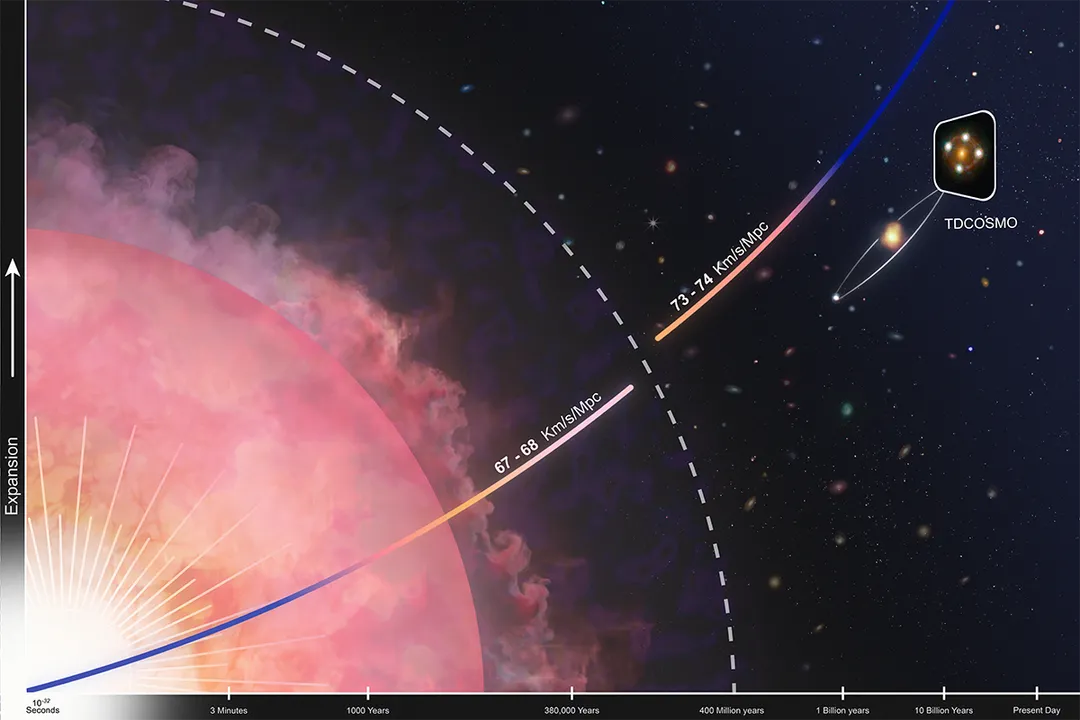
The Hubble constant, often symbolized as , is arguably one of the most fundamental numbers in all of cosmology. It acts as the master key for unlocking the history, scale, and future fate of our cosmos. At its simplest, this constant quantifies how fast the universe is expanding right now. The relationship is mathematically expressed in Hubble's Law, which states that a galaxy's speed of recession from us is directly proportional to its distance: , where is velocity, and is distance.
# Defining Expansion
When we talk about the Hubble constant describing the expansion rate, it's essential to grasp what is not changing. The constant itself is not a true physical constant that remains the same throughout all of cosmic time. Instead, the name describes its behavior at a specific instant. For any observer within a universe that is, on the largest scales, uniform and expanding equally in all directions—the picture described by the Friedmann-Lemaître-Robertson-Walker (FLRW) model—the value of measured today should be the same, regardless of where that observer is located. If the expansion rate is speeding up or slowing down over time, that variation is reflected in the evolution of the Hubble parameter (), but the instantaneous value today is the constant we call .
A higher value for means the universe is expanding more rapidly today than a lower value would suggest. This seemingly simple measurement carries profound implications for our understanding of when everything began.
# Cosmic Scale
The practical importance of extends directly into the realm of measurement. If we know the expansion rate, we can use the observed redshift of distant galaxies—how much their light has been stretched by the expansion of space—to calculate their distance from us. Redshift tells us the velocity (), and if we know , we can solve for distance (). This ability is what allows astronomers to map the three-dimensional structure of the observable universe.
Think of it like tracking traffic on a highway where you know the speed limit changes slightly every hour, but you need to know the current speed limit to estimate how far away a car you see is traveling. In the cosmos, the galaxies are the cars, and is that current speed limit sticker on the signpost of the present moment.
This reliance on makes its precise determination a central goal of astrophysics. Measuring it requires measuring two things very accurately: the recessional velocity, which is relatively easy via redshift spectroscopy, and the actual distance to the object, which is extremely difficult. Distances are typically found using standard candles, objects like Cepheid variable stars or Type Ia supernovae, whose intrinsic brightness is known. By comparing how bright they should be to how bright they appear, we derive their distance.
# Age Size
Perhaps the most compelling reason is significant is its direct link to the age and size of the universe. The Hubble constant is inversely proportional to the age of the universe, assuming a constant expansion rate throughout history (an approximation that holds for a universe dominated only by matter). A faster expansion rate, a higher , implies that the universe took less time to reach its current size, suggesting a younger age.
If we consider a simplified model where the expansion rate was constant, the age would simply be . In reality, the expansion rate has changed over cosmic history due to gravity slowing it down initially and dark energy later accelerating it. However, remains the anchor point for all age calculations within the standard CDM model. Knowing allows us to constrain the total energy content of the universe—the balance between matter, dark matter, and dark energy—which dictates the entire expansion history. If we can nail down , we get a better picture of the cosmic inventory.
To illustrate the sensitivity of the age calculation, consider a hypothetical scenario based on the differing measurements. If the universe were 13.8 billion years old, a specific value would be expected based on the CDM model parameters derived from the early universe. However, when we measure locally using contemporary methods, the resulting age estimate, if we assume the current model holds, tends to create a mismatch that suggests either the model is wrong or the measurement is flawed.
Here is a look at the two primary, widely accepted regimes for measuring :
| Measurement Regime | Typical Value () | Primary Methodologies Used | Implication on Age/Model |
|---|---|---|---|
| Late Universe (Local) | Cepheid Variables, Type Ia Supernovae, Gravitational Lensing | Suggests a faster expansion rate | |
| Early Universe (CMB Prediction) | Cosmic Microwave Background (CMB) analysis within CDM | Sets the standard for the predicted history |
This table highlights the core problem facing modern cosmology. The discrepancy, often cited as being around $9%$, is not negligible when dealing with the fundamental parameters of the entire cosmos.
# The Value Discrepancy
The current cosmological quandary is famously known as the Hubble Tension. This isn't just a slight disagreement; it represents a significant conflict between the value of derived from observations of the early universe and the value derived from observations of the local, late universe.
Observations based on the Cosmic Microwave Background (CMB)—the fossil radiation left over from when the universe was only about 380,000 years old—allow scientists to model the universe's composition and predict what the expansion rate should be today, assuming the standard CDM model is perfectly correct. This prediction consistently lands around .
In contrast, direct measurements focusing on objects within the last few billion years—using techniques anchored by the Hubble Space Telescope and refined by newer instruments—consistently yield a higher value, often near .
The launch and subsequent data from the James Webb Space Telescope (JWST) have only solidified this problem. JWST observations, which provide incredibly precise distance measurements to certain standard candles, have largely confirmed the higher expansion rates found by previous late-time measurements, increasing the confidence in the figure and making the tension more acute. Similarly, observations utilizing different local methods, such as those involving gravitational lensing time delays analyzed by observatories like Keck, also tend to support the higher value, suggesting the issue isn't just one type of measurement being systematically flawed.
When different, independent astrophysical tools—whether it's the old faithful HST, the new powerhouse JWST, or ground-based telescopes scrutinizing light bending—all point to a higher expansion rate for the local universe, the focus shifts from questioning the instruments to questioning the underlying physics that connects the early universe to the present day.
If the early universe physics and the late universe physics are describing the same cosmos, they must agree on the expansion rate history. The tension implies that either there are subtle, unaccounted-for errors in the distance ladder methods, or, more excitingly for theoretical physicists, the standard cosmological model (CDM) is incomplete. This incompleteness might require introducing new physics—perhaps a modification to dark energy or dark matter, or even new particles that existed in the early universe and altered the expansion rate before our current measurements began—to bridge the gap between the CMB prediction and the local measurement.
# Fundamental Implications
The importance of is therefore not just in knowing the scale, but in testing the entire structure of our physics. If the tension persists after years of refinement by new instruments, it serves as a flashing light indicating that our best description of reality might need significant revision.
Consider the impact on the concept of "constants" themselves. The idea that a parameter like the Hubble constant, which defines the current state, is tied inextricably to the physics of the first fraction of a second after the Big Bang is a powerful testament to a unified physical description. However, if the derived from early universe physics (CMB) is not what the late universe physics (supernovae) observes, it suggests a breakdown in the continuity of physical laws over cosmic time that we had not anticipated.
For those studying the early universe, like theoretical cosmologists attempting to model inflation or the very first moments of baryogenesis, the CMB-derived (the lower value) serves as a necessary input parameter to ensure their models correctly predict the observed structure of the early cosmos. For astronomers observing distant supernovae, the local (the higher value) dictates how they interpret the cosmic distance ladder and the acceleration history driven by dark energy.
The ongoing effort to resolve this tension is essentially an attempt to refine our cosmic ruler. If we can reconcile the $67$ and $73$ values—perhaps discovering that the standard candle calibration needs a subtle adjustment based on local environment effects that were previously ignored—then our confidence in the CDM model is cemented. If we cannot reconcile them, it opens the door to entirely new physics, perhaps something that begins to interact with gravity or matter in a way that only manifests in the recent universe, effectively creating a different expansion history than the standard model predicts. The precision of modern instruments, like the JWST, now allows us to check these calculations with an unprecedented level of confidence, turning a historical nuisance into a genuine crisis of standard cosmology.
The value of is thus more than just a number for calculating the size of the observable horizon; it is the diagnostic tool that tells us whether our current scientific model of the universe is perfectly calibrated or fundamentally incomplete.
Related Questions
#Citations
New Hubble Constant Measurement Adds to Mystery of Universe's ...
Astronomers Sharpen the Universe's Expansion Rate, Deepening a ...
Hubble's law - Wikipedia
Why are changes in Hubble constant (expansion rate of the universe ...
The Hubble constant might break our understanding of the universe
The Hubble Constant
If the universe is accelerating in expansion, then why is the Hubble ...
Scaling the universe: Gravitational lenses and the Hubble constant
Webb & Hubble confirm Universe's expansion rate - ESA