Why is the speed of light constant in a vacuum?
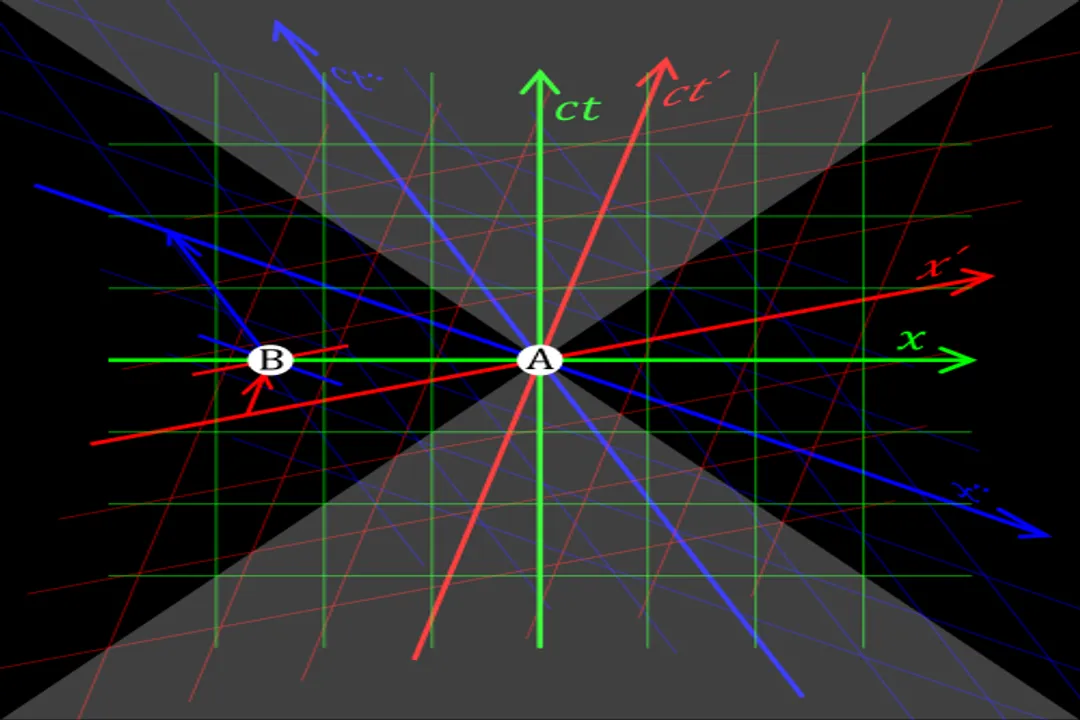
The speed of light in a vacuum, commonly symbolized as , is one of the most peculiar and non-negotiable numbers in all of physics. It sits as a hard ceiling on the universe, a value that observers always agree upon, no matter their own speed or the speed of the light source they are measuring. [1][4][6] If you are standing still, and a car with headlights on zips past you at half the speed of light, you measure its light traveling at . If you were somehow able to fly alongside that car at 99% of , you would still measure the headlight beams moving away from you at exactly . [1][4] This behavior defies simple, everyday intuition, which suggests that velocities should always add up; a ball thrown forward on a moving train goes faster than a ball simply thrown on the ground. [2]
# Field Equations
The initial mathematical framework that pointed toward this strange constancy came not from mechanics, but from electromagnetism in the mid-1800s. [3] James Clerk Maxwell unified the laws describing electricity and magnetism into a set of four core equations. [3][6] When these equations were solved for electromagnetic waves—light being one such wave—they predicted a specific, fixed propagation speed in empty space. [3]
This predicted speed was determined entirely by two fundamental properties of the vacuum itself: the electric permittivity of free space () and the magnetic permeability of free space (). [3][5][6] The relationship is given by the equation . [5][6] What is remarkable here is that the speed of light appears independent of the observer because the factors that define it—the stiffness of electric fields () and the ease of magnetic field formation () in the vacuum—are assumed to be absolute properties of space itself. [3][6] If the permittivity and permeability are the same everywhere and for everyone, then the speed derived from them must also be the same for everyone.
# Ether Search
Before Einstein formalized the theory of Special Relativity, physicists struggled to reconcile Maxwell’s prediction with Newtonian mechanics. The prevailing view suggested that light waves, like water or sound waves, needed a medium through which to travel, which they termed the "luminiferous aether". [6] If the aether existed, then an observer moving through it should measure a different speed of light depending on their direction of motion—faster when moving with the aether "wind," and slower when moving against it. [6]
The famous Michelson-Morley experiment in 1887 was designed specifically to detect this variation. [6] They used an interferometer to split a beam of light, send the two parts down perpendicular paths, and then recombine them, expecting to see an interference pattern shift as the Earth orbited the Sun and moved through the supposed aether. [6] The result was consistently null; no shift was detected. The speed of light appeared the same in all directions, regardless of the Earth's movement. [6] This failure to find the aether provided strong experimental evidence that the speed of light was not relative to a background medium, but absolute in a different sense.

# Spacetime Fabric
The true conceptual leap came with Albert Einstein's Special Relativity in 1905. [6] Rather than trying to force light into a classical framework by inventing an invisible medium, Einstein took the constancy of as a postulate—a starting assumption based on the experimental evidence gathered, such as the Michelson-Morley results. [6] His theory is built on two main principles: the laws of physics are the same for all inertial (non-accelerating) observers, and the speed of light in a vacuum is the same for all inertial observers. [6]
The profound consequence of accepting as invariant is that space and time must be flexible to accommodate it. [2] If you and a friend are moving relative to each other, you must disagree on measurements of length and time intervals (time dilation and length contraction) such that when you calculate the speed of the same light beam, you both arrive at . [2][6] The constancy of isn't just about light; it defines the geometry of spacetime itself. [2] It is the fixed conversion factor between spatial measurements and temporal measurements. [5]
To put this into context, consider the difference between how we traditionally add velocities and how physics demands we calculate speeds near . If you are moving at and fire a projectile forward at , classical physics says the projectile moves at relative to a stationary observer. Relativistically, the true velocity is calculated using the relativistic velocity addition formula, which ensures the result is never greater than . [2] The light signal, however, always requires the result to be precisely , irrespective of the starting speed of the source or the observer.
If we were to try and describe this concept using classical thinking, we might imagine that the only way for two observers moving at different constant velocities to agree on a measurement is if the measurement itself isn't measuring something moving through space, but measuring the fundamental structure of space and time. When we measure , we are measuring a property of the arena in which all events occur, not just the speed of a specific particle. [2]
# Vacuum Properties
Returning to Maxwell's prediction, the fact that is defined by and suggests that these properties of the vacuum are inextricably linked. [3] If you imagine the vacuum as something possessing a certain "resistance" to electric fields () and a certain "tendency" to support magnetic fields (), then the ratio of these two resistances dictates the speed at which their mutual influence—light—propagates. [3]
It’s interesting to consider the extreme sensitivity this implies. If, hypothetically, the vacuum's permittivity were somehow slightly higher in one region of space, while remained constant, the calculated speed of light in that region would necessarily be lower. This means that the constancy of is equivalent to the statement that the electrical and magnetic properties of empty space are fundamentally uniform throughout the cosmos.
This uniformity is what leads to the understanding that light itself is not required to move at in the sense that a car moves on a road; rather, is the intrinsic speed limit imposed by the constants governing the vacuum's response to electromagnetic disturbances. Because is a finite, invariant speed, it also represents the speed at which all massless particles must travel, whether they are photons or, theoretically, gravitons. [6] Any particle that has mass must travel slower than , as accelerating it to would require infinite energy, another consequence rooted in Special Relativity. [6]
# Measurement Context
While the speed of light in a vacuum is constant, it is important to remember that light slows down when it travels through a material medium, like glass, water, or air. [5] When light enters water, for example, it interacts with the electrons in the atoms of the water, causing it to be absorbed and re-emitted many times, resulting in a slower effective speed. [5] This reduction in speed is why lenses work, but this phenomenon does not contradict the constancy of in a vacuum, as the underlying electromagnetic constants ( and ) have changed due to the presence of matter. [5]
This difference between the speed in a medium and the speed in a vacuum is a critical distinction for applied physics. For instance, when designing high-speed fiber optics, engineers must account for the refractive index of the core material, which is precisely the factor by which the speed of light is reduced below . [5] If we know the refractive index () of the material, the speed of light within it () is simply . [5]
The unwavering nature of places profound limitations on causality. Because nothing can travel faster than light, an event happening at one point in space cannot instantaneously affect another distant point. The maximum speed of information transfer is strictly enforced by , preserving the cause-and-effect structure of reality. [6]
For an observer, the measurement of is performed using established standards for length (the meter) and time (the second). Since the 1980s, the definition of the meter has actually been derived from the speed of light, rather than the other way around. The meter is now defined as the distance light travels in a vacuum in of a second. [6] This means that the speed of light is no longer merely a value we measure; it is a definition upon which our unit of length is based, fixing its value exactly at $299,792,458$ meters per second. [6] This final step in metrology solidifies its status as an absolute constant of nature, woven into the very definition of how we quantify distance.
#Videos
I finally understood why speed of light is a constant! (My mind is blown)
Related Questions
#Citations
Why is the speed of light in vacuum constant? [duplicate]
What makes the speed of light constant? : r/AskPhysics - Reddit
Is The Speed of Light Constant?
I finally understood why speed of light is a constant! (My mind is blown)
Speed of light - Wikipedia
Is The Speed of Light Everywhere the Same? - UCR Math Department
Why the Speed of Light (c) Keeps Constant? - Scirp.org.
Why does the speed of light remain constant at c (in vacuums ...
Why is the speed of light constant? - BBC Science Focus Magazine
Why Constant Speed of Light | Physics Van - University of Illinois