What aspects of reality must be flexible to accommodate the constant speed of light ($c$) for all inertial observers?
Answer
Space and time measurements (length and time intervals)
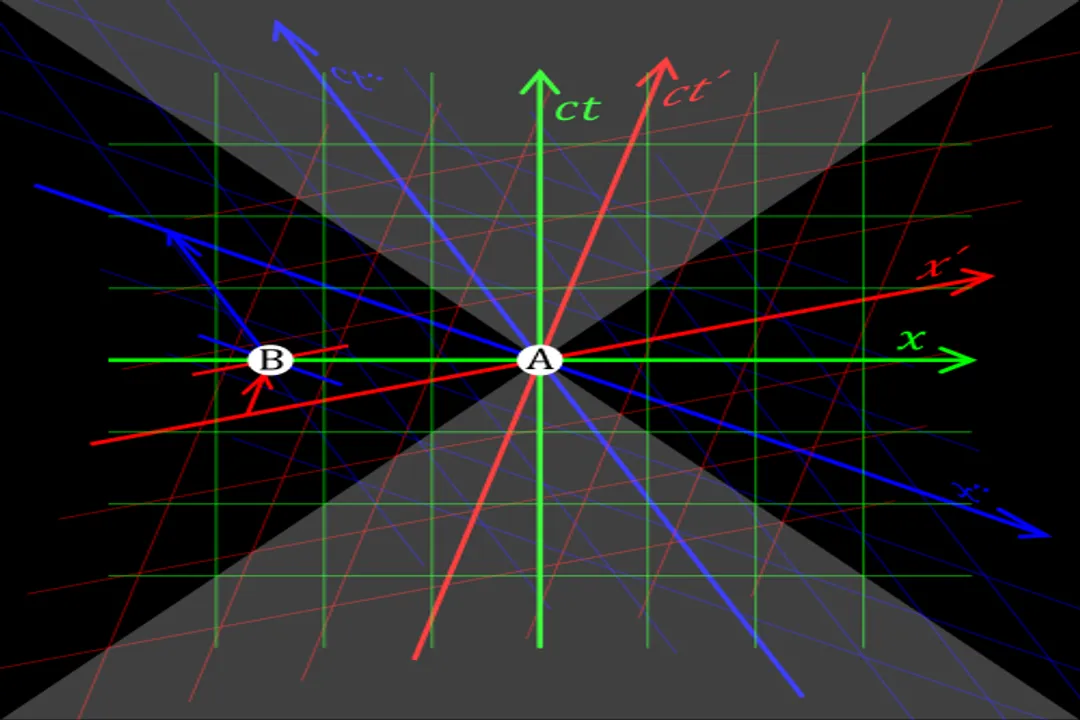
The profound consequence of accepting $c$ as invariant is that space and time must adjust (through phenomena like time dilation and length contraction) so that every observer calculates the speed of light to be exactly $c$.
#Videos
I finally understood why speed of light is a constant! (My mind is blown)
Related Questions
What speed is always measured for light in a vacuum, regardless of the observer's speed?What two fundamental properties of the vacuum define the speed of light according to Maxwell's equation?What was the specific instrument used in the Michelson-Morley experiment to detect movement through the hypothetical aether?What was the key experimental finding of the Michelson-Morley experiment?According to Einstein's Special Relativity, what did he take as a fundamental starting assumption?What aspects of reality must be flexible to accommodate the constant speed of light ($c$) for all inertial observers?What must travel at the speed $c$ in a vacuum, according to the text?If light travels through a material medium, how is its speed ($v$) related to the vacuum speed ($c$) and the material's refractive index ($n$)?How is the definition of the meter currently established in relation to the speed of light?What crucial concept in reality is strictly enforced because nothing can travel faster than the speed of light in a vacuum?