How is the definition of the meter currently established in relation to the speed of light?
Answer
The distance light travels in a vacuum in $1/299,792,458$ of a second
Since the 1980s, the meter has been defined based on the speed of light; it is the distance light covers in $1/299,792,458$ of a second, effectively fixing $c$ at exactly $299,792,458$ meters per second.
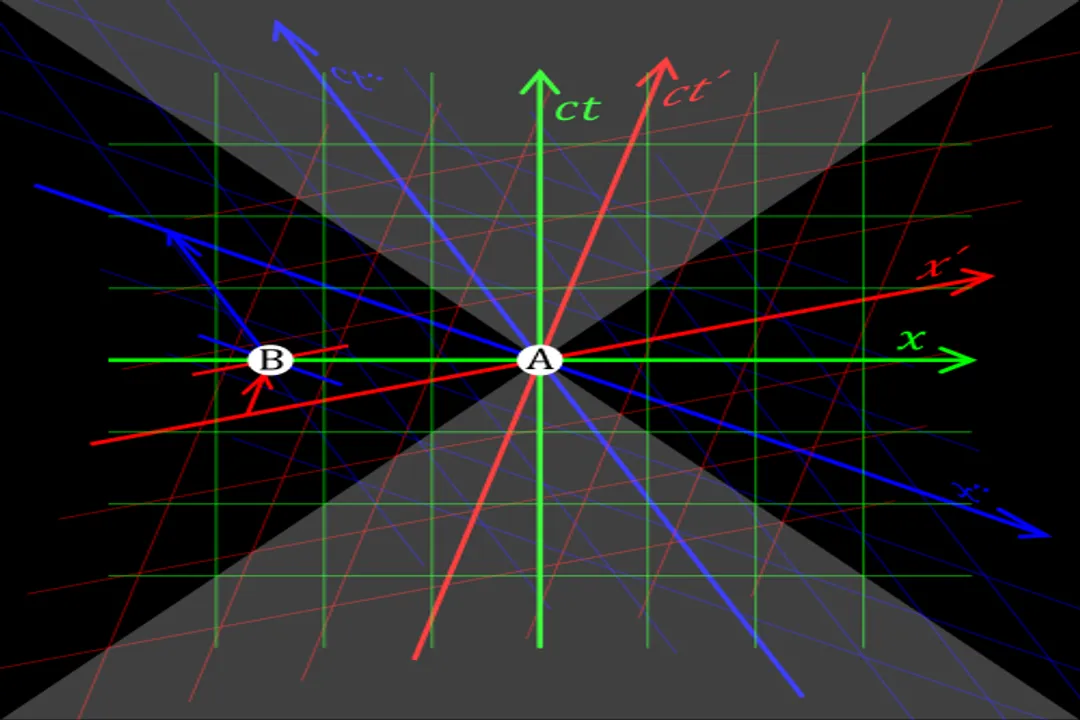
#Videos
I finally understood why speed of light is a constant! (My mind is blown)
Related Questions
What speed is always measured for light in a vacuum, regardless of the observer's speed?What two fundamental properties of the vacuum define the speed of light according to Maxwell's equation?What was the specific instrument used in the Michelson-Morley experiment to detect movement through the hypothetical aether?What was the key experimental finding of the Michelson-Morley experiment?According to Einstein's Special Relativity, what did he take as a fundamental starting assumption?What aspects of reality must be flexible to accommodate the constant speed of light ($c$) for all inertial observers?What must travel at the speed $c$ in a vacuum, according to the text?If light travels through a material medium, how is its speed ($v$) related to the vacuum speed ($c$) and the material's refractive index ($n$)?How is the definition of the meter currently established in relation to the speed of light?What crucial concept in reality is strictly enforced because nothing can travel faster than the speed of light in a vacuum?