What is the light of a star?
The light that reaches our eyes from the distant pinpricks in the night sky is the end product of immense physical processes occurring in cosmic furnaces billions of years ago. Starlight, simply put, is the electromagnetic radiation emitted by stars. While we often think of sunlight as distinct, sunlight is simply the term used for our Sun's starlight observed during the day. At night, that faint glow from other suns travels across the vacuum, sometimes for eons, only to finally interact with our retinas.
# Star Makeup
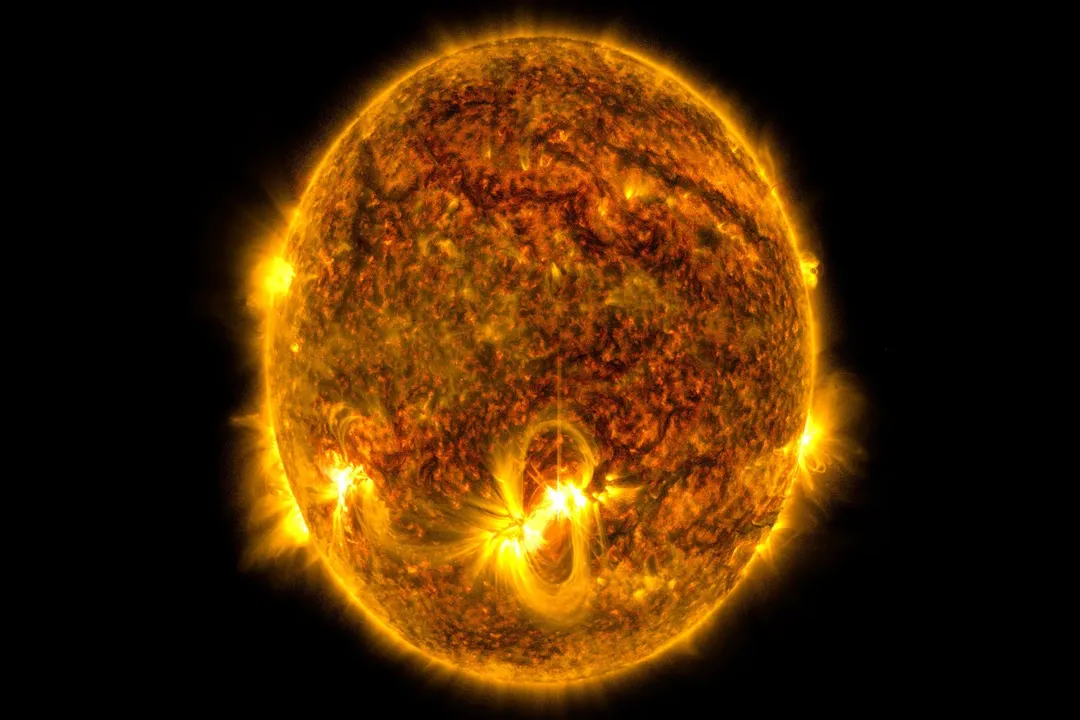
To understand the light, we must first grasp what produces it. A star is fundamentally a colossal sphere composed of extremely hot, glowing gas, often referred to as plasma. The primary ingredients are almost always hydrogen and helium, with only trace amounts of other elements mixed in. Gravity is the sculptor here, holding this massive ball of gas together and continuously compressing its interior.
This intense gravitational squeeze is the key to unlocking the light. As the star contracts, friction in the core causes the temperature to skyrocket. When the core temperature hits a critical threshold—around 15 million Kelvin—the necessary conditions are met for nuclear fusion to commence.
# Fusion Power
Nuclear fusion is the process where lighter elements are forced together to form heavier ones, and it is what allows stars to create their own light and energy. Specifically, in stars like our Sun, multiple stages of reaction crush hydrogen nuclei together to synthesize helium. This conversion is exothermic, meaning it releases far more energy than is consumed in the reaction. For instance, a star the size of our Sun is expending energy at a rate equivalent to joules of gamma radiation every second.
The mechanism that generates this illumination is rooted in fundamental physics involving charged particles. Every charged particle, such as a proton or electron within the star, is surrounded by an electric field that extends outward. When these particles are forced to change state during fusion—a phenomenon governed by quantum mechanics—they are effectively shaken. A disturbance in the electric and magnetic fields that pervade space is light. In the high-energy core environment, the immediate product of fusion is often ultra-high-frequency light known as gamma rays.
# Photon Travel
This high-energy light does not escape immediately. Instead, the photons generated deep within the stellar core are initially trapped. They begin a protracted, staggering journey outward through the star's interior, passing through layers like the radiative and convective zones. During this transit, a photon is continuously absorbed by an atom and then re-emitted. Each absorption-re-emission cycle causes the photon to lose a bit of its initial energy. This chaotic, multi-step path can take well over a hundred thousand years for a photon to escape the Sun's interior.
By the time these energetic ripples finally reach the star's surface, they have shed so much energy that their wavelength has shifted dramatically, often down to the visible part of the electromagnetic spectrum. Once free, these newly visible photons shoot across the vacuum of space in a straight line. When you look up at the night sky, your eye is often intercepting photons that have been traveling uninterrupted for hundreds or even thousands of years since leaving their stellar source.
Consider the incredible energy budget required to sustain this process over cosmic timescales. The more massive a star is, the more intensely it must fuse its fuel to counteract the crushing force of its own gravity, leading to a much shorter, brighter existence. Lower-mass stars, however, sip their hydrogen fuel more slowly and can maintain stable fusion, classifying them as main sequence stars for billions or even trillions of years. The variation in mass dictates a star's entire lifetime and its resultant light: the less massive stars tend to be dimmer and redder, while the more massive ones blaze blue and die young. This difference in fuel consumption speed highlights an interesting dynamic: a star like our Sun has a predictable, long-term energy output, whereas a hyper-massive star burns through its core fuel in mere millions of years before its death stages begin. This suggests that the light from a blue giant represents a frantic, temporary expenditure of mass-energy, whereas the light from a red dwarf is the patient glow of a cosmic marathon runner.
# What We See
The light we observe is a combination of the star’s temperature and the intervening space. The average color of all starlight across the observable universe has been measured and even given a name: Cosmic Latte.
The color of an individual star, however, tells us directly about its surface temperature, which reflects the average rate of motion of the particles inside. Stars that are cool have surface temperatures around and appear red. Conversely, the hottest stars can reach temperatures near and shine white.
# Stellar Spectra
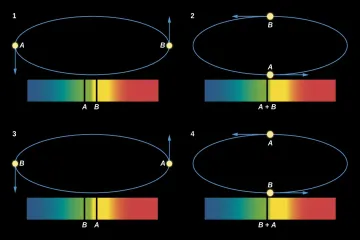
The detailed analysis of starlight involves spectroscopy, the practice of splitting the light into its component colors to study its makeup. When charged particles within a star are agitated, the light they produce has a color corresponding to the frequency of that agitation. When electrons in the cooler outer atmosphere of a star are confined within an atom, they can only absorb or emit very specific, discrete colors of light. These discrete sets of colors are known as line spectra. By identifying these specific absorption lines, astronomers can determine precisely which elements are present in the star, much like a chemical fingerprint. For example, studies of line spectra indicate that elements like iron are more common in stars closer to the Milky Way's center, suggesting different elemental enrichment histories across the galaxy.
# Appearance and Distance
A common question arises when looking up: why do we see individual points of light instead of one uniform, bright haze, given the incredible volume of photons emitted by stars across the universe? This relates to the famed Olbers Paradox, which posits that if the universe were infinite and uniform, the night sky should be completely bright.
The resolution involves two main factors. First, the universe is expanding, which shifts the light from extremely distant stars into longer wavelengths, often beyond what the human eye can detect. Second, the light we do see from relatively nearby stars remains undiffused because the space between us and them is largely empty. On average, there is only about one hydrogen atom per cubic meter in the vast gulf between stars, meaning there is very little interstellar gas or dust to scatter or block the light. If starlight travels a very long distance, the light from some stars is diffused by interstellar matter, but the photons from closer sources arrive intact, allowing our eyes to resolve them as distinct points.
# Light Beyond Fusion
While nuclear fusion powers the stars we see most often, it is not the sole mechanism for starlight production across the cosmos. When a star exhausts its core hydrogen fuel and begins to die, the fusion pressure stops balancing gravity, causing the core to collapse.
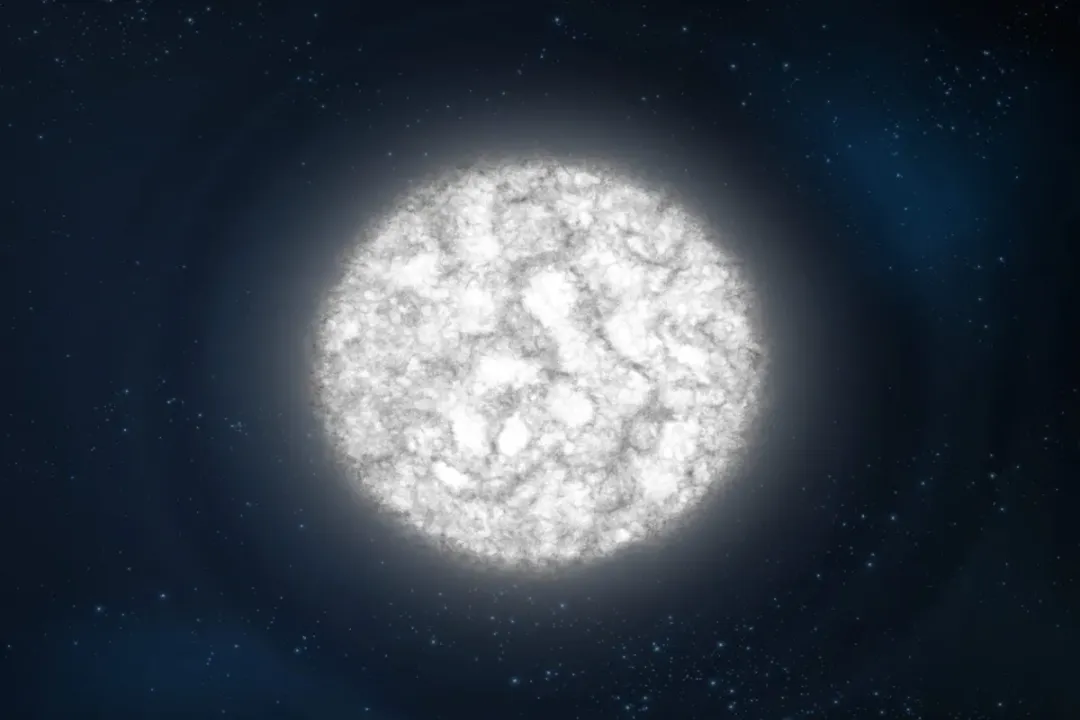
For low-mass stars, like the Sun, the end stage involves puffing up into a giant, ejecting outer layers to form a planetary nebula, leaving behind a white dwarf—a cooling stellar cinder. White dwarfs and neutron stars are no longer generating new energy via fusion. Their light output is simply the residual kinetic energy, or heat, stored up from their active lifetimes. They continue to shine for billions of years as their charged particles slowly jostle, creating faint electromagnetic ripples until the stored heat finally dissipates.
Massive stars meet a more dramatic end, fusing heavier elements until their core turns to iron, a process that stops releasing energy and triggers a collapse and rebound explosion called a supernova. The dense core left behind becomes a neutron star or a black hole.
Black holes, paradoxically, also emit light. This light originates not from the black hole itself, but from the material approaching it. Gas, dust, or stars that fall toward a black hole form a swirling mass known as an accretion disc. The particles in this disc smash into one another with such violence that their constituent charges shake intensely, heating the disc to extremes that cause it to shine brightly, often in X-ray light.
Another class, the brown dwarfs, offers a dim reminder of pre-nuclear physics. These "underwhelming" objects are not massive enough to ignite sustained hydrogen fusion. Their meager glow, mostly in the infrared, comes from the heat generated by the very process Lord Kelvin once suggested for the Sun: the slow, inexorable gravitational compression as they shrink.
# Light's Properties
The light that reaches us carries more information than just brightness and color. Starlight has been observed to exhibit polarization. This occurs when the light passes through elongated interstellar dust grains that are aligned by the galaxy’s magnetic field. As the light travels, the component polarized parallel to the dust grain's alignment is transmitted more effectively, leaving the resulting starlight partially linearly polarized. Measuring this polarization allows astronomers a method to map the structure of the galactic magnetic field itself.
Furthermore, our interaction with this ancient light has driven technological and cultural advances. For instance, in the 1950s, the U.S. Army developed passive starlight scopes that could amplify this faint illumination, along with moonlight and other natural light sources, by as much as fifty thousand times, enabling vision in darkness without emitting active signals. This reliance on photons as a source of information, whether for military application or scientific measurement, underscores the profound nature of stellar emission.
# Observing the Faintest Signals
The ability to accurately measure the apparent brightness of stars has defined observational astronomy for millennia. Early astronomers like Hipparchus categorized stars into visual brightness categories called magnitudes, ranging from first-magnitude (brightest) to sixth-magnitude (faintest visible). Today, this is quantified through techniques like photometry. The diversity of light we measure is also why we have classifications like blue stragglers—stars in established clusters that appear unexpectedly hotter than expected based on their age, often suggesting they have recently merged or stolen mass from a companion star, radically altering their fuel supply and color.
In essence, the light of a star is not a simple steady beam. It is a complex record, forged in the ultra-hot, dense core of a celestial body through nuclear violence, then filtered, attenuated, and colored during a lengthy escape that can span epochs, finally arriving at Earth as a measurable electromagnetic whisper carrying data about its birthplace, composition, and age.

#Videos
How Do Stars Produce Light? - Physics Frontier - YouTube
Related Questions
#Citations
Starlight - Wikipedia
What is the Light From Stars? - Universe Today
Why Do Stars Look Like Points of Light Rather than a Uniform Haze ...
What is a star? - Cool Cosmos - Caltech
Video: What Causes a Star to Shine Brightly? - Study.com
Star Basics - NASA Science
How Do Stars Produce Light? - Physics Frontier - YouTube
How do stars shine? | BBC Sky at Night Magazine