How does a star generate heat?
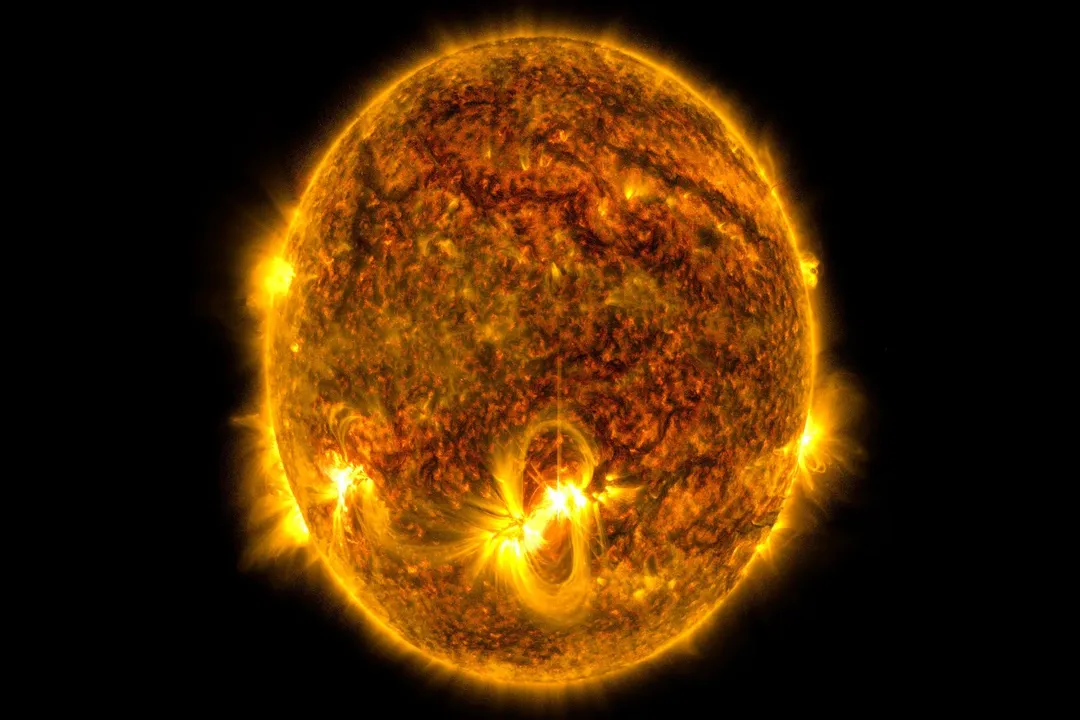
The incredible radiance pouring from the night sky is a direct measure of the colossal engine operating deep within a star’s core. For millennia, this steady output of heat and light was a profound mystery, but modern astrophysics confirms that what makes a star shine is not combustion, as we understand it on Earth, but a far more powerful, fundamental reaction locked within the atomic structure of matter itself. Before a star settles into its long, stable life, however, it has to get hot enough to start this process, a critical prerequisite established entirely by its own immense bulk.
# Gravitational Collapse
Long before the nuclear fires ignite, a star is born from the collapse of vast, cold clouds of interstellar gas and dust, known as molecular clouds. [4] These clouds can span hundreds of light-years and contain enough material to form thousands of stars. [4] Initially, these regions are cold, which allows gas to clump together, increasing density in localized pockets. [4] As these pockets gain mass, their gravitational force strengthens, compelling surrounding material inward. [4] This initial crunching of matter is the very first, entirely mechanical source of heat.
Imagine a giant, diffuse cloud of gas being squeezed relentlessly inward by its own gravity. As the particles fall closer together, they collide more frequently and with greater speed. [3] This increase in the speed and agitation of the constituent particles is directly translated into an increase in temperature—an essential link between the macroscopic force of gravity and the microscopic property of heat. [2][3] In essence, the gravitational potential energy stored in the widely distributed mass is converted into the kinetic energy of the gas particles. [3]
The heat generated during this phase turns the collapsing mass into a protostar—a baby star that shines, but not yet through fusion. [4] This early heating is significant; for instance, the intense heat generated from the formation process alone is so substantial that Jupiter, which failed to accumulate enough mass to become a star, still radiates energy at four times the rate it receives from the Sun, purely from the residual energy of its own gravitational collapse. [3] This initial phase demonstrates a fascinating property related to the Virial Theorem: as the gas cloud loses energy through radiation, it paradoxically becomes hotter because the internal kinetic energy () and gravitational potential energy () are linked such that for a bound object. [2] Therefore, removing total energy () forces a reduction in potential energy (, making it more negative) which requires an increase in kinetic energy (), thus raising the temperature. [2] This heating and subsequent increase in outward gas pressure is what eventually fights back against gravity, slowing, though not immediately stopping, the inward collapse. [3]
# Core Ignition
The gravitational compression continues until the stellar core reaches a staggering critical threshold. For a star to transition from a hot, collapsing body to a true, shining star, the temperature and pressure in the center must become extreme enough to overcome the natural electrostatic repulsion between atomic nuclei. [5] These nuclei, positively charged, naturally want to push each other away. Overcoming this Coulomb barrier requires incredible kinetic energy—which means an extreme temperature—allowing the strong nuclear force to take over at close range. [5]
For a star like our Sun, this threshold is estimated to be around Kelvin (). [5] Only when this temperature is achieved does the continuous, self-sustaining energy production mechanism—nuclear fusion—switch on, replacing the heat generated solely by contraction. [2]
# Nuclear Engine
Once the core is hot and dense enough, hydrogen nuclei (protons) begin fusing together to form helium nuclei. This process, called hydrogen burning or stellar nucleosynthesis, is the sustained heat source for the majority of a star's life. [5][6] The energy released from this reaction is what keeps the star luminous and prevents it from collapsing entirely under the unrelenting pressure of its own gravity. [4][6]
It is vital to distinguish between the chemical burning of hydrogen (like in a fire) and nuclear fusion. When four protons combine to form one helium-4 nucleus, the resulting helium atom has slightly less mass than the initial four protons combined. [5] This missing mass has not vanished; it has been converted directly into a tremendous amount of energy according to Einstein's famous relation, . [6] This energy is initially released as kinetic energy of the resulting particles and as electromagnetic radiation, the light and heat we observe across the cosmos. [5]
There are two primary ways stars execute this hydrogen fusion, determined largely by the star’s initial mass and corresponding core temperature: [5]
The Proton-Proton (PP) Chain: This is the dominant energy producer in stars up to about the Sun's mass. [5] It involves a sequence of steps starting with the fusion of two protons to form deuterium (a heavy hydrogen isotope), ejecting a positron and a neutrino. [5] The Sun's core operates at about , where the PP chain is most efficient. [5] This reaction rate is relatively insensitive to temperature—a $10%$ temperature rise yields only about a $46%$ increase in energy output. [5]
The Carbon-Nitrogen-Oxygen (CNO) Cycle: In stars significantly more massive than the Sun (those exceeding about $1.3$ times the Sun's mass), the core temperature is high enough (above roughly ) to favor the CNO cycle. [5] This process is catalytic, meaning carbon, nitrogen, and oxygen nuclei are used as intermediaries to fuse hydrogen into helium, but they are regenerated at the end of the cycle. [5] The CNO cycle is drastically more sensitive to temperature, with the reaction rate increasing by a factor of about $350%$ for a mere $10%$ temperature rise. [5] This extreme sensitivity means that in massive stars, the energy generation is highly concentrated in the very innermost core region. [5]
The Sun itself generates about $99%$ of its energy via the PP chain, with the CNO cycle contributing only around $1%$. [5] Understanding this dependency is critical; the Sun's specific temperature dictates which reaction dominates its energy budget. [5]
# Sustaining the Star
A star's entire existence is defined by a precarious, continuous balancing act known as hydrostatic equilibrium. [4][6] This state is achieved when the colossal, inward crushing force of gravity is perfectly matched by the enormous, outward thermal and radiation pressure generated by the core's nuclear fusion. [2][4][6]
If fusion suddenly slowed, the outward pressure would drop, gravity would win the local tug-of-war, and the star's core would compress, causing it to heat up again—which ironically would accelerate the fusion rate back towards equilibrium. [2] Conversely, if fusion accelerated beyond the required rate, the resulting extreme pressure would cause the star to expand slightly, cooling the core and slowing the reaction back down. [2] This inherent feedback mechanism allows a star to maintain a near-constant temperature and size for billions of years while it consumes its primary fuel.
To put this sustained energy output into perspective, consider the sheer scale. If we look at our Sun, it converts about 600 million tons of hydrogen into helium every single second. [6] While this sounds like an unimaginable quantity, the Sun's fuel supply is so vast—a reservoir of hydrogen stretching across its entire main sequence lifetime—that this rate allows it to shine steadily for billions of years, roughly midway through its expected lifespan now. [4] Lower-mass stars are more frugal; they burn their fuel dimmer and cooler, allowing them to shine for trillions of years, far longer than the current age of the universe. [4]
When we compare the energy density, it’s startling. A standard stellar core operating via the PP chain might generate an energy density equivalent to a weak campfire, yet because that energy is produced across a volume millions of times larger than our entire planet and over timescales of eons, the result is a permanent, massive furnace. [6] The star is essentially an enormous, naturally occurring, self-regulating hydrogen reactor. [6]
# Advanced Burning Stages
The heat generation mechanism doesn't stop when the core runs out of the most abundant fuel, hydrogen. While hydrogen fusion into helium is the longest phase, stars must evolve to continue producing the pressure needed to counteract gravity. [5] As the hydrogen in the core is exhausted, the core begins to contract again under gravity, causing the temperature to rise until it becomes hot enough to ignite the next fuel source: helium. [4][5]
For Sun-like stars, this is the red giant phase, where helium fusion (the triple-alpha process) begins, turning helium nuclei into carbon, and subsequently oxygen. [4][5] In the most massive stars, the process accelerates violently. Gravity drives the core hotter and hotter, forcing sequential ignition of heavier elements: carbon, then neon, oxygen, and silicon. [5] Each subsequent fusion stage produces less energy and buys the star less time; this entire sequence, from hydrogen exhaustion to iron formation, can occur in just a few million years in a massive star. [4] The final stage of this process, silicon fusing into iron, happens in a matter of days, because iron fusion consumes energy rather than releasing it, instantly removing the outward pressure and leading to catastrophic collapse—the supernova explosion. [4]
# Element Creation
The heat generated through these successive fusion reactions is directly responsible for forging the elements of the periodic table. The Big Bang created nearly all the hydrogen, helium, and a tiny amount of lithium in the cosmos; everything else—the carbon in our bodies, the oxygen we breathe, the iron in our blood—was manufactured inside stars through these high-temperature nuclear processes. [6] Stellar nucleosynthesis is the universe’s primary factory for creating elements heavier than iron, forged during the final, explosive moments of massive stars known as supernova nucleosynthesis. [5] Thus, the heat that warms a planet today is the residual energy from atoms that were once forged in the extreme thermal conditions of a long-dead star's core. [4][5]
The process is dictated entirely by temperature. A star’s mass sets its core temperature ceiling; only the most massive objects can generate the heat necessary to initiate the fusion chains that lead to elements like iron. [4] This fundamental relationship between mass, core temperature, and resulting energy output explains the diversity we see across the galaxy, from dim, long-lived red dwarfs to brilliant, short-lived supergiants.
#Videos
Nuclear Fusion - How Stars Generate Energy - YouTube
Related Questions
#Citations
Star Basics - NASA Science
Stellar nucleosynthesis - Wikipedia
ELI5: In the formation of a star, how does the heat generated during ...
How do stars create and release their energy? - Astronomy Magazine
What Makes Stars Hot? - Astronomy Stack Exchange
Nuclear Fusion - How Stars Generate Energy - YouTube