What does the evolution of a star depend on?
The entire life story of a star, from its birth in a cold cloud of gas to its eventual dramatic end, is written into its very being at the moment of conception. What dictates this grand cosmic evolution is almost entirely one factor: the star's initial mass. While the initial chemical composition, or metallicity, plays a secondary role in the finer details of timing and reaction rates, the mass locks the star onto one of a few distinct evolutionary tracks. A star with significantly less mass than our Sun will experience a slow, quiet retirement, whereas a star born with perhaps fifty times the Sun’s mass will live fast and die in a spectacular explosion, leaving behind exotic remnants.
# Initial Mass
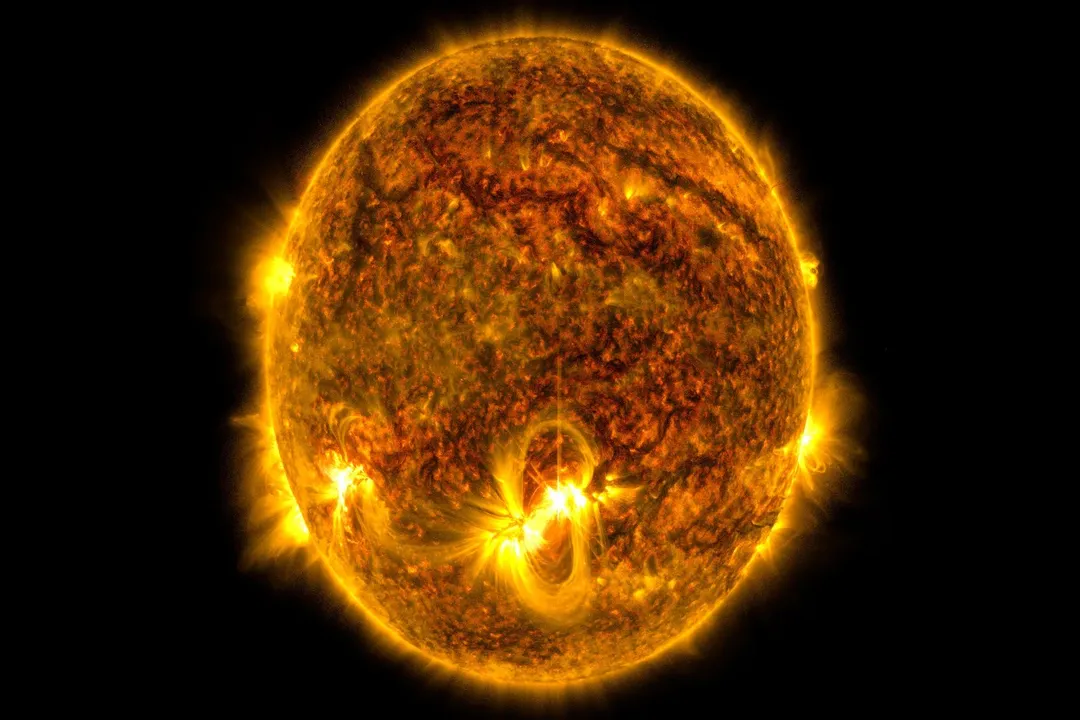
The concept of stellar evolution hinges on balancing the crushing force of gravity with the outward pressure generated by nuclear fusion in the core. It is the star's mass that determines the strength of gravity, and consequently, how much pressure and heat are required to maintain this critical balance, known as hydrostatic equilibrium. The greater the mass, the stronger the gravitational pull inward.
To resist this intense inward pressure, a more massive star must ignite its core fuel—hydrogen—at a far higher temperature and rate. This leads to a remarkable consequence: high-mass stars burn through their fuel supply much faster than low-mass stars.
Consider the main sequence, the longest phase of a star's life when it steadily fuses hydrogen into helium. A star like the Sun, with one solar mass, is expected to remain on the main sequence for about 10 billion years. In stark contrast, a star born with 25 times the Sun's mass will exhaust its core hydrogen in only about 7 million years. This disparity means that while low-mass stars are the venerable elders of the galaxy, high-mass stars are the brief, brilliant meteors of the cosmos.
# The Genesis Phase
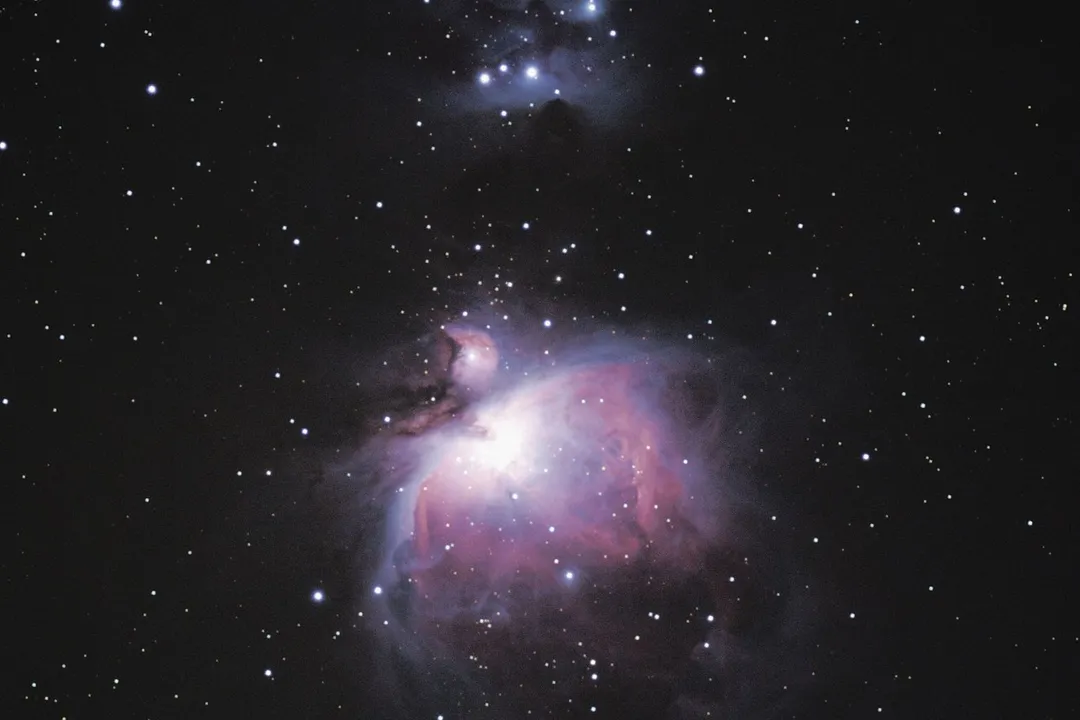
Every star begins its existence as a dense clump within a vast, cold molecular cloud composed primarily of hydrogen and helium. Gravity causes this material to contract, increasing the density and temperature at the center. As this collapsing mass shrinks, it heats up until it forms a protostar. This pre-stellar object glows from the heat of gravitational contraction, but it is not yet a true star.
The transition to a true star occurs when the core temperature and pressure finally become sufficient to initiate sustained nuclear fusion—the process where four hydrogen nuclei combine to form one helium nucleus, releasing enormous amounts of energy. Once this fusion ignites, the outward thermal pressure generated counters the inward pull of gravity, establishing hydrostatic equilibrium, and the object officially lands on the Main Sequence. The star’s location on the Hertzsprung-Russell (H-R) diagram is determined by its mass, which sets its initial luminosity and surface temperature.
# Hydrogen Burning
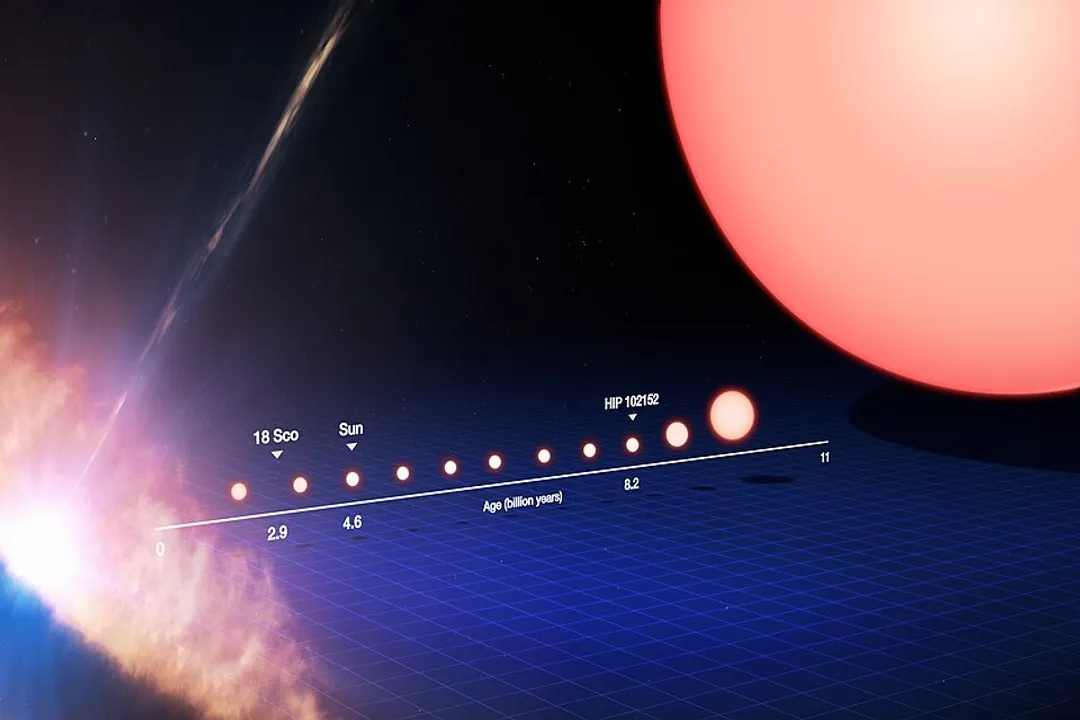
The main sequence is where stars spend roughly 90% of their active lives, quietly burning hydrogen. The chemical makeup of the initial cloud affects the specific path taken within this phase, particularly for the heavier elements present, known as metallicity. For instance, the abundance of elements heavier than hydrogen and helium can slightly alter the energy generation mechanisms and the precise surface temperature a star exhibits while fusing hydrogen. However, the fuel being used is always hydrogen in the core, and the process of balancing fusion against gravity defines this stable period.
When we plot stars based on their color (temperature) and brightness (luminosity), main sequence stars form a distinct diagonal band. A star’s initial mass acts like a dial, tuning its position on this band: high mass means high temperature and high luminosity (top-left), while low mass means low temperature and low luminosity (bottom-right).
# Core Depletion
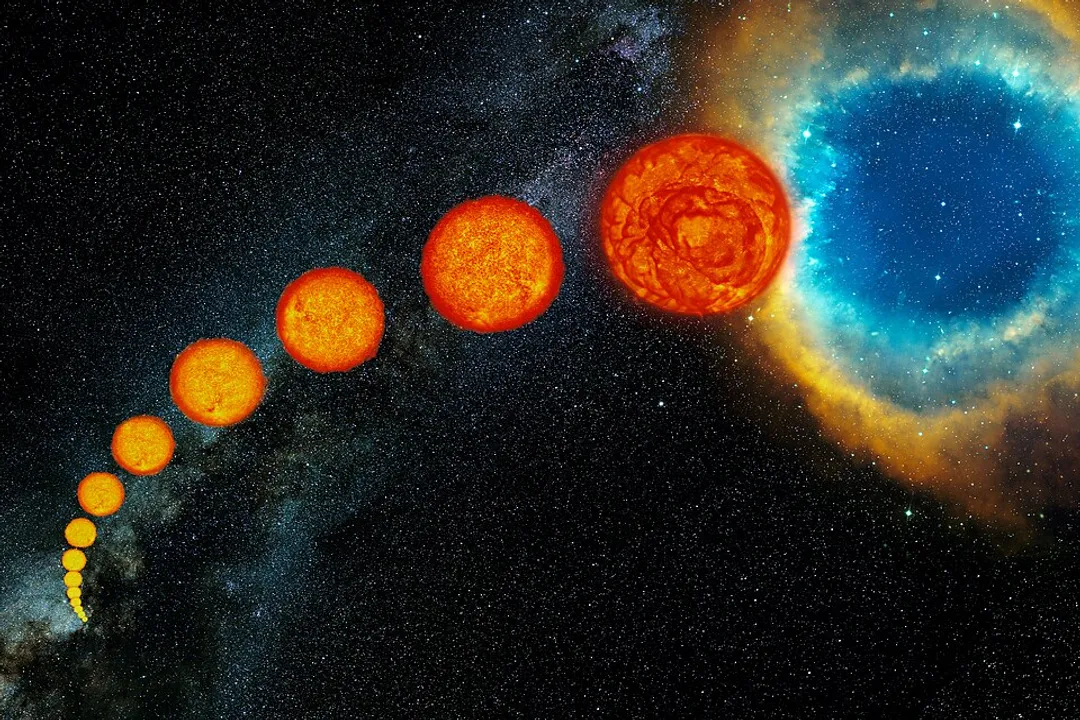
The evolutionary clock starts ticking down when the hydrogen fuel in the star's core is exhausted and converted into inert helium ash. At this point, the primary energy source shuts down, gravity gains a temporary advantage, and the core begins to contract and heat up once more. This contraction raises the temperature of the shell of hydrogen surrounding the helium core high enough for fusion to ignite there—this is known as shell burning.
This new energy source generates more outward pressure than the star previously experienced when just burning core hydrogen, causing the star's outer layers to expand dramatically and cool down. This expansion marks the definitive end of the main sequence phase and the beginning of the star's final, dramatic stages, with the exact path dictated by that initial mass parameter.
# Low Mass Track
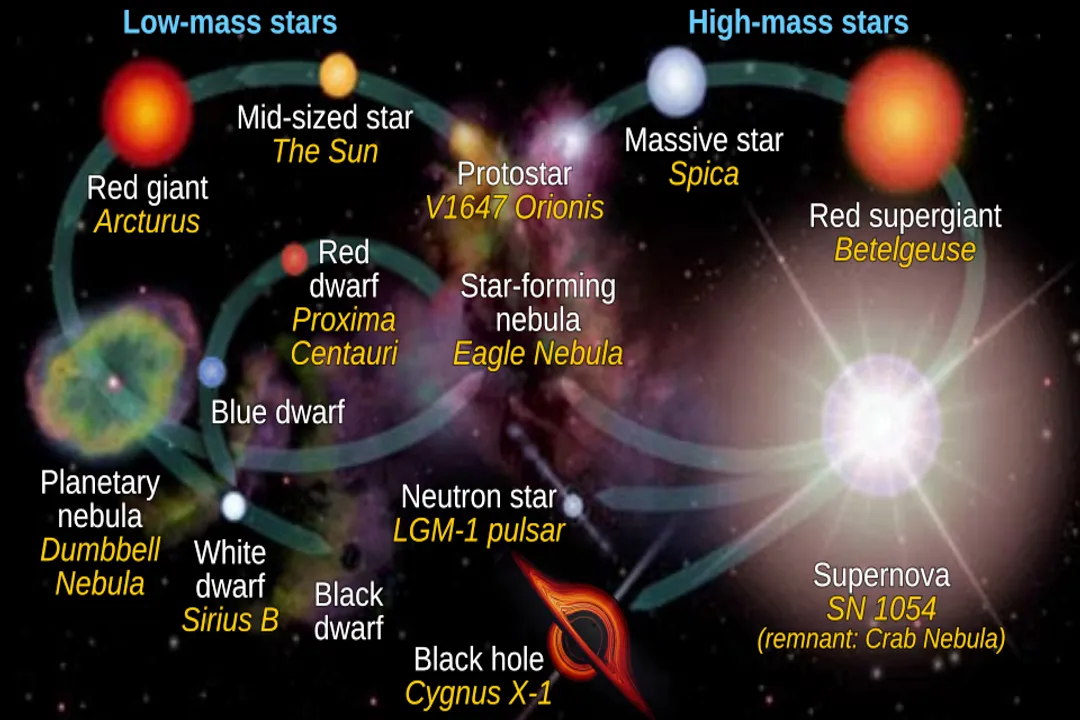
Stars that begin their lives with masses up to about eight times that of the Sun follow a more gentle evolutionary path. Once the core hydrogen is gone and shell burning begins, the star swells into a Red Giant. For Sun-like stars, the expansion is significant; the Sun is predicted to swell enough to engulf Mercury, Venus, and possibly Earth.
As the Red Giant's core continues to contract and heat, the helium in the core eventually reaches the critical temperature needed to start fusing into carbon and oxygen. In stars less than about 2.25 solar masses, this ignition happens suddenly in an event called the Helium Flash. After this, the star briefly stabilizes while fusing helium in its core, leading to a secondary, shorter period of stability.
When the core helium is spent, the star is not massive enough to generate the temperatures required to fuse carbon. Fusion ceases in the core, and the outer layers of gas are gently expelled into space, often forming a beautiful, expanding shell known as a Planetary Nebula. The remaining core shrinks down to a very hot, dense object roughly the size of Earth: a White Dwarf. This white dwarf, supported only by electron degeneracy pressure, slowly cools and fades over trillions of years into a cold, dark black dwarf.
# High Mass Track
For stars born with masses greater than about eight times that of the Sun, the end is far more violent. These massive stars do not become simple Red Giants; instead, they expand into Red Supergiants. Their immense gravity drives core temperatures so high that once hydrogen is gone, they can fuse heavier and heavier elements in successive shells surrounding the core.
This process creates an "onion-like" structure, fusing helium to carbon, carbon to neon, neon to oxygen, and so on, all the way up to iron. Iron fusion is the terminal point because it consumes energy rather than releasing it, meaning the core can no longer support itself against gravity. When the iron core forms, the outward pressure vanishes instantaneously, and gravity triumphs catastrophically.
The core collapses in a fraction of a second, triggering a massive rebound explosion known as a Type II Supernova. This explosion is so luminous it can temporarily outshine an entire galaxy and is responsible for creating and dispersing nearly all elements heavier than iron into the cosmos. The fate of the remnant core depends on its leftover mass after the explosion.
# Stellar Remnants
The final state of a star is a direct consequence of its initial mass, filtered through the mass of its core remnant after the giant phase or supernova.
For less massive stars (like the Sun), the remnant is the White Dwarf, supported by electron degeneracy pressure, possessing a mass limit of about 1.4 solar masses (the Chandrasekhar Limit). Stars slightly more massive than the Sun might leave behind a core that collapses further, overcoming electron degeneracy pressure, forming a Neutron Star. These objects are incredibly dense, packing more than the mass of the Sun into a sphere only about 10 to 20 kilometers across.
If the original star was sufficiently massive—generally more than 20 to 25 times the Sun's mass—the remnant core left after the supernova will exceed the limit for a neutron star (the Tolman-Oppenheimer-Volkoff limit). In this ultimate gravitational collapse, nothing can stop the implosion, and the core shrinks to an infinitely dense point, forming a Black Hole.
It is fascinating to observe how the universe sorts stars into these few distinct end-states based on that single initial parameter. If we were to chart a star's life not on a timescale but based on the total number of fusion cycles it completes, the difference between a low-mass star (which completes only two major cycles: H He, then He C/O) and a massive star (completing up to 8 or 9 cycles) highlights the extreme energetic diversity driven solely by mass. The initial mass is the fundamental constant dictating which of these final scenarios—white dwarf, neutron star, or black hole—will ultimately define the star's legacy.
Related Questions
#Citations
Stellar evolution - Wikipedia
Stellar Evolution - | The Schools' Observatory
Star Basics - NASA Science
Stellar Evolution - aavso
Stellar Structure and Evolution | Center for Astrophysics | Harvard ...
The Origin, Structure, and Evolution of the Stars - BYU Studies
Stellar evolution | Astronomy explained - SCNAT knowledge
A crash course in stellar evolution - Astronomy WA
Stellar Evolution | COSMOS