What do the stages of a star depend on?
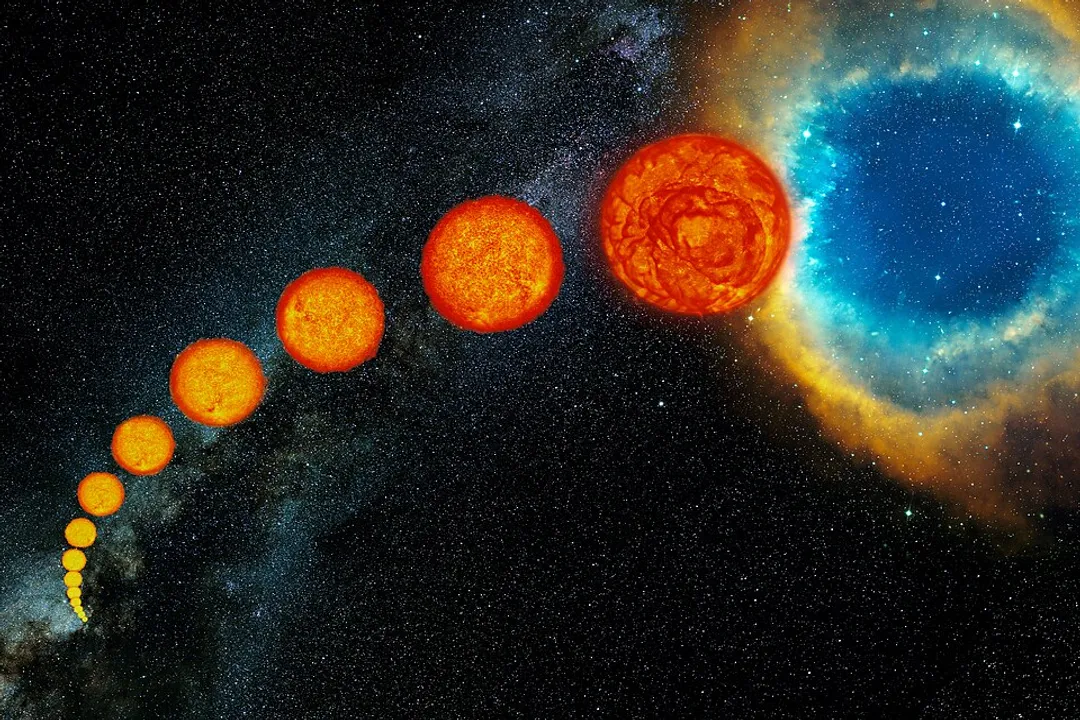
The destiny of any star in the universe, from its first flicker of light to its final collapse, is determined almost entirely by one fundamental characteristic: its initial mass. [1][3][6] While gravity, pressure, and the relentless process of nuclear fusion are the actors in this cosmic drama, the mass sets the stage and writes the script. [5][8] Stars are born from vast, cold clouds of gas and dust called nebulae. [3][7] Within these clouds, localized regions collapse under their own gravity, heating up until they form a dense, hot core known as a protostar. [5][7] This gravitational collapse continues until the core becomes hot and dense enough—around 15 million Kelvin—to ignite sustained nuclear fusion, converting hydrogen into helium. [1][5] Once this stable fusion reaction begins, the star officially enters the longest phase of its existence: the Main Sequence. [3][8]
# Primary Control
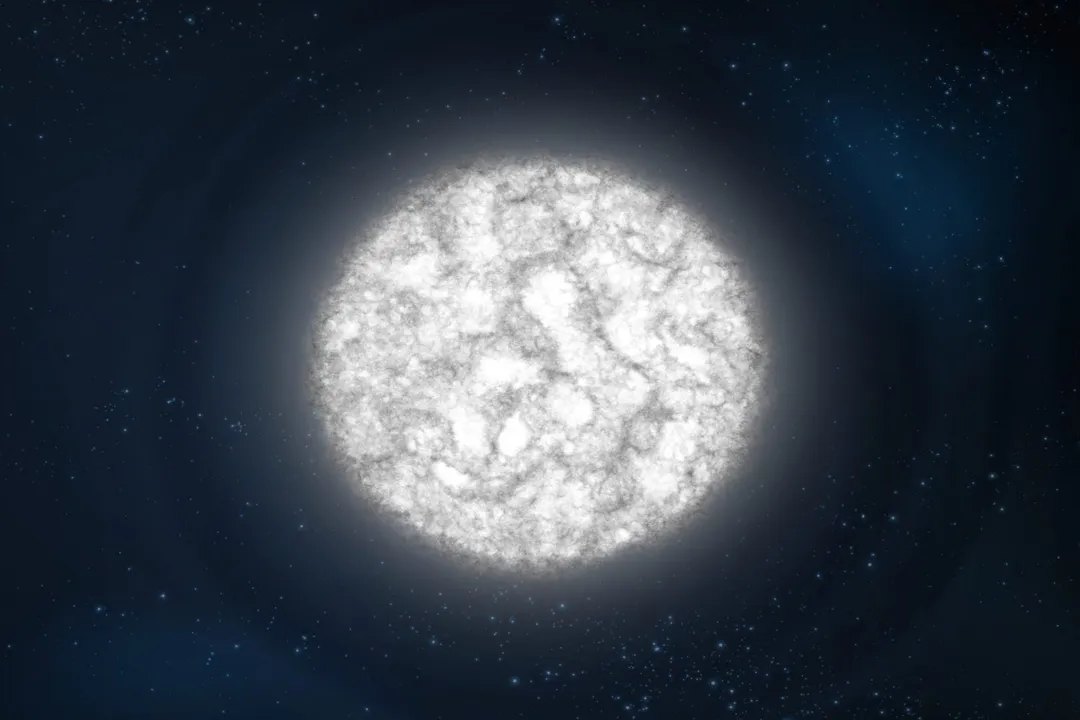
The core concept that governs stellar evolution, from birth to demise, is the star's starting mass, measured relative to our Sun. [1][6] Mass dictates the strength of the gravitational squeeze on the stellar core. [1] A greater mass means a stronger gravitational pull, which translates directly into higher pressures and temperatures within the core. [5] This increased heat and pressure dramatically increase the rate at which the star consumes its primary fuel, hydrogen. [5][8] This dependency is so absolute that we can generally divide stars into two broad categories for understanding their life cycles: those with masses similar to the Sun (low-to-intermediate mass) and those significantly more massive (high-mass stars). [1][6]
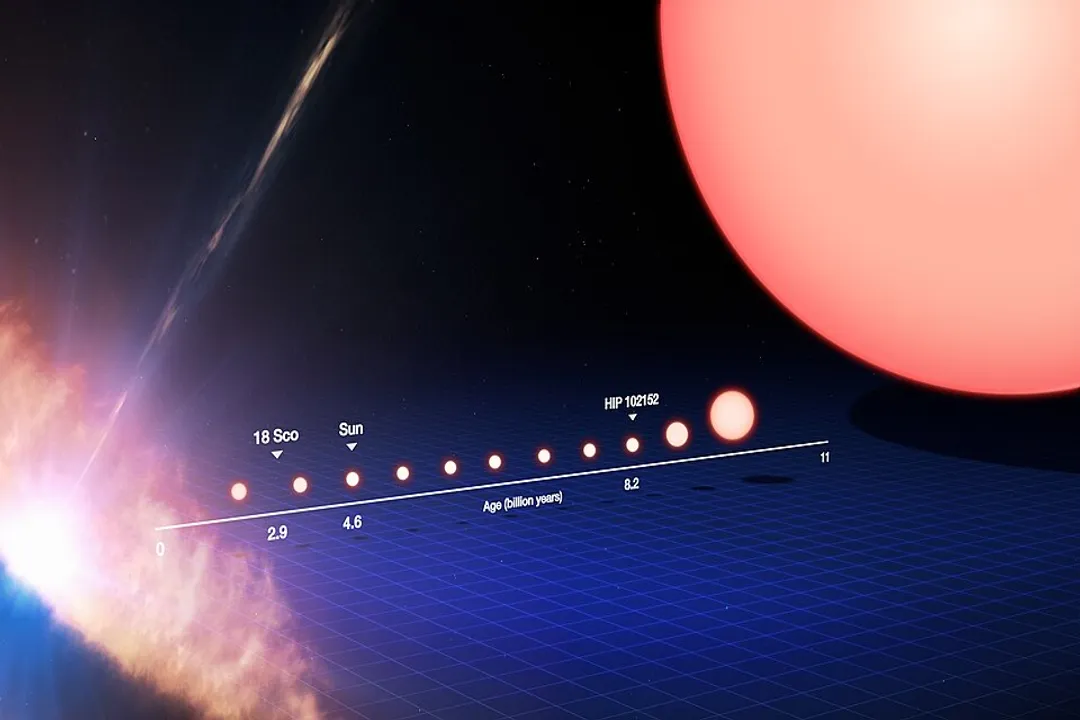
If we could chart the potential life spans, the contrast in speed is staggering. A star like the Sun, being mid-range, is expected to spend about ten billion years on the Main Sequence. [3][5] Conversely, a very massive star, perhaps 20 or more times the Sun's mass, burns through its fuel so prodigiously due to its immense core pressures that its Main Sequence life might last only a few million years. [8] Think of it like comparing a fuel-efficient sedan versus a drag racer: both use gasoline, but the racer's enormous engine demands fuel at a vastly higher rate, resulting in a much shorter, though much more spectacular, performance run. [5]
# Hydrogen Burning
During the Main Sequence phase, a star is in hydrostatic equilibrium—a perfect, albeit temporary, balance where the outward pressure generated by nuclear fusion precisely counteracts the inward pressure from gravity. [1][5] For stars like the Sun, this phase is marked by the steady fusion of hydrogen into helium in the core. [3][8] The specific temperature threshold for ignition is what makes the Main Sequence possible; if the initial mass is too low, the core never reaches the required 10 million degrees Celsius, resulting in a body that never becomes a true star, such as a brown dwarf. [1] A star must have at least about 0.08 times the mass of the Sun to achieve this ignition. [1]
The color and luminosity of a Main Sequence star are also directly linked to its mass. [6] More massive stars pack more material, creating more intense core conditions, which results in higher energy output, leading them to be hotter and significantly bluer or whiter in color. [6] Less massive stars are cooler, resulting in a dimmer, redder appearance—these are the Red Dwarfs, the most common stellar type in the galaxy. [1] This observation has a neat implication for observing the cosmos: even though massive blue stars are incredibly luminous and easy to spot across vast distances, their short lives mean we statistically encounter far more long-lived, dimmer, lower-mass stars simply because they've had far more time to accumulate across the galaxy's history. [5]
# Giant Phase
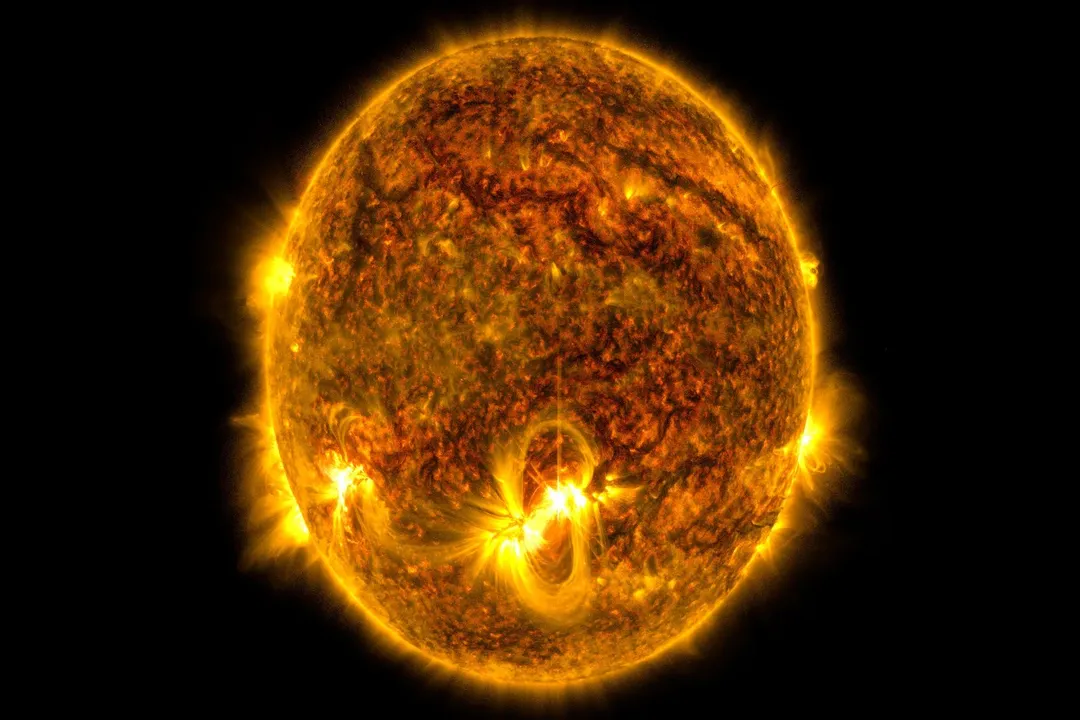
When a star exhausts the hydrogen fuel in its core, the delicate equilibrium is broken, and the star begins to fundamentally change its structure. [8] This transition is perhaps the clearest indicator that the stages depend on the initial mass, as the pathway diverges sharply based on how much material the star has left.
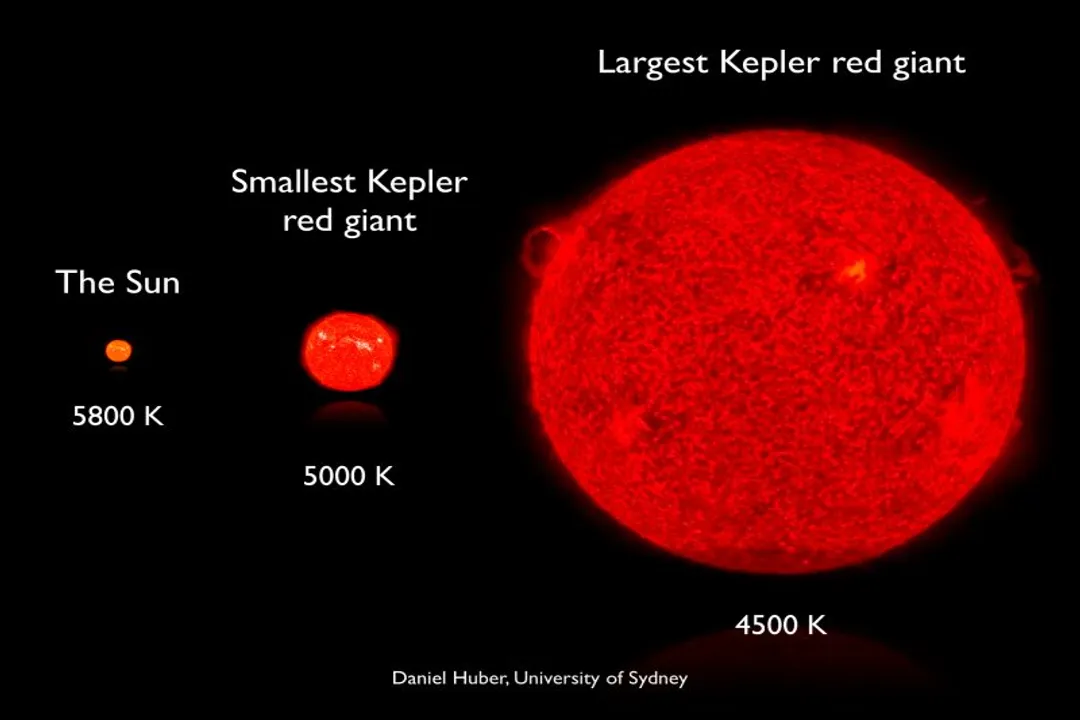
For stars comparable to the Sun, once the core hydrogen is spent, the core contracts under gravity and heats up. [3][6] This increased heat ignites a shell of hydrogen surrounding the helium core. [1] The energy from this shell fusion forces the star's outer layers to expand dramatically and cool down, causing the star to evolve into a Red Giant. [3][6] The star's radius can swell enormously, possibly engulfing inner planets. [3] Eventually, the helium core becomes hot and dense enough (around 100 million Kelvin) to start fusing helium into carbon and oxygen, a process often called the helium flash for Sun-like stars. [1][6] This new phase stabilizes the star for a while, but it is far shorter than the initial Main Sequence phase. [8]
# Final Stages
The path taken after core helium is exhausted is entirely mass-dependent. [1][5] The determining factor here is often considered the Chandrasekhar Limit (about 1.4 solar masses) for the eventual white dwarf core, or the Tolman–Oppenheimer–Volkoff (TOV) Limit (around 2 to 3 solar masses) for the maximum mass a neutron star can support. [1]
For stars with initial masses similar to or slightly greater than the Sun:
- After helium fusion ceases, the core contracts again, but for these lower-mass stars, the core never gets hot enough to fuse carbon. [6]
- The outer layers of the star drift away gently, forming an expanding shell of glowing gas called a planetary nebula. [3][6] This process is relatively peaceful, dispersing the star's material back into the interstellar medium for future generations of stars. [7]
- What remains is the hot, dense, inert carbon-oxygen core, which slowly cools over eons—a White Dwarf. [1][6]
For high-mass stars (typically eight times the Sun's mass or more), the story ends much more dramatically. [1][5][8] These stars have enough gravitational power to continue fusion past carbon, creating progressively heavier elements like neon, oxygen, silicon, and finally, iron. [1][6] Iron fusion, however, consumes energy rather than releasing it, meaning the core has no outward pressure source to fight gravity. [1] In a fraction of a second, the core collapses violently, leading to a massive rebound explosion known as a Type II Supernova. [3][6] This explosion briefly outshines entire galaxies and is responsible for forging all elements heavier than iron, scattering them across space. [1][6]
# Stellar Corpses
The remnant left behind after a supernova is a direct consequence of the mass of the initial collapsing core, which is usually a fraction of the star's original total mass. [1]
If the remaining core mass is between approximately 1.4 and 3 solar masses, gravity compresses the material so tightly that protons and electrons merge to form neutrons. [1][5] This incredibly dense object is a Neutron Star. [6] A teaspoon of neutron star material would weigh billions of tons. [7] If the remaining core exceeds the TOV limit (roughly 2 to 3 solar masses), even the resistance offered by compressed neutrons cannot halt gravity's advance. [1] In this extreme scenario, the core collapses completely, forming a region where gravity is so intense that nothing, not even light, can escape: a Black Hole. [1][5][6]
Therefore, understanding what a star will become requires an accurate measure of what it was at birth, highlighting the immense deterministic power contained within that initial value. [1][3] Every star, regardless of its ultimate fate—whether a gentle fade as a white dwarf or a cataclysmic supernova—is executing a sequence entirely predicated on the initial gravitational potential energy it possessed as a collapsing cloud fragment. [5][8]
Related Questions
#Citations
Stellar evolution - Wikipedia
Star Basics - NASA Science
Life Cycle of Stars - BYJU'S
How Stars Form: A Star's Life Cycle in Six Stages - KiwiCo
A Star is Born: The Life Cycle of Stars | Wisconsin Space Grant ...
The Life Cycle of Stars | National Air and Space Museum
The Life Cycle of a Star - Little Passports
The Life Cycles of Stars - Imagine the Universe! - NASA
Stellar Evolution - aavso