What is the final stage of a super massive star?
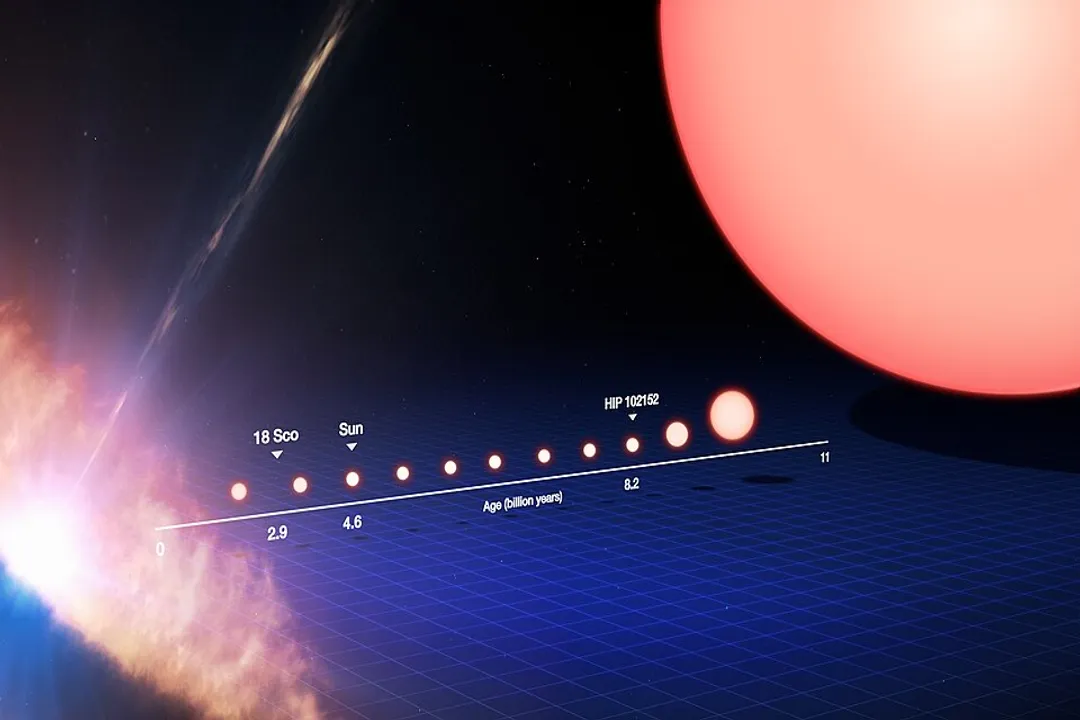
The lives of the largest stars in the universe are spectacular, brief affairs marked by rapid fuel consumption and culminating in an end so violent it can briefly outshine entire galaxies. While stars like our Sun spend billions of years calmly fusing hydrogen, a star born with many times the Sun's mass races toward its final act in mere millions of years. The "final stage" isn't a single event, but a rapid, cascading series of core failures that result in either an unimaginable explosion or an immediate collapse into a singularity.
# Fuel Burning Shells
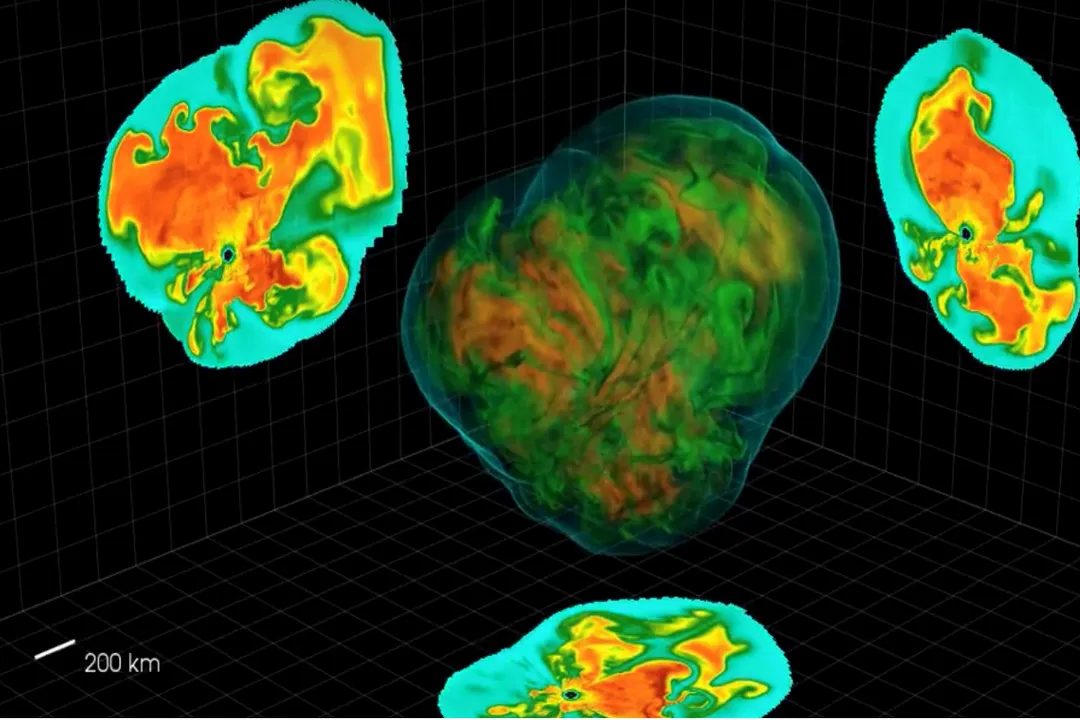
The entire evolutionary path of any star is dictated by its initial mass. For the most massive stars—those exceeding about eight times the mass of the Sun—the internal pressures and temperatures are high enough to sustain fusion beyond simple helium production. This rapid consumption creates a layered, or "onion-skin," structure within the star's interior as it ages.
Once hydrogen in the core is exhausted, the core contracts and heats up until the next element, helium, ignites, fusing into carbon. This continues in a sequence dictated by physical necessity. The products of one fusion cycle become the fuel for the next, but each subsequent stage requires higher temperatures and pressures to initiate. This process proceeds through fusion cycles that create progressively heavier elements: carbon fuses into neon, neon into oxygen, oxygen into silicon, and finally, silicon fuses into iron. Each layer is structured around the core, with hydrogen fusion occurring in the outermost shell, followed inward by shells of helium, carbon, and so on, down to the innermost silicon-fusing layer.
The sheer speed of this process is staggering when viewed against the backdrop of solar-type stars. While the Sun will spend about 10 billion years on the main sequence, a star 25 times the mass of the Sun might only last 7 million years, and the most massive stars exhaust their fuel in just a few million years.
To put this swift demise into perspective, consider the time scales involved:
| Star Type | Main Sequence Lifetime (Approximate) | Final Energy Release Mechanism |
|---|---|---|
| Sun-like Star () | Billion Years | Gentle Planetary Nebula/White Dwarf |
| Massive Star () | Million Years | Core-Collapse Supernova |
| Very Massive Star () | Million Years | Potential Direct Collapse or Hypernova |
| [1][6] |
This stark contrast highlights that for these stellar giants, time is a luxury they simply do not possess, forcing them into extreme thermodynamic scenarios rapidly.
# Iron Core Limit
The fusion chain grinding to a halt at iron is perhaps the most critical physical turning point in the star's life. Iron, with its tightly bound nucleus, represents the end of the road for energy-releasing nuclear fusion. Unlike fusing lighter elements—where combining smaller nuclei releases excess energy that supports the star against gravity—fusing iron consumes energy.
When the silicon burning ceases, the star develops a massive, inert core composed almost entirely of iron. Since fusion no longer generates the outward thermal pressure required to counteract the immense gravitational force pulling the star inward, the core has no support mechanism left.
The mass of this iron core is crucial. If the core's mass exceeds the Chandrasekhar limit, which is about $1.4$ times the mass of the Sun, gravity wins instantly. Even the quantum mechanical resistance known as electron degeneracy pressure, which supports white dwarfs, is overcome by the sheer weight of the overlying stellar material. For a supermassive star, this core can be significantly larger, sometimes exceeding $2$ or $3$ solar masses, depending on the star's initial composition and mass loss. Once this threshold is breached, the collapse begins, and the star's fate is sealed in the span of milliseconds.
# Supernova Mechanism
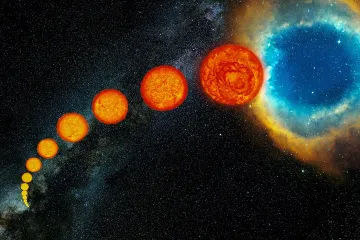
The process that follows the collapse is catastrophically rapid. Gravity compresses the iron core inward at speeds reaching up to a quarter of the speed of light. As the core shrinks, it compresses matter to unimaginable densities, forcing protons and electrons together to form neutrons and releasing vast numbers of neutrinos. This leaves behind a hyper-dense ball of neutrons, known as a neutron star.
This sudden, catastrophic halting of the inward fall—when the density of the core approaches that of an atomic nucleus—causes the material to "bounce". This generates a powerful outward-moving shock wave. This shock wave barrels through the outer layers of the star, heating them to billions of degrees and causing an enormous, brilliant explosion known as a Type II core-collapse supernova. For a brief period, the supernova can radiate as much energy as a whole galaxy, making it one of the most luminous events in the cosmos.
The energy released during the final collapse and rebound is astronomical. While the preceding fusion stages generate the star's luminosity over millions of years, the supernova shock wave explosion releases an energy equivalent to about joules per second for a few weeks. It is a dramatic illustration of how binding energy is liberated when a structure fails violently, rather than through steady, gentle nuclear generation. The explosion serves to scatter newly forged heavy elements—everything heavier than iron—out into the interstellar medium, seeding the universe for future generations of stars and planets.
# Final Remnants Form
The identity of the final stellar corpse depends entirely on the mass of the remnant core that is left behind after the shock wave dissipates. The star's initial mass determines the final outcome, resulting in one of two primary compact objects: a neutron star or a black hole.
# Neutron Star Birth
If the collapsing core's mass remains below a critical threshold, often estimated to be around $2$ to $3$ solar masses, the resulting object is a neutron star. This object is incredibly dense; a teaspoon of neutron star material would weigh billions of tons. The neutrons are packed so tightly that the object is supported by neutron degeneracy pressure, successfully resisting further collapse. These objects are small, typically only about $10$ to $20$ kilometers in diameter, yet they contain more mass than the Sun.
# Black Hole Formation
However, if the initial star was extremely massive (often cited as greater than about $25$ or $40$ solar masses, though estimates vary), the remnant core left after the explosion might exceed the maximum stable mass limit for a neutron star. When the core's mass is too great, even the tremendous pressure of degenerate neutrons cannot halt the inward crush of gravity.
In this scenario, the collapse continues indefinitely, creating a point of infinite density called a singularity, surrounded by an event horizon—a black hole. This object warps spacetime so severely that nothing, not even light, can escape its gravitational pull.
# Alternate Fates Exist
While the core-collapse supernova leading to a neutron star or black hole is the standard path for massive stars, the most extreme cases present nuances in how the star sheds its outer layers.
# Hypernovae
For some of the most massive stars, the explosion that results is far more energetic than a standard Type II supernova. These extreme events are sometimes termed hypernovae. A hypernova is likely associated with the collapse of a very massive star into a black hole, and it is often linked to the production of long-duration gamma-ray bursts (GRBs). The process involves a "collapsar" model, where the rapidly forming black hole launches extremely powerful jets of matter and energy outward along the star's rotational axis, creating the observed burst of high-energy photons.
# Direct Collapse
In a few specific cases involving stars at the very upper end of the mass scale, the star might fail to produce a visible supernova explosion altogether. If the star is too massive and has shed very little of its outer envelope through stellar winds before collapse, gravity can overwhelm all opposing forces so rapidly that the entire star falls directly into the nascent black hole. This "direct collapse" scenario results in a black hole forming without the spectacular, bright light show that characterizes a supernova, leaving behind little transient evidence of the star's demise save for gravitational wave emissions.
Understanding these final stages—the rapid creation and failure of the iron core, the resulting shockwave, and the subsequent birth of either a black hole or a neutron star—provides astronomers with critical insight into the universe's elemental abundance and the most energetic phenomena observable today. The final moments of a supermassive star are not merely an ending, but the mechanism by which the universe builds complexity.
Related Questions
#Citations
Stellar Evolution - | The Schools' Observatory
Stellar evolution - Wikipedia
The Life Cycles of Stars - Imagine the Universe! - NASA
DOE Explains...Supernovae - Department of Energy
What is the end stage of a massive star? | CK-12 Foundation
Massive Star | Definition & Life Cycle - Lesson - Study.com
Life Cycle of a Giant Star - How a Supernova Works | HowStuffWorks
How Do The Most Massive Stars Die: Supernova, Hypernova, Or ...
The Life Cycle of Stars | National Air and Space Museum
Evolution of Massive Stars: An Explosive Finish | Astronomy