What is the core of a massive star?
The heart of any star, whether it is a modest, long-lived dwarf like our Sun or a spectacular, short-lived giant, is its core. This is the furnace where the star generates the tremendous energy required to defy its own overwhelming gravity. [3][6] For the Sun, the core is an incredibly dense plasma, reaching $15,000,000$ Kelvin, where hydrogen nuclei are relentlessly fused into helium nuclei, a process that converts mass into energy according to Einstein’s famous equation. [4][3] This thermonuclear balancing act sustains the star for billions of years, which is why our Sun is currently in its main sequence, its longest phase. [3]
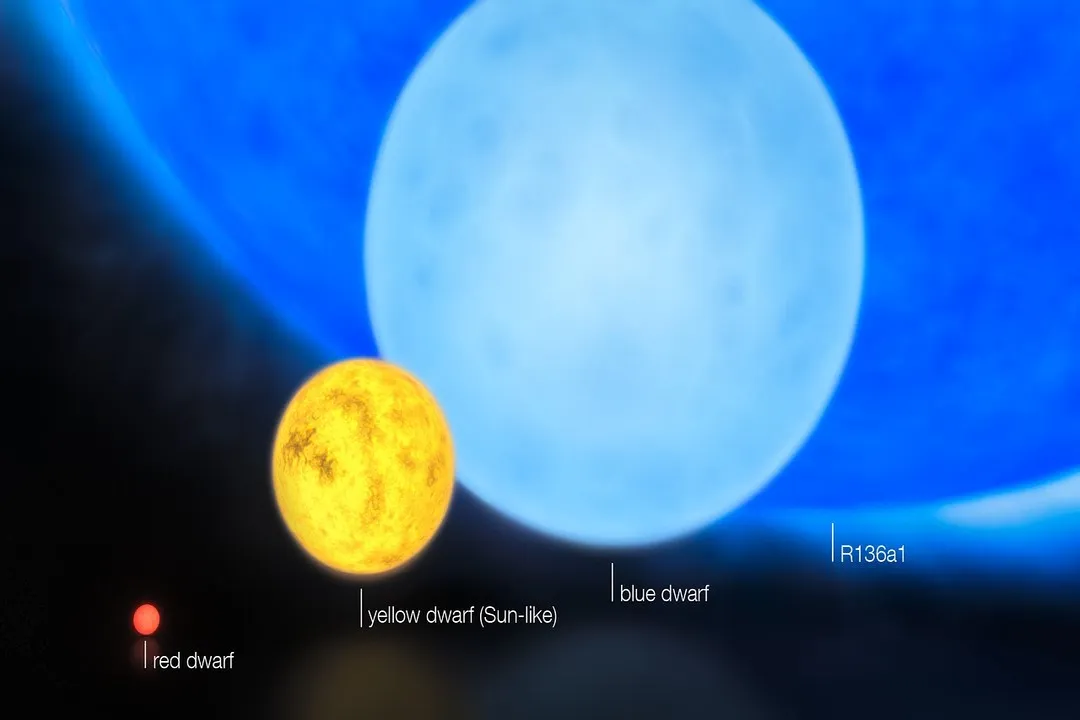
However, the core of a massive star—one significantly heavier than the Sun, perhaps eight times the mass or more—is an entirely different beast, destined for a far more dramatic end. [4][6] These heavyweights live fast and furiously, burning through their hydrogen fuel in mere millions of years, compared to the Sun’s ten-billion-year lifespan. [5][6] Their cores must achieve vastly higher temperatures and pressures to resist the intensified gravitational crush, leading to an extended, multi-stage element-building process that low-mass stars can never achieve. [4]
# Progressive Fusion
The core of a low-mass star eventually exhausts its hydrogen, leading to a helium-burning phase that creates carbon and oxygen before the star gently dies. [4] Massive stars, due to their extreme internal conditions, skip this gentle end. Once hydrogen is depleted, the core contracts, heats up, and ignites the next fuel source, moving up the periodic table like building blocks stacked on top of each other. [4]
This creates a complex, layered structure, often compared to an onion skin in its final stages before collapse. [4] The innermost region is the site of the heaviest element fusion occurring at that moment. The layers surrounding this core are fusing lighter elements:
- The very center fuses Silicon into Iron. [4]
- Surrounding shells fuse elements like Neon, Magnesium, and Oxygen. [4]
- Outer shells continue to process Helium and Hydrogen, often in shells surrounding the main product zones. [4]
For a star massive enough to eventually explode as a core-collapse supernova, the inert core that develops at the center is composed almost entirely of iron. [4][2] In these high-mass stars, the core can represent a significant portion of the star's total mass, potentially constituting between $20$ to $30%$ of it just before death. [1]
# The Iron Barrier
The defining characteristic of the massive star's core is its terminal material: iron. The progression of fusion up to this point—from hydrogen to helium, carbon, oxygen, and so on—releases energy because the product of the reaction weighs slightly less than the reactants combined (the mass defect). [4] This released energy creates the outward pressure that supports the star against gravity. [4]
Iron marks a hard stop on this energy-producing process. The nucleus of an iron atom has one of the highest binding energies per nucleon on the chart of elements. [2] Fusing iron does not release energy; it consumes it. [4] When the core becomes saturated with iron, the star loses its primary source of outward thermal pressure. [4] At this point, the star’s fate is sealed, and it has only minutes to live before a catastrophic event occurs. [4]
A subtle but significant detail is that the final stable product of silicon burning is often Nickel-56 (), which rapidly decays into Iron-56 (). [2] This means the final, critical core is an iron 'ash' heap that can no longer sustain the star's equilibrium.
When considering the massive star's life, we can observe a distinct 'Iron Load' that builds up. For a low-mass star like the Sun, the core material that ceases fusion (mostly carbon/oxygen) is a relatively small component of the total structure, and the death is gradual. In contrast, the massive star accumulates a core constituting up to a quarter of its bulk made of iron, an inert mass that must be dealt with violently. This concentrated, non-radiating mass is the direct trigger for the subsequent implosion, meaning the star’s internal structure has become top-heavy with material that actively steals energy to maintain its existence, rather than contributing to its support.
# The Race Against Gravity
Once fusion in the iron core ceases to provide the required thermal support, the star must rely on electron degeneracy pressure—a quantum mechanical resistance to further compression—to hold itself up. [2] For less massive remnants, this pressure is sufficient, resulting in a white dwarf. [6]
For a massive star, however, the sheer weight of the overlying material generates pressures that overcome this degeneracy barrier, provided the core mass exceeds the Chandrasekhar limit (about $1.4$ solar masses). [2] The collapse is then immediate and runaway. [4] Gravity wins the battle instantaneously, causing the iron core to implode inward at incredible speeds. [2]
During this extreme compression, two critical physical processes transform the core’s composition:
- Electron Capture (Neutronization): The immense pressure forces free electrons to merge with protons, effectively creating neutrons and releasing neutrinos. This process robs the core of its remaining outward-pushing pressure sources. [2][4]
- Photodisintegration: High-energy gamma rays, generated in the superheated environment, collide with the iron nuclei, violently splitting them apart into lighter components like alpha particles (helium nuclei). [2] This process consumes energy, further cooling and accelerating the collapse. [4]
This rapid inward fall halts only when the core reaches nuclear density—the density of an atomic nucleus—forming a hyper-dense object, either a neutron star or, if the mass is too great, it continues collapsing into a black hole. [2][6]
# Alchemy After the Core Fails
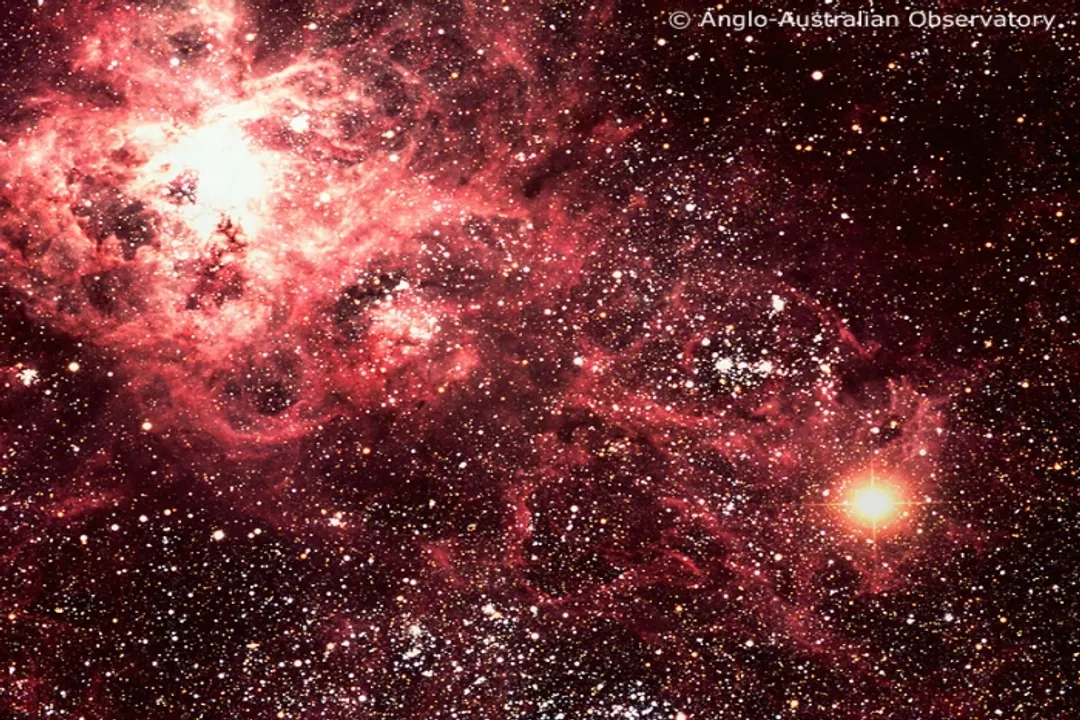
The core's failure is not the end of the story for the elements; it is the catalyst for the creation of everything heavier. As the core collapses and then violently rebounds off the newly formed proto-neutron star, it sends a powerful shockwave outward through the star's remaining layers. [4]
This shockwave, combined with the immense burst of neutrinos created during neutronization, creates temperatures far exceeding those found in the stable, layered core fusion phases. [4] These extreme conditions allow for rapid nucleosynthesis—the creation of elements heavier than iron. [4]
Elements such as gold, silver, and uranium are forged in this brief, explosive moment, often in processes known as the r-process (rapid neutron capture). [4] Thus, the ultimate composition of the massive star's core—the inert iron layer—is paradoxically the necessary precursor to seeding the galaxy with the heaviest elements that make up rocky planets and, eventually, life. [6][5] The very materials composing our bodies were forged in the fiery death of a star whose core finally succumbed to the iron ceiling. [5][4]
# The Stellar Nursery Context
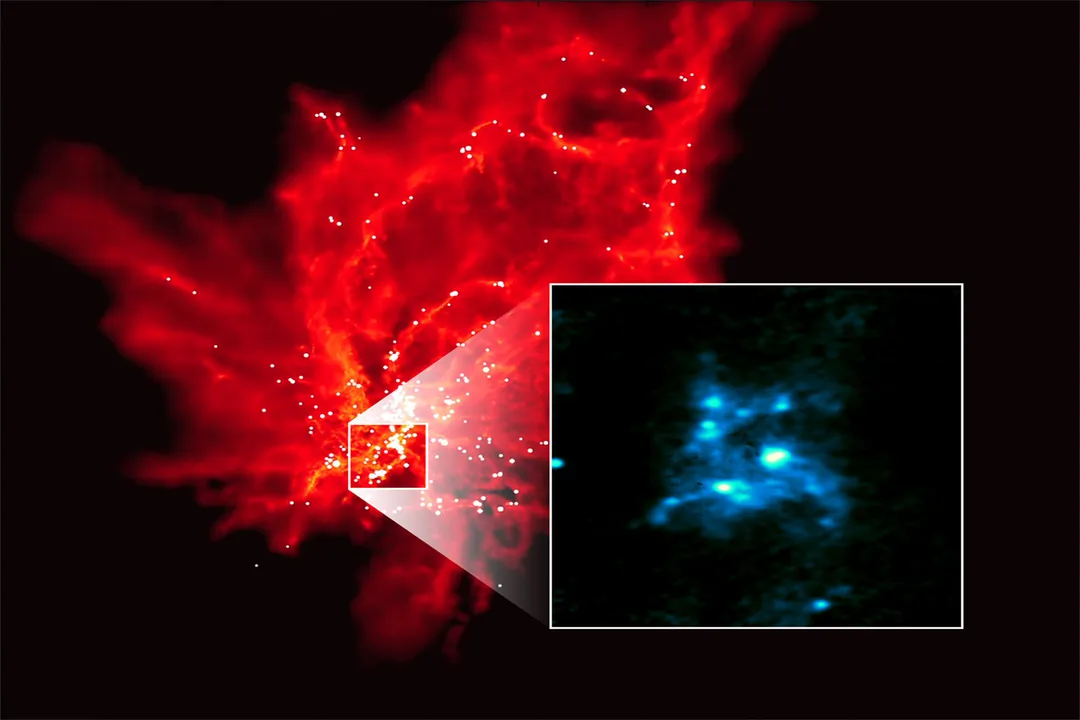
While the core's death is a result of its mass and evolution, it is worth noting that massive stars begin their lives in highly energetic environments. [7] Observations of star-forming regions reveal that the gas clumps destined to create these behemoths are themselves structured by rapid collapse and rotation, leading to dense molecular cores where the most massive stars begin to form. [7] This early structure, characterized by spiraling accretion flows, dictates the final mass that ends up fueling the engine that will eventually lead to that catastrophic iron core. [7] The initial conditions set the stage for the final, definitive role of the core as the site of cosmic creation and destruction.
The massive star's core, therefore, is not merely a region of steady energy production; it is a ticking time bomb of elemental accumulation. It is the point where the star’s nuclear roadmap ends, where the fundamental physics of energy balance is broken by the creation of iron, triggering one of the most spectacular and element-generating events in the known cosmos. [4] The core is the transition point between stellar longevity and cosmic enrichment. [6]
Related Questions
#Citations
Star Basics - NASA Science
What happens to a massive star's iron core before it collapses?
Core of a Star - Universe Today
The Evolution of Massive Stars and Type II Supernovae | ASTRO 801
ALMA Reveals the Cradles of Dense Cores
What is the composition of a star's core in terms of its mass? - Quora
Massive stars - Professor Paul Crowther