Why in the core of red Super giants nuclear fusion restarts but not in the core of red giants?
The shift in a star's life from a main-sequence star to a swollen, luminous giant involves dramatic internal restructuring, and the fate of its core dictates whether it becomes a gentle Red Giant or a truly immense Red Supergiant. The key difference in what happens at the very center of these two stellar classes boils down to one fundamental variable: mass. It dictates the ultimate temperatures and pressures a star can achieve in its interior, which in turn dictates whether fusion can ignite again after the initial hydrogen-burning phase concludes. [1][5]
# Stellar Swelling
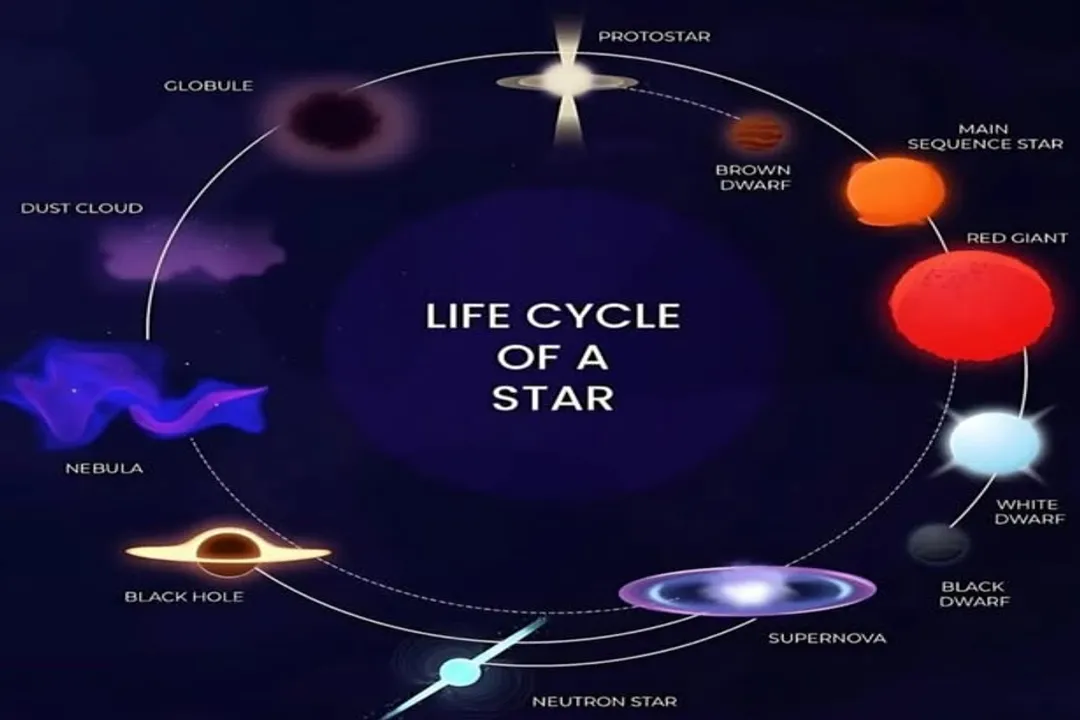
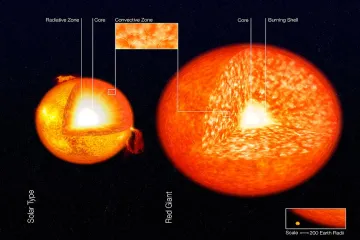
When a star exhausts the hydrogen fuel in its core, it transitions off the main sequence. For stars like our Sun, this leads to the Red Giant phase. As the core becomes dominated by inert helium ash, hydrogen fusion continues in a shell surrounding the core, generating more heat. This outward pressure forces the outer layers of the star to expand immensely and cool down, resulting in the characteristic reddish hue and vast size of a Red Giant. [1][3][9]
Red Supergiants, on the other hand, represent the end-stage evolution for stars significantly more massive than the Sun—typically those starting at around eight times the Sun's mass or more. [5][6] They also expand due to core exhaustion, but their initial mass endows their cores with far greater gravitational force, allowing them to reach much higher central temperatures and densities than lower-mass giants. [5]
# Red Giant Core Limits
In the core of a standard Red Giant, once hydrogen is converted to helium, the core contracts under gravity until the temperature and pressure are sufficient to initiate helium fusion via the triple-alpha process, where three helium nuclei () combine to form carbon (). [1][9]
For lower-mass stars, this ignition can happen suddenly in a degenerate core, known as the helium flash, though the overall process is quite rapid compared to the star's main sequence life. [9] After this helium burning phase concludes, the star typically develops an inert carbon-oxygen core surrounded by shells burning helium and hydrogen. [3] For stars similar to the Sun, core fusion effectively ceases after helium burning. The star cannot achieve the necessary temperatures to ignite carbon fusion, and it eventually sheds its outer layers to become a white dwarf, leaving behind the inert core. [3] Therefore, in the core of a typical Red Giant, fusion restarts once (Helium burning) but does not restart again with heavier elements.
# Supergiant Core Progression
The situation in a Red Supergiant is far more dramatic and extended because of its colossal initial mass. When the core runs out of hydrogen, it contracts, heats up, and ignites helium fusion, just like the Red Giant. [2] However, the immense gravity of a Red Supergiant drives the core contraction much further. Once helium is depleted, the carbon-oxygen core contracts again until it reaches the staggering temperatures needed to fuse carbon into neon and magnesium. [2][5]
This is where the key difference solidifies: fusion does not stop after one subsequent stage; it restarts sequentially with heavier and heavier fuels. The core temperature keeps climbing, allowing for further ignitions. The star develops an onion-like structure, with different elements burning in concentric shells around an ever-growing, inert core of heavier elements. [5] After carbon burning, the core ignites oxygen burning, followed by neon burning, then silicon burning. [2][5] Each stage requires higher temperatures and lasts for a progressively shorter time, sometimes lasting mere days or even hours for the final stages. [5]
The ability of the Red Supergiant core to achieve ignition after ignition is purely a function of its mass providing the necessary gravitational pressure to overcome the Coulomb barriers between increasingly charged nuclei. This repeated ignition of heavier fuels in the core—helium after hydrogen, carbon after helium, and so on—is what fundamentally distinguishes the core dynamics from that of a lower-mass Red Giant core which usually settles after the helium stage. [2]
# The Final Barrier
Fusion continues within the Red Supergiant core until the central product becomes iron (). [2][5] Iron sits at the peak of the nuclear binding energy curve. Fusing iron nuclei does not release energy; instead, it consumes energy. [2] Once the core is predominantly iron, there is no thermal energy left to generate from fusion to support the star against gravity. [2][5] The energy required to keep the subsequent fusion cycles running is no longer being supplied by the core. At this point, fusion effectively stops forever in the core, leading to catastrophic collapse and a supernova explosion. [2]
It is interesting to consider the time scales involved here. While a star like the Sun spends billions of years on the main sequence and then millions of years as a Red Giant, the successive core burning stages in a massive Red Supergiant are incredibly brief. [5] If you were tracking the star's internal energy output, you would see massive, recurring spikes in power as each new fuel ignites in the core, providing a temporary reprieve from collapse before that fuel is exhausted. This contrasts sharply with the long, steady burn of hydrogen in a main-sequence star or even the relatively long helium burning phase in a Red Giant core. [9]
# Comparison of Core Activity
The distinction between the two stellar types centers on what the core can do once the initial hydrogen is gone:
| Feature | Red Giant Core | Red Supergiant Core |
|---|---|---|
| Initial Mass (Relative) | Low (up to ) | High () |
| Initial Fuel Burned | Hydrogen () | Hydrogen () |
| Fusion Restart in Core | Yes (Helium Carbon) [9] | Yes (Multiple times) [2] |
| Subsequent Core Ignition | Typically No (ends in inert core) | Yes (, , up to ) [5] |
| Final State | Planetary Nebula / White Dwarf | Supernova Explosion |
Even if a star is large enough to become a Red Supergiant, the time it spends in that phase is relatively short compared to the main sequence, often only a few million years. [5] During this time, the outer envelope swells to enormous proportions, sometimes reaching hundreds of times the Sun's radius. [6] This enormous, cool exterior acts like a gigantic thermal blanket, masking the violent, fast-paced nuclear fireworks occurring at the star's very center. The surface appearance gives little hint to an external observer of the rapid, cyclical destruction and recreation of fusion processes occurring within the iron-producing core. [2]
# The Role of Degeneracy
A subtle but important physical difference arises depending on the star's initial path. In lower-mass stars destined to become Red Giants, the helium flash occurs when the core is supported by electron degeneracy pressure. [9] This pressure depends only on density, not temperature, which prevents the core from regulating the fusion rate effectively via expansion, leading to a runaway ignition.
In contrast, the cores of the more massive Red Supergiants, due to their greater gravitational compression, remain hot enough that they are supported primarily by thermal gas pressure, not degeneracy, when they initiate helium, carbon, and subsequent burning stages. [1] Because the fusion rate is sensitive to temperature in a thermal pressure-supported core, any excess energy generation causes the core to expand slightly, cooling it and bringing the reaction rate back under control. This self-regulating mechanism allows the massive star to safely burn through its heavier fuels sequentially—the necessary condition for fusion to "restart" multiple times in the core rather than terminating abruptly. [2][5]
Understanding this difference is key to mapping stellar evolution. A star that stops core fusion after helium burning is destined for a quieter end as a white dwarf. A star that manages to ignite carbon, neon, oxygen, and silicon in its core—the Red Supergiant pathway—has already condemned itself to a violent, spectacular demise because the creation of iron is inevitable once those heavier elements are successfully fused. [2] The contrast is stark: one star ends its life by slowly shedding its skin, while the other ends by detonating from the inside out due to the failure of its final energy source. [5]
#Videos
How Do Red Giants Become Supernovae? - Physics Frontier
Related Questions
#Citations
Why do stars become red giants? - Astronomy Stack Exchange
Why do red supergiant stars explode when the fusion stops? - Quora
Red Giant - ESA/Hubble
Question about the life cycle of stars - red giants, black holes, etc.
Red supergiant - Wikipedia
The lifecycle of stars: red giant phase - Facebook
Lecture 15: Red Giants
Questions i. Write the differences between (two points for each) - Filo
Undergrad Expansion of a star to become a red giant - Physics Forums
How Do Red Giants Become Supernovae? - Physics Frontier