Do red giants live short lives?
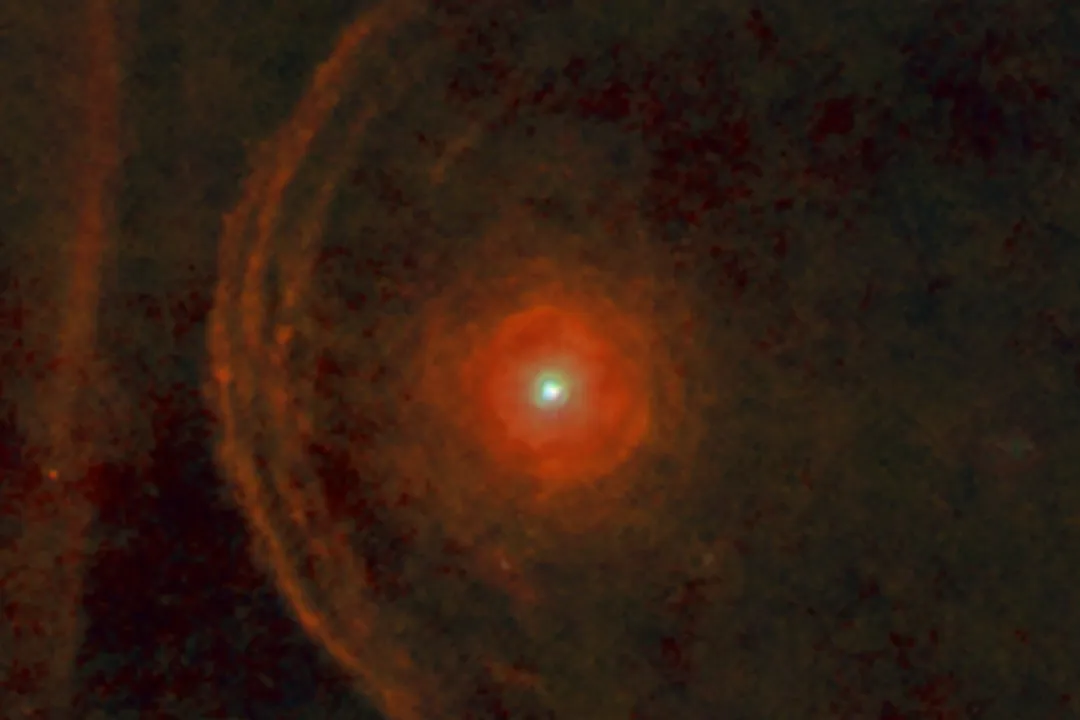
The transformation of a star like our Sun into a red giant prompts a fascinating question about stellar time: Are these brilliant, bloated behemoths brief actors on the cosmic stage? To answer this, one must first appreciate the sheer scale of stellar existence. A star spends the vast majority of its life in a steady, predictable state known as the main sequence, diligently fusing hydrogen into helium in its core. For a star like our Sun, this is a tenure lasting approximately 10 billion years. In contrast, the red giant phase—the star’s dramatic middle-age crisis—is comparatively fleeting, though still spanning an almost incomprehensible length of time for terrestrial observers.
A red giant is defined as a luminous giant star of low or intermediate mass, typically between about $0.3$ and $8$ solar masses (). This stage is triggered when the star exhausts the primary hydrogen fuel in its core. Lacking the outward pressure from core fusion, gravity wins a temporary victory, causing the core to contract and heat up. This compression eventually ignites a shell of hydrogen surrounding the inert helium core, generating far more intense energy. This increased output forces the star’s outer layers to expand dramatically, cool down, and shift their color toward the red end of the spectrum—hence the name.
# Stellar Contrast
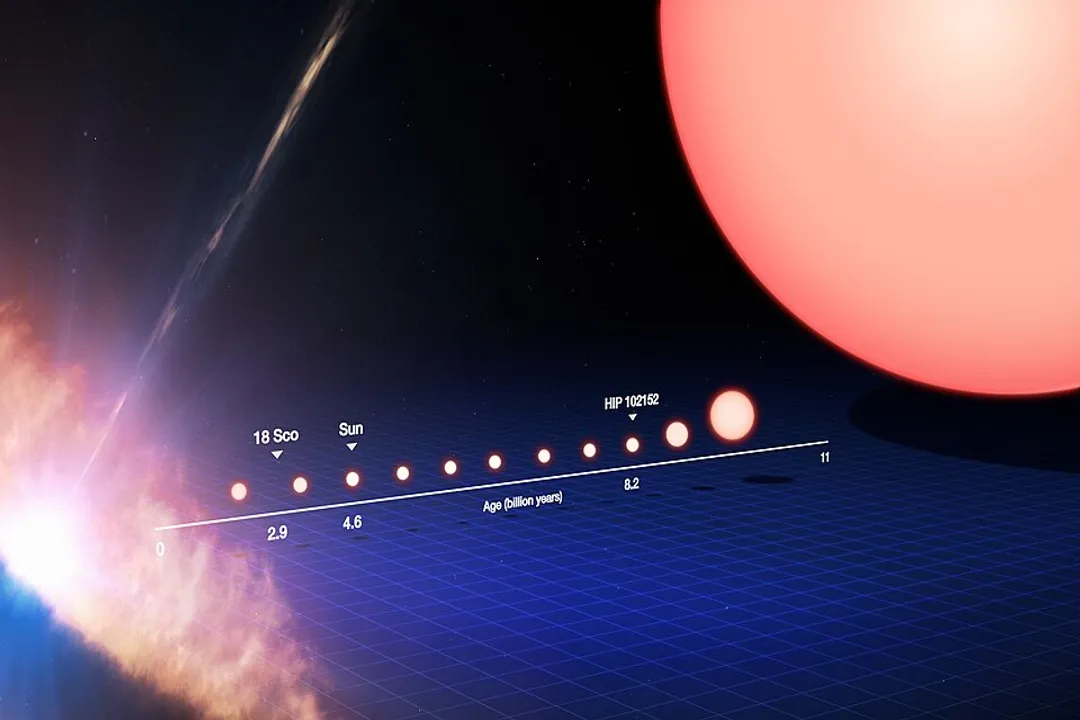
When we frame the red giant stage against the entire stellar lifespan, the notion of a "short life" becomes clear, though context is everything. If a star’s main sequence life is the marathon, the red giant phase is a rapid sprint. For a star with the mass of the Sun, the main sequence is a 10-billion-year commitment. The subsequent red giant transition, however, is estimated to last for typically around one billion years in total. This billion-year span, while immensely long for any known biological process, represents only about 1% of that star’s total shine time.
Consider the other end of the spectrum. The smallest stars, the red dwarfs (below about ), are the marathon runners of the cosmos. They sip their fuel so slowly that their main sequence lifetimes can extend up to a trillion years. For these stars, the red giant phase—if they achieve it at all, as some low-mass ones might not initiate helium core fusion—would be even more insignificant in the context of their total existence.
# Phase Duration
The billion-year total for a Sun-like red giant isn't uniform across its evolution; it is broken down into distinct sub-phases, each with its own tempo.
The initial ascent onto the red-giant branch (RGB), powered by hydrogen shell burning, consumes the bulk of that billion years and is the most stable period within this late evolutionary chapter. For the Sun, this entire progression, from leaving the main sequence through the subgiant stage, is estimated to take a few hundred million to a billion years.
However, the subsequent stages accelerate dramatically. Once the core begins fusing helium via the triple-alpha process—a phase known as the horizontal branch (HB) or red clump—the star's evolution quickens substantially. The horizontal-branch and asymptotic-giant-branch (AGB) phases proceed tens of times faster than the initial RGB climb. The AGB phase, in particular, involves thermal pulses that cause the star to shed its outer layers, eventually leading to the ejection of a planetary nebula and the star's final collapse into a white dwarf. This final shedding process is extremely fast when measured against the star's life, lasting perhaps only a few tens of thousands of years.
This internal ticking clock creates a unique predicament for any life that might be orbiting the star. Life, as we understand it, requires billions of years to evolve from single cells to complexity. While the star enjoyed eons of stability on the main sequence, its move to the red giant phase shifts the habitable zone drastically outward, promising temporary warmth to worlds that were previously frozen. Yet, as one commenter noted, if the habitable zone shifts too quickly, life might not have enough time to take hold before the planet is scorched or the star enters a faster-burning sub-phase. The initial billion years of the red giant phase might be long enough for life to gain a foothold in this new, distant orbit, but the subsequent stages are far too quick for evolutionary processes to reliably adapt to the rapid changes in luminosity and stellar wind.
# Mass Matters
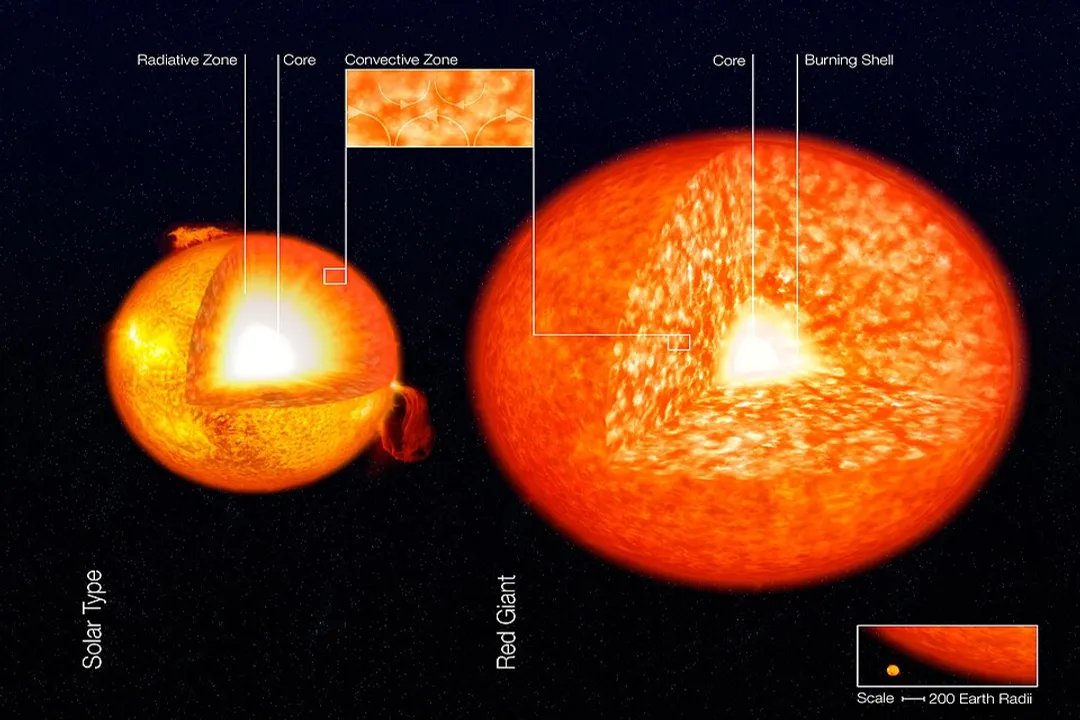
The answer to the question of lifespan is inextricably linked to the initial mass of the star. The $0.8$ to stars become red giants, while stars exceeding bypass this fate to become red supergiants—even larger and more luminous stars that experience a far more violent end via Type II supernova.
Massive stars burn through their hydrogen and helium cores in only a few million years on the main sequence. Consequently, their red supergiant phase is also short-lived, measured in a few million years before they fuse heavier elements up to iron, stopping fusion and collapsing violently. For these stars, the entire post-main sequence existence, including the red supergiant phase, is undeniably short, ending in a massive explosion that scatters heavy elements across space.
Conversely, the Sun-like star, which has a protracted main sequence life, enjoys a longer, though still finite, red giant phase. The Sun, for instance, is expected to spend about one billion years as a red giant before its outer layers are expelled.
# The Billion-Year Stop
It is helpful to visualize the lifespan difference in a more tangible way. If we take the Sun’s $10$-billion-year main sequence life as our baseline unit, the red giant phase, at one billion years, represents only one-tenth of that primary phase. If you condense the Sun's entire $11$-billion-year life (main sequence plus red giant phase) into a single human lifetime, say 80 years, the main sequence would occupy about $72$ years, while the entire red giant evolution, from initial swelling to planetary nebula ejection, would be compressed into a mere $7$ to $8$ years [Analysis based on ]. This drastic acceleration highlights why, cosmically speaking, the red giant phase is indeed short.
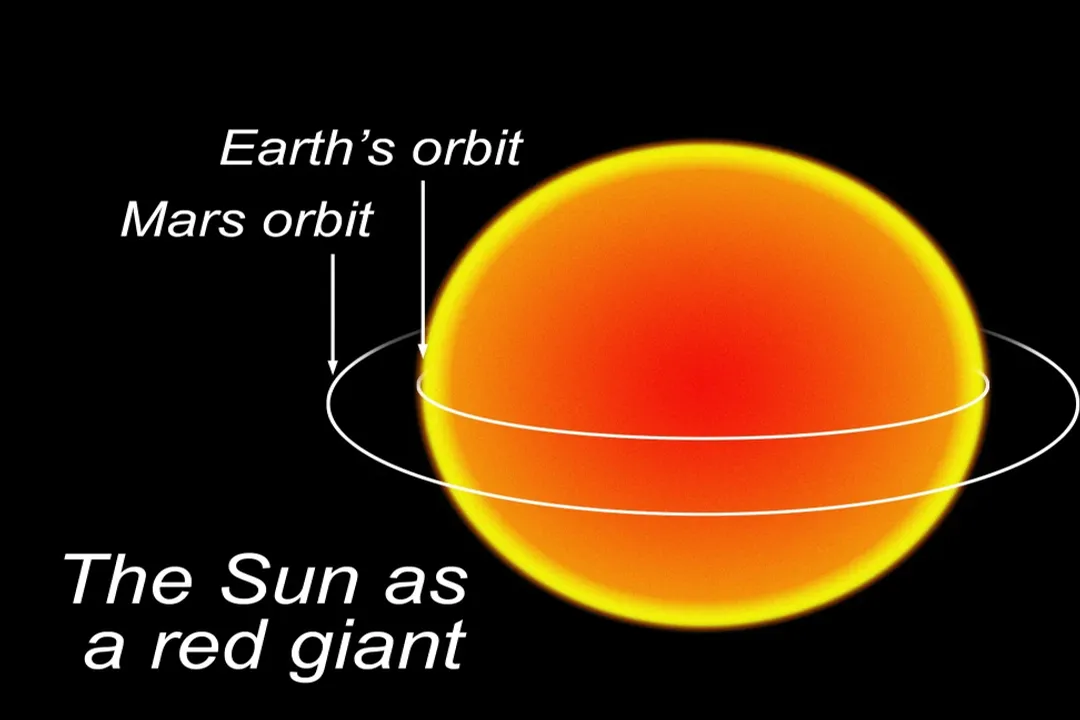
Furthermore, the destructive nature of the red giant phase means any life that survives the star's transition must rapidly adapt to extreme conditions. For our own Sun, when it becomes a red giant in about $5$ billion years, it will expand so much that it will engulf Mercury, Venus, and likely Earth. Even if Earth is not physically swallowed, the increased radiation will have sterilized the planet long before the final expansion, pushing the "habitable zone" far beyond Mars's current orbit. During the helium flashes on the AGB, conditions will fluctuate rapidly, potentially causing ice on outer moons like Europa or Enceladus to melt and refreeze on timescales of millions of years—a difficult environment for complex life to manage.
# Post-Giant Potential
While the red giant phase itself is a cosmic blink, the remnant it leaves behind offers a different timescale for consideration. After shedding its atmosphere, the core collapses into a white dwarf—a small, incredibly dense, Earth-sized object radiating residual heat.
A fascinating aspect of this stellar death is that the white dwarf remnant establishes a new habitable zone, much closer to the stellar corpse than where the red giant's zone was located. For the Sun’s future white dwarf, the habitable zone could remain stable for billions of years—a longevity rivaling the main sequence.
However, this presents a difficult challenge for any potential life. The red giant phase swells up and consumes the inner planets, potentially destroying any life that managed to move outward. For a planet to reside in the white dwarf's long-lived habitable zone, it would need to have survived the star’s rampage or somehow been captured into a new, tight orbit after the violent ejection of the outer layers. This scenario suggests that the shortest phase in the star's post-main sequence life (the ejection of the nebula, lasting only tens of thousands of years) paradoxically creates the longest-term potential for habitability in the system’s final stages. This post-mortem stability lasts orders of magnitude longer than the red giant phase itself.
In summary, red giants do live "short" lives relative to their main sequence youth, especially when compared to the trillion-year prospects of a red dwarf. The total lifespan of the red giant phase for a Sun-like star—about a billion years—is swift for a star, but it is the acceleration of changes in the later AGB stages that poses the greatest threat to any orbiting biology, making the red giant era an exciting but terminally brief destination in stellar history.
Related Questions
#Citations
Red giant - Wikipedia
Could life be possible around red giant stars? : r/askastronomy
What are red giants? Our sun will become one! - EarthSky
Stellar Evolution - | The Schools' Observatory
Red Giants | Terraforming Wiki - Fandom
Red Giant Star: Journey to the Late Stages of Stellar Life - The Planets