Which stars live longer, high or low-mass?
The lifespan of a star is not determined by random chance or external factors, but by one singular, dominant characteristic: its mass. [8] Put simply, the heavier a star is when it forms, the shorter its life will be, and conversely, the lighter it is, the longer it will endure. [6][9] This seemingly straightforward relationship is the bedrock of stellar evolution, dictating everything from a star's color and temperature to its final spectacular demise. [8]
# Mass Determines Destiny
Stars spend the vast majority of their existence anchored to what astronomers call the main sequence, a stable phase where they fuse hydrogen into helium in their cores. [2] During this period, the star’s mass sets the rules for how quickly it burns through its nuclear fuel. [6] When comparing a high-mass star, perhaps twenty times the mass of our Sun, to a low-mass star like a small red dwarf, the difference in longevity is staggering. [9]
A star's mass directly correlates with the pressure and temperature required in its core to counteract gravity and maintain hydrostatic equilibrium. [8] More mass means a greater gravitational crush, demanding far higher core temperatures to keep from collapsing. [7] This intense heat acts as a hyper-efficient furnace, driving nuclear fusion at an utterly furious pace in the massive star. [7]
# Fuel Burn Rate
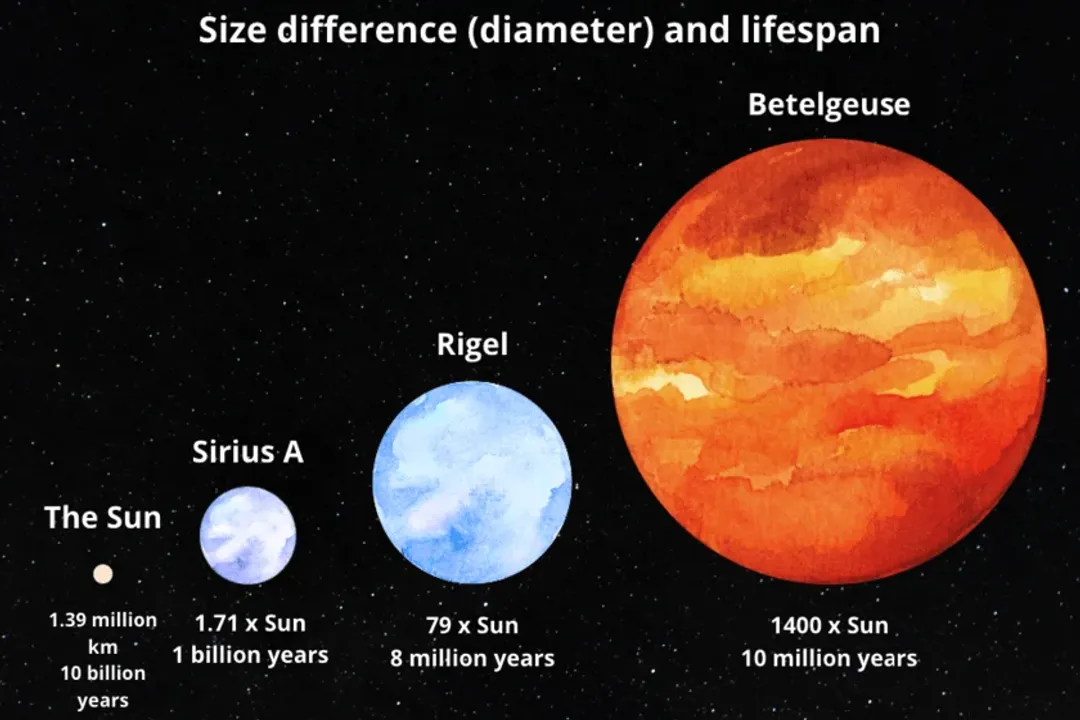
To truly grasp the disparity, consider the difference in fuel consumption. A star that possesses ten times the mass of the Sun doesn't just burn its fuel ten times faster; it burns it about a thousand times faster. [7] This extreme inefficiency is why massive stars live so briefly in cosmic terms. While our Sun is expected to live for about 10 billion years on the main sequence, a star ten times its mass might only last for 20 million years—a veritable blink of an eye across the universe’s timeline. [9]
Imagine a fleet of identical cars where you have an infinitely long road to drive. For the low-mass car, you sip fuel meticulously, driving gently enough that you might never run out of gas within the known history of the cosmos. For the high-mass car, you floor the accelerator from the start, knowing the tank will empty in a matter of hours or days. [7] The fuel source is the same—hydrogen—but the rate at which it is converted into energy is governed by that initial mass budget. [6]
# Longevity Champions

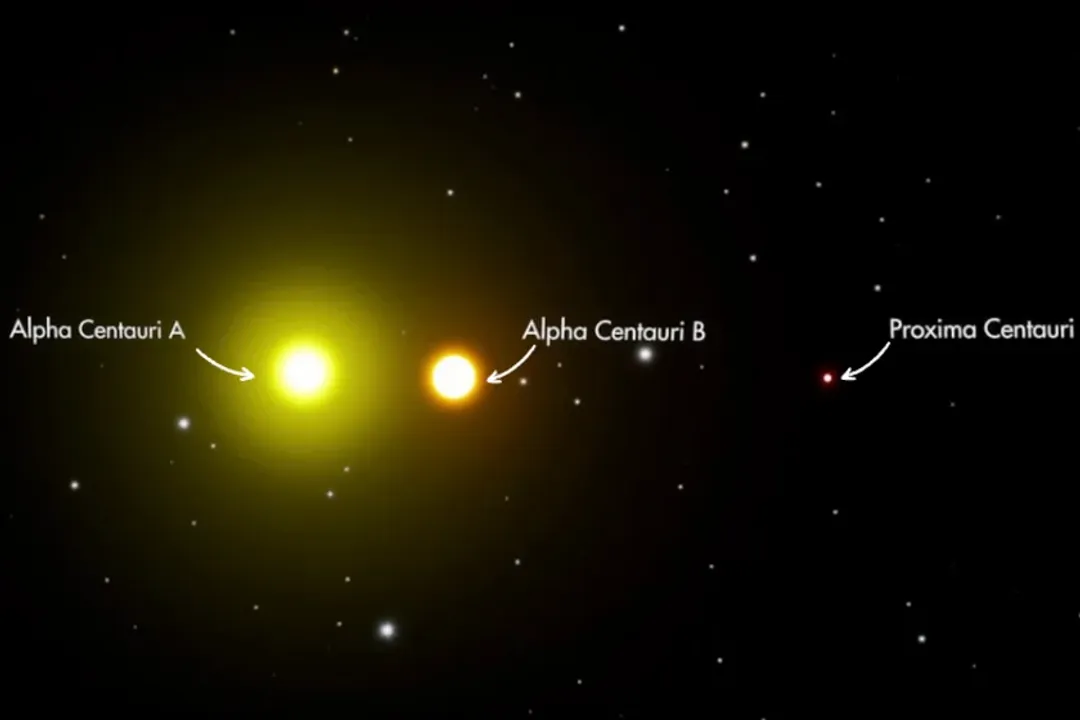
The true record-holders for stellar lifespan are the smallest, least massive stars: red dwarfs. [3][5] These faint, cool objects are incredibly frugal with their hydrogen supply. [5] Because they are so small, the required core temperature is relatively low, meaning fusion occurs at an agonizingly slow crawl. [5]
The longest-lived stars in the universe are theorized to be these red dwarfs, with estimated lifespans reaching into the trillions of years. [9] This timescale is immensely difficult for the human mind to process, as it dwarfs the current age of the universe, which is roughly 13.8 billion years. [9] Therefore, every red dwarf that has ever formed since the Big Bang is still burning hydrogen today, waiting patiently for an evolutionary end that is still many eons away. [3]
# Evolutionary Paths Diverge
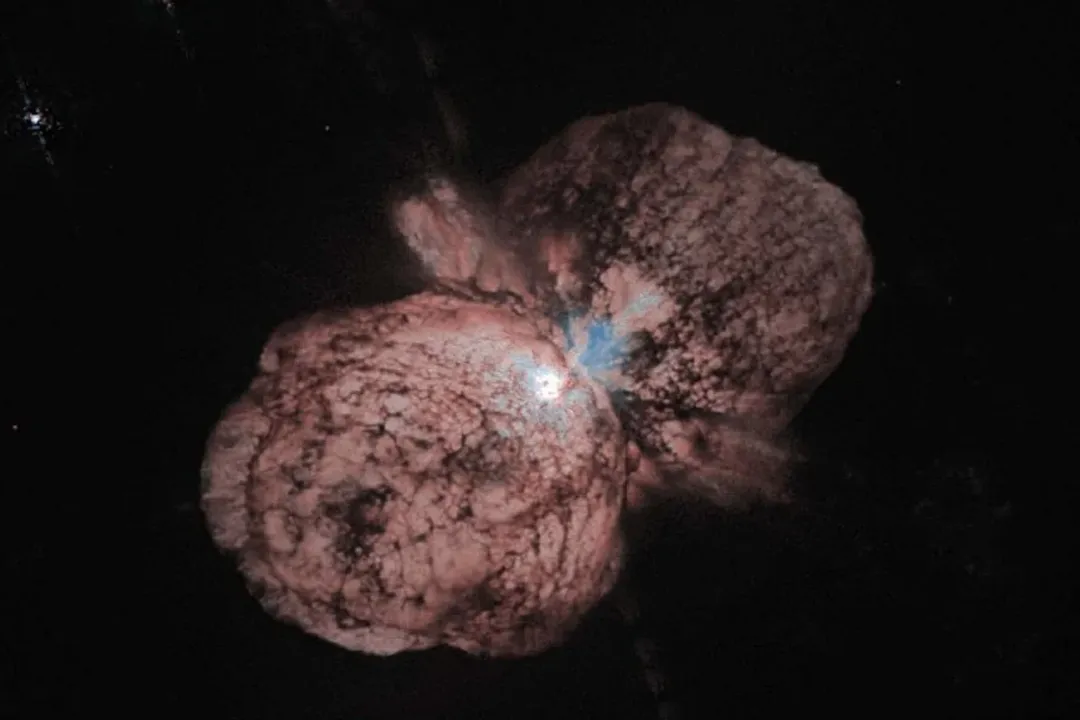
Mass not only dictates how long a star lives but also how it dies. [2] Once a star exhausts the hydrogen in its core, its fate is sealed by its initial mass, which determines its subsequent stage, often involving expansion into a giant phase. [2]
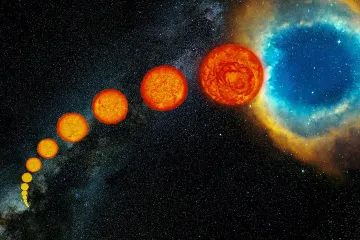
For instance, while the main sequence lifetime is the longest part of any star's life, even within the red giant classification, mass still plays a role. Low-mass red giants, after their initial hydrogen burning, evolve differently than their more massive counterparts, and their giant phases tend to last longer than the equivalent phases in higher-mass stars. [4] However, this is a secondary consideration; the primary driver remains the initial main sequence duration, which dwarfs all other phases combined. [2]
When a star exhausts its fuel, its subsequent path can lead to vastly different endpoints: white dwarfs, neutron stars, or, for the most massive stars, black holes. [2] A star like our Sun will swell and then shed its outer layers to become a white dwarf, a process taking billions of years. A star many times the Sun’s mass will end its life in a spectacular supernova explosion. [2]
# Astrophysical Perspective
It is useful to keep the scale of stellar lifetimes in perspective when thinking about the cosmos. Our own Sun, a decidedly average G-type star, is currently about halfway through its main sequence life, having formed approximately 4.6 billion years ago. [8] This means it still has about 5 billion years left before it starts its transition phase. [8] For every second our Sun has existed, a star 50 times its mass has already burned through its entire existence and is now a remnant object, perhaps having already collapsed into a black hole. [7]
If we consider the possibility of life arising on a planet orbiting a low-mass star, the evolutionary stability is almost incomprehensible. Planets around a red dwarf might enjoy a habitable environment for tens of trillions of years. [9] This offers an extraordinary amount of time for biological evolution to proceed, dwarfing the entire history of complex life on Earth by orders of magnitude. While red dwarfs present challenges for habitability—such as tidal locking and extreme flare activity—their unparalleled longevity offers an almost infinite window for potential slow-moving development, a concept starkly contrasting with the ephemeral existence afforded by life near high-mass stars. [5]
Related Questions
#Citations
Homework 7 & 8 Flashcards - Quizlet
Stellar evolution - Wikipedia
The Lives of the Longest Lived Stars - aavso
Do low-mass red giants last longer than high-mass red giants?
Here's why they live for so long Red dwarfs are the longest-lived ...
Main Sequence Lifetime | COSMOS
Why do larger/higher mass stars have shorter lifespans? - Reddit
Star Basics - NASA Science
How Long Do Stars Live? - Label Stars