How does mass impact a star?
The fundamental property that dictates nearly every aspect of a star's existence, from its color to its final spectacular death, is its mass. This single attribute sets the parameters for its internal furnace, determining how long it burns, how bright it shines, and what it ultimately leaves behind in the cosmic graveyard. Stellar mass is usually measured in units of solar mass (), where one solar mass is the mass of our own Sun. Understanding this scale is key; stars can range from meager brown dwarfs, which barely qualify as stars, up to behemoths that might possess more than a hundred times the mass of the Sun.
# Mass Scales

The distribution of stellar masses in the universe is not uniform. When astronomers map out how many stars form at different weights, they find a clear pattern described by the Initial Mass Function (IMF). This function shows that while massive stars are incredibly important for chemical enrichment and spectacular events, they are statistically rare. In contrast, low-mass stars, those significantly smaller than the Sun, are the most common inhabitants of galaxies.
A star’s fate is entirely pre-written based on its initial weight. A star that begins its life with about $0.08$ times the mass of the Sun or less will never ignite stable hydrogen fusion and will likely become a brown dwarf, a failed star. On the other end of the spectrum, the most massive stars, those exceeding roughly eight times the mass of the Sun, are destined for explosive conclusions. Even stars with only a few solar masses will follow a path very different from our Sun.
# Fuel Consumption
Mass governs the pressure and temperature within a star's core, which directly controls the rate of nuclear fusion. Simply put, a heavier star has a more immense gravitational squeeze, forcing its core hotter and denser than a lighter star's core. This increased heat causes hydrogen fuel to fuse into helium at a vastly accelerated pace.
The relationship between mass and luminosity—the total energy output—is extreme. This concept is often summarized by the mass-luminosity relation, where luminosity () scales with mass () raised to a power, often around $3.5$ for main-sequence stars. This means a small increase in mass yields a massive increase in energy output. For instance, a star that is just twice the mass of the Sun might shine perhaps ten times brighter. Thinking about this mathematically, the extreme exponent in that scaling factor means that for every doubling of mass, the available fuel is burned away exponentially faster than one might intuitively expect. This fundamental physical principle sets the stage for the next crucial impact of mass: lifespan.
# Lifespan Compression
Because massive stars burn their fuel so prodigiously, their lives are surprisingly brief relative to their size. This relationship creates a stark contrast across the stellar population. Our Sun, a medium-sized star, is expected to reside on the main sequence for about 10 billion years. A low-mass star, like a red dwarf with perhaps , burns its fuel so slowly and coolly that it can survive for hundreds of billions or even trillions of years—longer than the current age of the universe.
The high-mass stars, however, live fast and die young. A star beginning with might exhaust its core hydrogen in only a few tens of millions of years. To put that into perspective, if one were to watch a Sun-like star, it would live through more cycles of human civilization than we can count, whereas the entire history of Homo sapiens would barely register as a brief flash in the existence of a blue supergiant. This extreme compression of existence means that the massive stars, despite their rarity, are responsible for seeding the galaxy with heavy elements very quickly after star formation events.
# Evolutionary Paths
The mass a star is born with dictates the entire sequence of its later life, leading to two very distinct evolutionary tracks: the modest retirement of low-mass stars and the violent exit of high-mass stars.
# Low-Mass Evolution
Stars with masses between about and follow a relatively gentle path toward retirement. After exhausting core hydrogen, they begin fusing hydrogen in a shell around the core, causing the outer layers to swell dramatically and cool, turning them into Red Giants. Once the helium in the core ignites, the star stabilizes for a time before entering the final phases. Eventually, these stars shed their outer layers into space, creating beautiful, expanding shells of gas known as planetary nebulae. The remnant left behind is a dense, hot core called a White Dwarf. This white dwarf slowly cools over eons, no longer generating energy through fusion.
# High-Mass Evolution
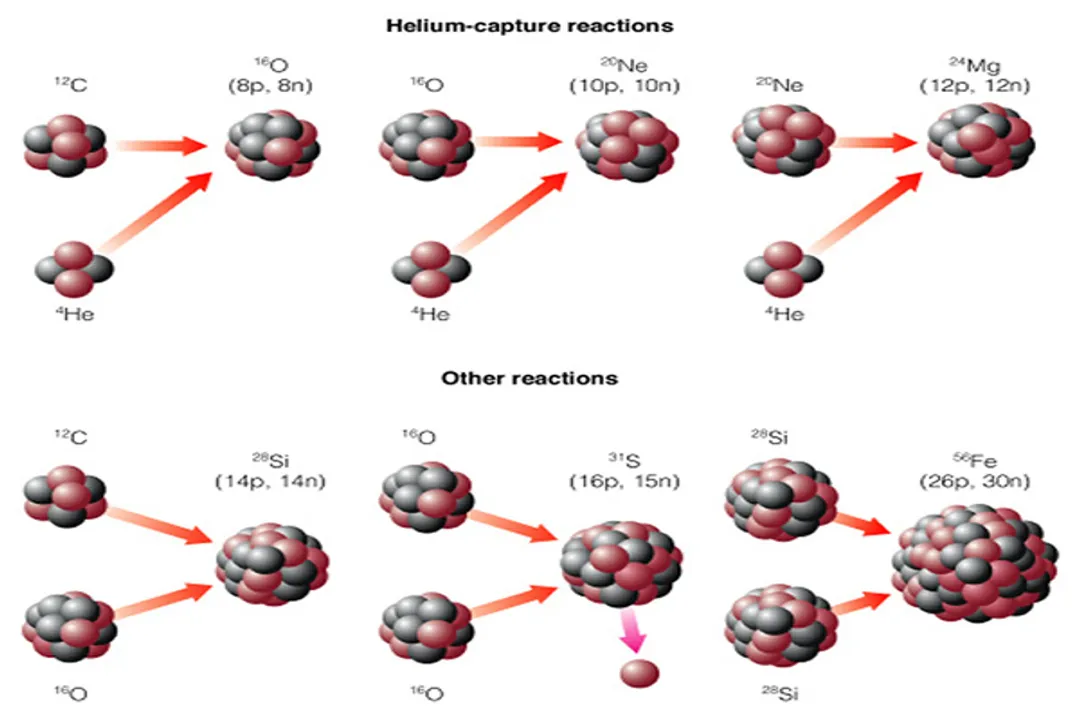
Stars above that threshold follow a path of increasing drama. Due to their extreme core temperatures, they can fuse progressively heavier elements once hydrogen is depleted—helium into carbon, carbon into neon, and so on, building up an 'onion-like' structure of shells. This process continues until the core attempts to fuse iron. Since fusing iron consumes energy rather than releasing it, the fusion furnace suddenly switches off, and gravity wins instantaneously.
This catastrophic collapse triggers a rebound shockwave, resulting in a Type II Supernova explosion. This explosion is so energetic it can briefly outshine entire galaxies and is responsible for forging elements heavier than iron, scattering them throughout the cosmos.
# Remnant Destiny
The final remnant left after a supernova is also entirely dependent on the initial mass of the star, although a small secondary dependence exists on the mass remaining after the explosion.
If the progenitor star was massive (perhaps between and ), the remaining core, though incredibly dense, might still be supported against total collapse by neutron degeneracy pressure. This forms a Neutron Star. These objects are mind-bogglingly compact; a star many times the mass of the Sun is compressed into a sphere only about 20 kilometers across.
For the truly most massive stars—those exceeding approximately at birth—the core remnant will be so heavy that no known force can halt its collapse. This ultimate victory of gravity results in a Black Hole, a region of spacetime where gravity is so intense that nothing, not even light, can escape.
In summary, the initial mass acts as a master switch for a star. It dictates the required core temperature, which controls the burn rate and luminosity, which in turn determines the length of the main sequence phase. This initial decision then routes the star down one of two primary evolutionary highways—the slow, peaceful retirement of a sun-like star into a white dwarf, or the rapid, explosive demise of a giant into a neutron star or black hole. Observing a star’s current mass, luminosity, or chemical composition gives astronomers an immediate and precise reading on its entire biography and its coming fate.
#Videos
How Does Mass Affect a Star's HR Diagram Evolution? - YouTube
Related Questions
#Citations
Stellar mass - Wikipedia
How Does Mass Affect a Star's HR Diagram Evolution? - YouTube
The Life Cycles of Stars: How Supernovae Are Formed
The Initial Mass Function | Center for Astrophysics
Star mass - Stellar Catalog | Discover the nearby universe
The Mass-Luminosity Relationship | ASTRO 801
High-Mass Stars | Research Starters - EBSCO
Stellar Evolution - | The Schools' Observatory
The Lives of High Mass Stars - NMSU Astronomy
How does mass affect a star life cycle class 10 biology CBSE