Can a high-mass star become a supernova?
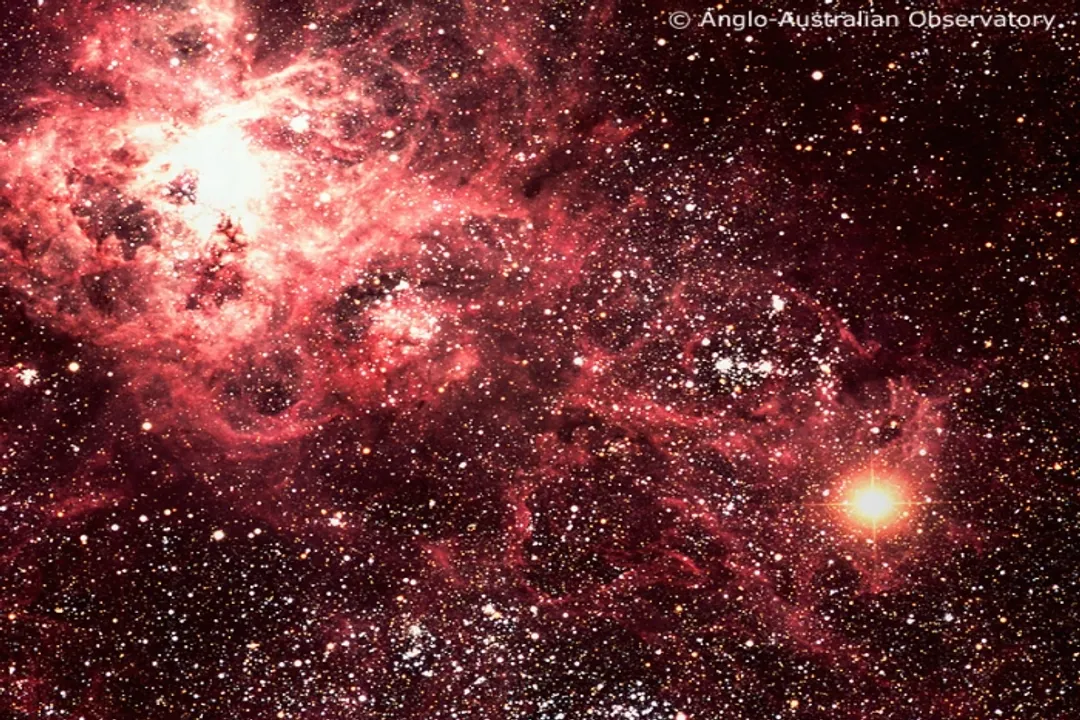
The violent, incandescent death of a star, known as a supernova, is one of the most spectacular events in the cosmos, and it is reserved almost exclusively for stars that begin life with significant heft—the high-mass stars. Not every star in the universe, including our own Sun, is destined to end its existence in such a dramatic fashion. The fate of a star is inextricably linked to its initial mass; it acts as the ultimate arbiter of its life cycle and spectacular finale.
# Mass Determines Fate
The primary prerequisite for a core-collapse supernova—the type associated with massive stars—is reaching a critical mass threshold. Stars that are not sufficiently massive simply run out of fuel, shed their outer layers, and contract into a white dwarf, perhaps eventually cooling into a black dwarf. However, the stars we are discussing here are substantially larger than the Sun, sometimes beginning their lives with masses exceeding eight or ten times that of our star.
If a star is massive enough to initiate the thermonuclear fusion processes that build up heavier elements in its core, it will eventually reach the point where fusion ceases to produce outward pressure capable of counteracting gravity. Specifically, when a star's core fuses elements all the way up to iron, it hits a dead end. Iron fusion consumes energy rather than releasing it, meaning the thermal pressure supporting the star against its own immense gravitational pull vanishes almost instantly.
It is interesting to consider the lower bound. While the Sun will become a white dwarf, a star with perhaps solar masses might still be on the edge of producing a Type II supernova, although the remnant fate can be complex. The core must reach a mass threshold, often cited around $1.4$ solar masses (the Chandrasekhar limit for electron degeneracy pressure) but then growing much larger due to the overlying stellar material, before collapse is inevitable. If the core is simply too small to reach these critical conditions, the star simply will not detonate as a Type II supernova.
# Core Implosion
When the iron core forms and supporting pressure collapses, the speed of the implosion is staggering, approaching a significant fraction of the speed of light. This inward rush of material compresses the iron atoms so tightly that protons and electrons merge into neutrons, a process called inverse beta decay.
The collapse continues until the core reaches nuclear densities—a state where the repulsive forces between neutrons effectively halt the infall, creating a rigid neutron core. This sudden stop causes the rest of the star’s infalling outer layers to violently rebound off this incompressible core, sending a powerful shockwave outward that blasts the rest of the star into space. This outward explosion is the supernova event. The resulting light can briefly outshine an entire galaxy.
| Stellar Initial Mass (Solar Masses, ) | Final Fate (Simplified) | Primary End Mechanism |
|---|---|---|
| (Sun-like) | White Dwarf | Outer layers shed, core cools |
| Neutron Star | Core-collapse supernova (Type II, Ib, Ic) | |
| (Very Massive) | Black Hole or Neutron Star | Direct collapse or hypernova |
While the primary mechanism relies on this core collapse, it's worth noting that not all high-mass stars leave a standard neutron star. If the star is extremely massive, the pressure exerted by the collapsing core may exceed the maximum pressure that even neutrons can withstand, leading directly to a black hole formation, potentially bypassing a visible supernova or creating an especially energetic one.
# Pre-Explosion Mass Loss
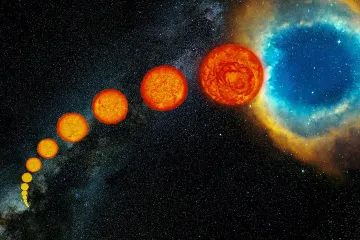
One fascinating aspect of these colossal stellar giants is their habit of shedding a significant portion of their outer layers before the final supernova explosion occurs. Massive stars burn through their fuel incredibly quickly due to their extreme core temperatures and pressures. This rapid, energetic life often results in intense stellar winds that blow away tremendous amounts of mass over millions of years.
An example observed by astronomers revealed a star that shed an astonishing amount of its mass shortly before its explosive demise. The star in question was initially predicted to be quite massive, but its final stages saw it eject material equivalent to about five times the mass of our Sun over a relatively short period, significantly reducing the amount of material available for the ensuing supernova. This dramatic weight loss means that a star that started as, say, a star might actually explode when it only possesses of material left, impacting the observed supernova characteristics. Understanding this pre-supernova shedding is critical for correctly classifying the resulting explosion, such as distinguishing between Type II supernovae (hydrogen envelope present) and Type Ib/Ic supernovae (envelope already lost). The final mass present at the moment of core collapse is arguably more important than the initial birth mass when predicting the remnant object.
# The Remnant Object
The aftermath of a high-mass star supernova is not empty space but rather the dense, collapsed core of what remains, which settles into one of two exotic objects. For stars that result in a core mass between about and (the Tolman-Oppenheimer-Volkoff limit), the object will stabilize as a neutron star. These are incredibly compact spheres composed almost entirely of neutrons, packing the mass of several Suns into a city-sized volume.
If the initial star was so massive that the remnant core exceeds that upper neutron degeneracy limit (roughly ), even the neutron pressure cannot halt gravity's relentless pull. In this scenario, the core collapses completely, creating a black hole. This distinction in remnant—neutron star versus black hole—is a direct consequence of the exact mass of the collapsing core, which itself is dictated by the star's initial mass and subsequent mass loss. A star that begins its life extremely massive, say or more, has a very high probability of skipping the neutron star phase entirely and forming a black hole instead.
# Distinguishing Explosions
While the core-collapse of a massive star is the most common context for discussing supernovae, it is important to acknowledge that "supernova" is a broad term. The explosions resulting from high-mass stars are generally classified as Type II (if they retain a hydrogen envelope), Type Ib, or Type Ic (if the hydrogen and/or helium envelopes have been stripped away, perhaps by those intense stellar winds mentioned earlier).
Contrast this with Type Ia supernovae, which occur in binary systems where a white dwarf accretes matter from a companion until it exceeds the Chandrasekhar limit and undergoes runaway thermonuclear fusion, rather than gravitational core collapse. A high-mass main-sequence star, by itself, does not undergo this process; it requires the physics of gravity overcoming degeneracy pressure after forming an iron core. Therefore, the specific mechanism—the iron core collapse—is what fundamentally defines the high-mass stellar death sequence, leading to the incredible energy release we observe. Understanding these different pathways reveals that a star’s mass doesn't just determine if it explodes, but how it explodes, which dictates what we see billions of light-years away.
Related Questions
#Citations
Causing a supernova : r/astrophysics - Reddit
Can a star be massive enough to go 'supernova' yet not be massive ...
Extreme Weight Loss: Star Sheds Unexpected Amounts of Mass Just ...
Do all stars eventually shrink down and go supernova or just ... - Quora
The Evolution of Massive Stars and Type II Supernovae | ASTRO 801
How Do The Most Massive Stars Die: Supernova, Hypernova, Or ...
Supernova explosions - Las Cumbres Observatory
The Life Cycles of Stars: How Supernovae Are Formed