How does a star go from a red giant to a planetary nebula?
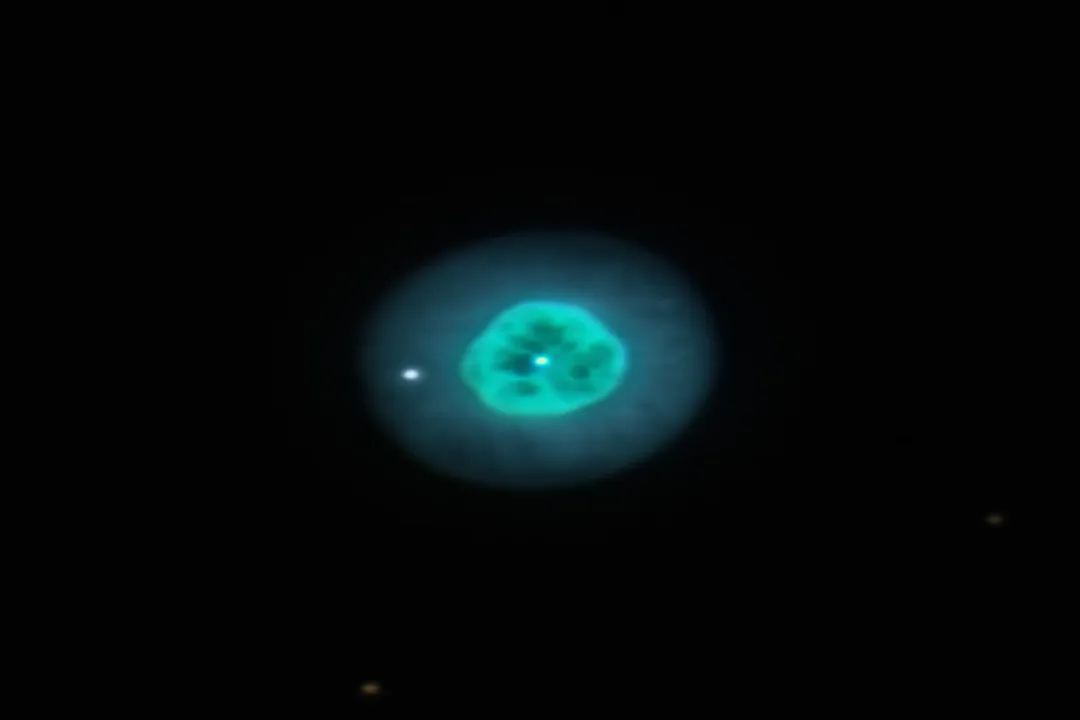
The journey of a Sun-like star from its expansive, aging phase as a red giant to the ephemeral beauty of a planetary nebula is one of the most visually striking transformations in the cosmos. It represents the final, dramatic shedding of mass that prepares the stellar core for its long, slow decline into a white dwarf. This process is not instantaneous; it involves millions of years of internal readjustment followed by a relatively brief period of intense atmospheric instability and mass ejection. [1][7]
# Core fuel exhaustion
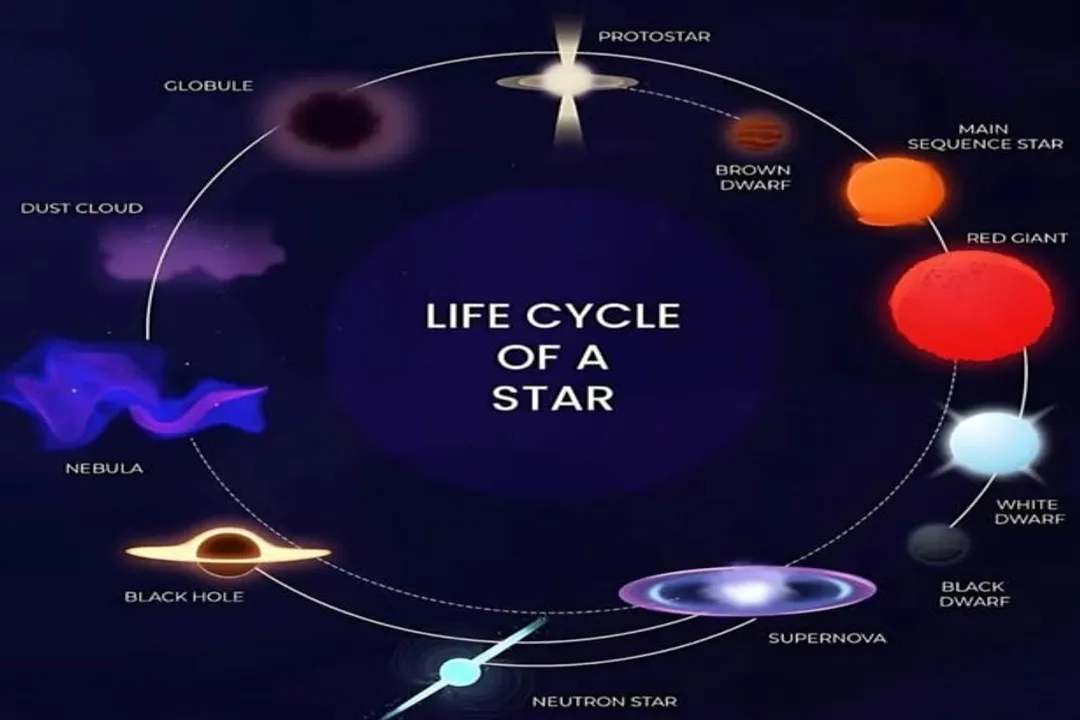
The story begins long after a star has finished its primary life phase on the Main Sequence, where it spent billions of years fusing hydrogen into helium in its core. [3][6] Once the hydrogen fuel in the very center is depleted, fusion ceases there, and gravity begins to win the long-standing battle, causing the inert helium core to contract and heat up significantly. [3][6] This central heating is crucial because it ignites a shell of fresh hydrogen surrounding the helium core, starting hydrogen shell burning. [3]
# Giant expansion
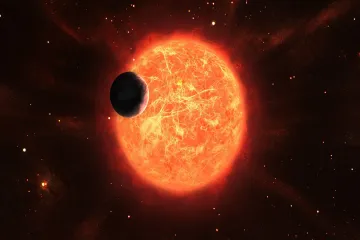
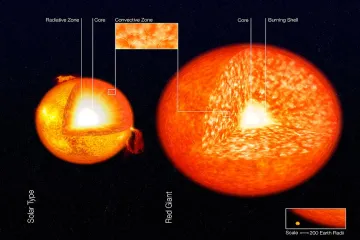
The energy output from this new, intense shell fusion is far greater than the previous core fusion was at its peak. [3] This massive surge of energy pushes the star’s outer layers outward, causing them to expand enormously—hundreds of times their original size. [3] As these outer layers puff up, the surface area increases dramatically, causing the surface temperature to drop, which shifts the star’s color toward the red end of the spectrum, thus earning it the name red giant. [3] For a star like our Sun, this expansion will eventually engulf the inner planets, including Mercury and Venus, and possibly Earth. [4] During this phase, the star becomes highly luminous but relatively cool on its surface. [1]
# Mass loss drivers
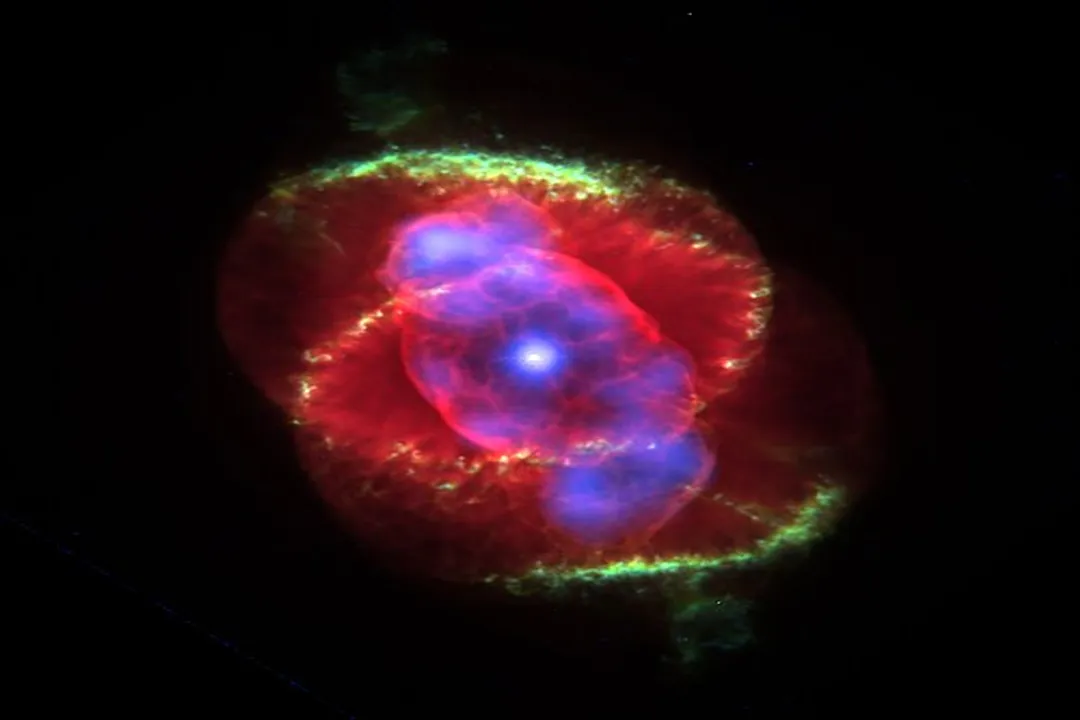
The instability that drives the ejection of the outer layers is primarily linked to thermal pulsations and very strong stellar winds. [4][6] As the star transitions, it becomes highly unstable, exhibiting stronger and more frequent pulsations that physically drive vast amounts of gas and dust away from the star’s surface. [4] These winds are incredibly dense and move much slower than the supersonic winds seen later, carrying away material at rates far exceeding what a Main Sequence star expels. [7] The star is literally blowing off its atmosphere. Think of it like a gigantic, sustained stellar sneeze that lasts for millennia. [1] This phase of heavy mass loss continues for perhaps 50,000 years, slowly stripping the star down to its superheated interior. [5][7] The mass loss rate can be astonishing—sometimes reaching solar masses per year. [7]
It is fascinating to consider the sheer difference in timescales here. A star like the Sun spends roughly 10 billion years fusing hydrogen steadily, but the entire post-red giant transformation, from the start of significant mass loss to the full formation and fading of the planetary nebula, occurs over mere tens of thousands of years. [5] This means that while the red giant phase feels relatively permanent on a cosmic scale, the subsequent dramatic event is over in the blink of an astronomical eye.
# Hot remnant core
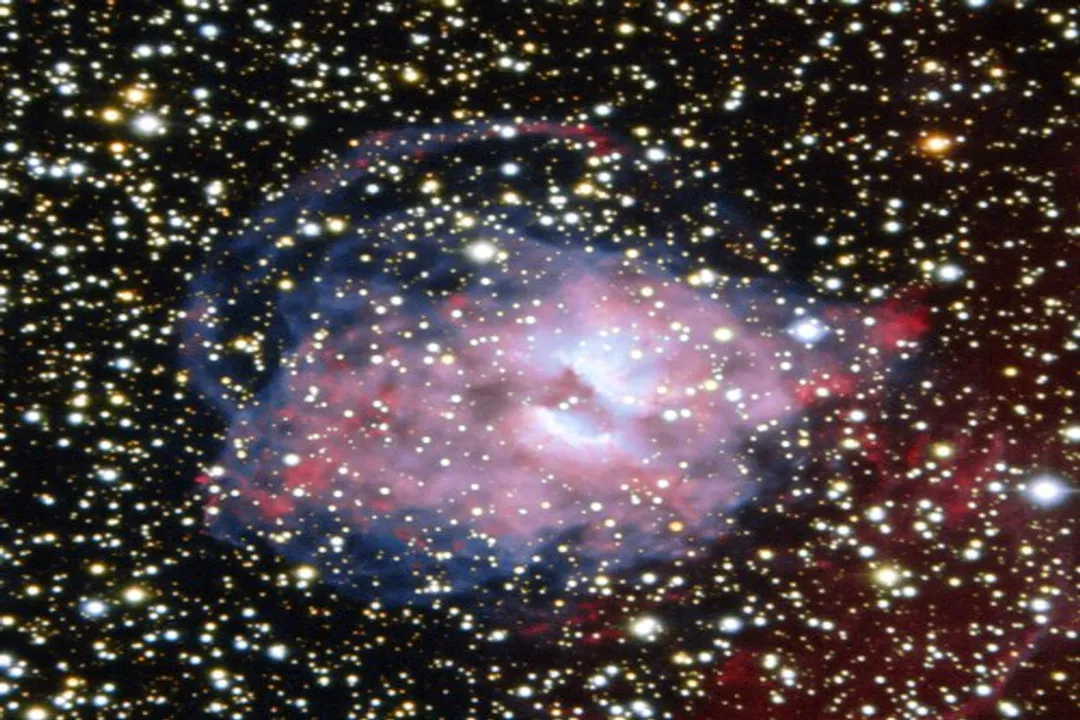
As the outer envelope is steadily blown away by the stellar winds, the contracting, inert core—which has now begun fusing helium into carbon and oxygen—is progressively exposed. [3] This remaining core is incredibly hot, a dense sphere called a white dwarf. [7] This exposed core is the engine room for the next act. Although the star has lost perhaps 50 to 80 percent of its original mass, that remaining core is only about half the mass of the original Sun, compressed into a volume similar to that of Earth. [7][3]
# Gas ionization glow
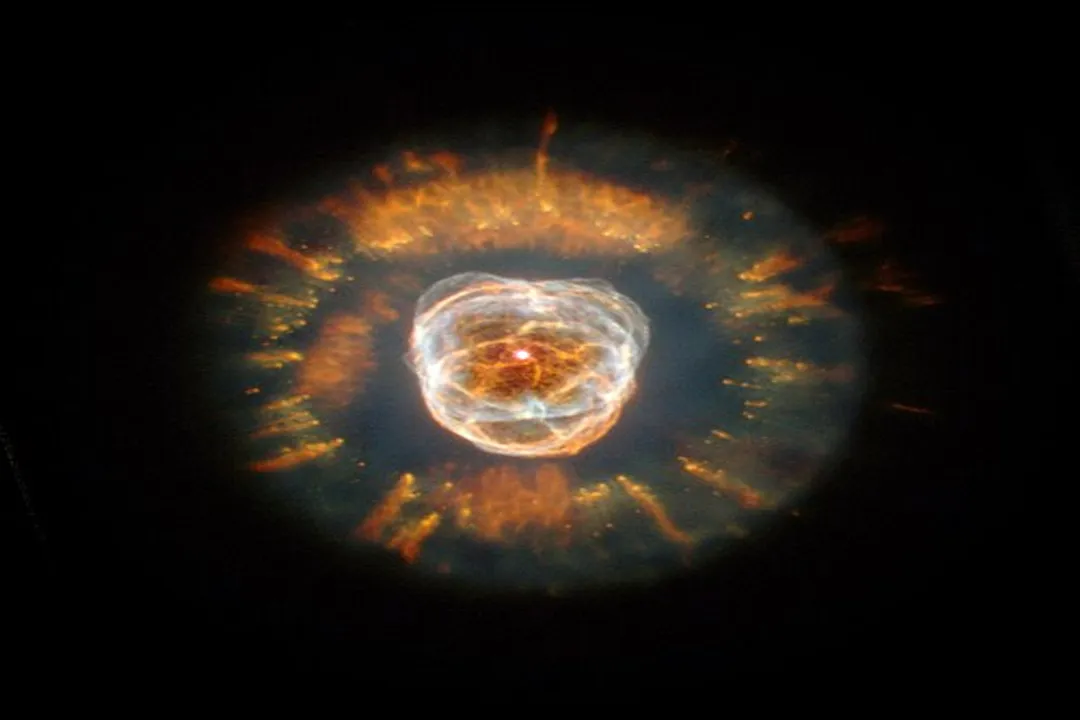
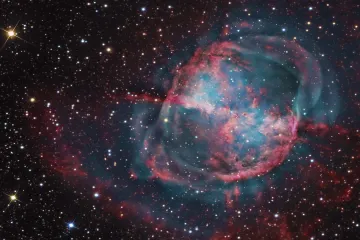
The planetary nebula itself is not the ejected material per se, but rather the material illuminated by the newly revealed core. [5] The surface temperature of the hot, exposed white dwarf remnant skyrockets, reaching temperatures that can exceed $100,000$ Kelvin. [5] This extremely hot object emits copious amounts of intense ultraviolet (UV) radiation. [5][6] When this high-energy UV light strikes the cooler, expanding shell of gas that was just ejected, it strips electrons from the gas atoms—a process called ionization. [5][6] When these electrons are later recaptured by the ions, they emit light at very specific wavelengths, causing the gas to glow brilliantly in vibrant colors like reds and greens. [5] This ionized shell is what we observe as the planetary nebula. [5][7] It is important to note that the name is a historical misnomer; these objects have no actual connection to planets, having acquired the name because early telescopes made them look like fuzzy, round planetary disks. [7]
If we were to look at the energy involved, it provides a neat conceptual framework for understanding the transition. The red giant was primarily shedding mass through relatively cool mechanisms. In contrast, the white dwarf produces its light not through burning (though it is extremely hot), but through radiating away its immense residual thermal energy. [7] Therefore, the visible light of the nebula is the signature of the core’s cooling, channeled directly into lighting up the material it just discarded.
# Nebula structure
Planetary nebulae are not simple, uniform bubbles of gas. They exhibit remarkable structural diversity, which astronomers use to study the magnetic fields and rotation of the central star just before and during ejection. [2][7] While some appear nearly spherical—like the classic appearance that gave them their name—many others are bipolar, showing two opposing lobes of gas. [2][7] The mechanisms driving these varied shapes are still areas of active study, but explanations often involve fast winds interacting with slower, previously ejected material, or the influence of companion stars or strong magnetic fields shaping the outflow. [2][7]
# Fading light
The brilliance of a planetary nebula is fleeting. [5] Once the gas is ejected, it continues to expand outward into the interstellar medium. [5] Because the ionizing source is the exposed core, and the gas is rapidly thinning out as it expands, the visual spectacle wanes quickly on astronomical timescales. [5] The entire illuminated phase lasts perhaps only $10,000$ to $50,000$ years before the gas density drops too low for the UV radiation to cause significant excitation. [5] After this period, the material simply diffuses into the general interstellar medium, becoming undetectable as a nebula. [7] The remaining central object, the white dwarf, continues to cool down slowly over the eons, eventually becoming a cold, dark black dwarf. [3][7]
The formation of a planetary nebula is truly the final act of stellar material recycling for Sun-like stars. The nebula enriches the galaxy with elements heavier than hydrogen and helium—the very elements necessary to build future stars, planets, and life—before the remnant core settles down for its long, quiet fade. [1]
#Videos
How Does A Red Giant Become A Planetary Nebula? - YouTube
How Do Red Giants Create Planetary Nebulae? - Physics Frontier
Related Questions
#Citations
How Does A Red Giant Become A Planetary Nebula? - YouTube
Red giant and it's planetary nebula : r/astrophysics - Reddit
Stellar Evolution - | The Schools' Observatory
What causes a red giant to eject its outer layers, forming a planetary ...
Planetary Nebula - ESA/Hubble
Planetary nebula - Wikipedia
The lifecycle of stars: red giant phase - Facebook
Stellar Death Match I: Planetary Nebulae - Introduction to Astronomy