What are the elements in a giant star?
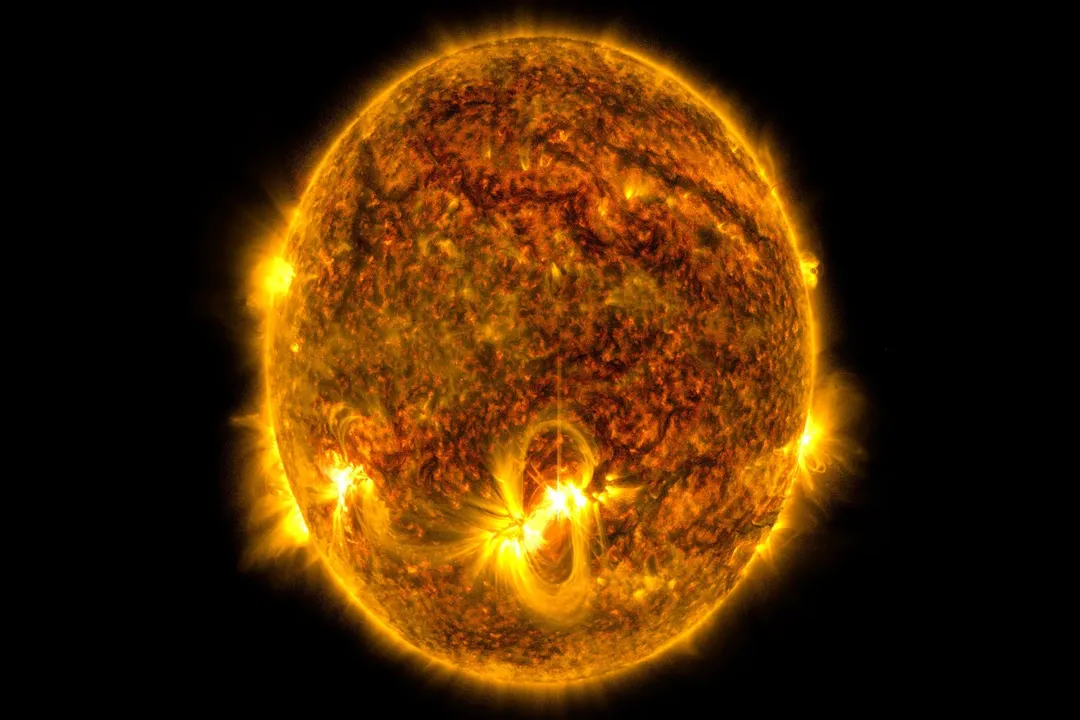
The elemental makeup of a giant star is a direct consequence of its life story, a long-term nuclear process that builds the building blocks of the cosmos. While it might seem logical that an ancient, massive star could transmute everything into the heaviest elements, the reality is dictated by the physics of energy release and stability. Generally, all stars, regardless of eventual size, begin their existence with an overwhelming majority of the lightest elements forged in the Big Bang.
# Initial Inventory
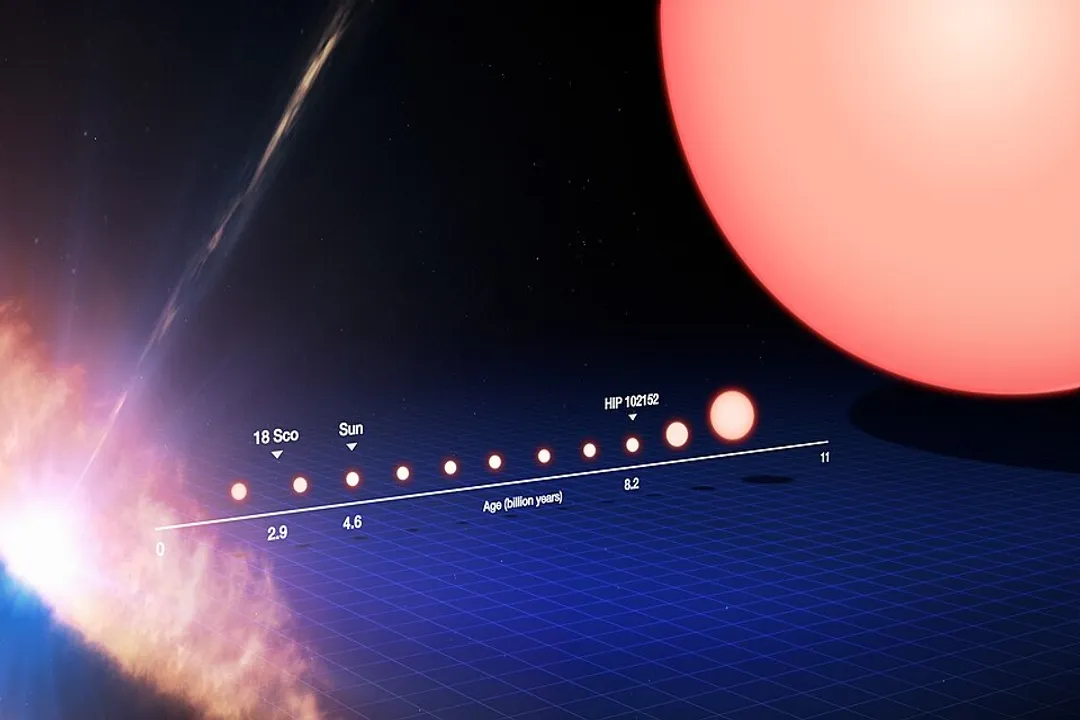
When a star first condenses from the vast, cold molecular clouds of gas and dust, its bulk composition is heavily skewed toward the two lightest elements. By number, hydrogen () dominates, followed by helium (). In astrophysical terms, everything else—carbon, oxygen, iron, gold—is lumped together and referred to as "metals" (). For a star forming from material with solar metallicity, the mass fractions are approximately 70% hydrogen (), 28% helium (), and just 2% metals ().
For smaller stars, like our Sun, the main-sequence lifetime—the phase where core hydrogen fuses into helium—lasts for billions of years. During this phase, the core becomes rich in helium, but the star's structure often keeps this processed material confined. Stars like the Sun develop a radiative zone surrounding the core where energy moves as photons; this layering prevents the newly formed helium from mixing with the outer layers, which remain mostly pristine hydrogen. Therefore, when a Sun-like star evolves into a red giant, the surface composition that we measure through light analysis still reflects its original, hydrogen-dominated state, even as the core chemistry changes drastically.
# Red Giant Chemistry
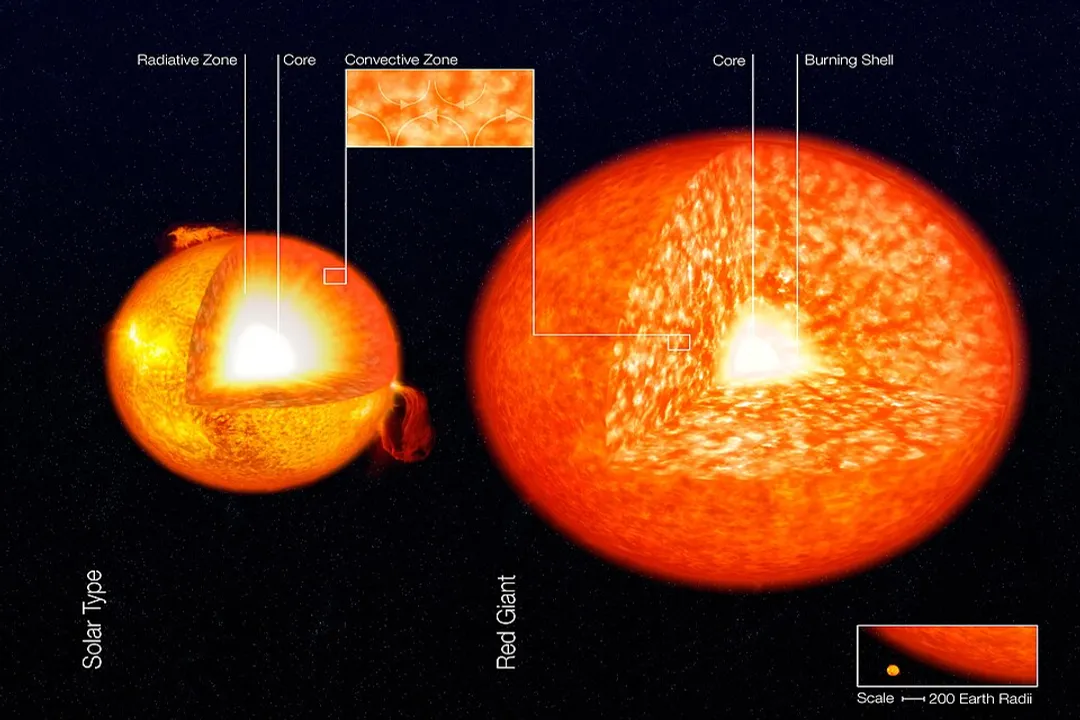
When a star of low or intermediate mass exhausts the hydrogen fuel in its core, it leaves the main sequence and swells into a red giant. The core contracts under gravity, increasing temperature until a shell of hydrogen surrounding the inert helium core ignites. This shell-burning phase forces the outer layers to expand dramatically.
As this process continues, the inert helium core eventually reaches about . At this temperature, helium nuclei begin to fuse into carbon via the triple-alpha process. In stars around $4$ to $6$ solar masses, this is often the final major step. If the star is massive enough to reach the Asymptotic Giant Branch (AGB), it undergoes a second phase of expansion where a helium-burning shell operates outside the degenerate carbon-oxygen core. This evolutionary stage allows for material created deep inside, like carbon and helium, to be convected up to the surface in what is known as the second dredge-up.
# Supergiant Layers
Stars significantly more massive than the Sun—those that become red supergiants—have enough gravitational pressure to trigger a much more complex sequence of nuclear burning. These stars burn their fuel hotter and exponentially faster, lasting only a few million years compared to the Sun's 10-billion-year main-sequence life.
In these truly giant stars, the core progressively contracts and heats, igniting heavier elements in successive stages that create an internal structure resembling an onion.
The sequence of fusion layers in a massive supergiant's late stages often looks like this, moving from the center outward:
- Iron-group elements (, ) in the innermost core.
- A silicon-burning shell producing iron-group elements.
- An oxygen-burning shell producing silicon and sulfur.
- A neon-burning shell.
- A carbon-burning shell.
- A helium-burning shell producing carbon and oxygen.
- An outer hydrogen-burning shell.
The elements synthesized are dependent on the mass of the star, with larger stars achieving the higher ignition temperatures required to fuse successively heavier atomic nuclei.
# The Iron Barrier
The entire chain of fusion reactions that generates stellar energy—from onward—stops abruptly at iron (). Iron nuclei possess the most stable configuration of any element in terms of binding energy per nucleon. Any attempt to fuse iron into an even heavier element does not release energy; rather, it consumes energy.
Once the core is converted to iron, the star loses its energy source required to counteract gravity, leading to an immediate, catastrophic collapse. The thermal energy that supported the star against its own immense weight vanishes almost instantly. This collapse halts only when the core reaches incredible densities, forming neutron degenerate matter, which then rebounds in a massive shockwave—the supernova explosion.
# Beyond Iron Forging
If core fusion ceases at iron, where do elements like gold (), platinum (), and uranium () originate? These elements require energy input to form, meaning they cannot be created during the normal, energy-releasing fusion stages. Their creation occurs during the cataclysmic conditions of stellar death or specific late-stage shell burning.
Two primary processes are responsible for building elements heavier than iron:
- The -process (Slow Neutron Capture): This occurs over thousands of years, often in evolved stars on the asymptotic giant branch, where nuclei slowly capture neutrons.
- The -process (Rapid Neutron Capture): This requires extremely high densities of free neutrons and occurs rapidly, traditionally associated with the shockwave of a supernova explosion.
More recent astronomical observations, particularly those involving gravitational wave detectors like LIGO, have dramatically reshaped our understanding of the heaviest elements. It is now theorized that the collision of two neutron stars—an event of unimaginable violence—is a prodigious factory, creating massive amounts of the heaviest, neutron-rich elements, perhaps creating more gold in a single merger than exists on Earth.
While a massive star's core fusion stops at iron, it is the mechanism that ejects the star and powers the subsequent creation processes that yield everything else. The stability of iron means it is a common "ash" product compared to the elements just slightly heavier, such as titanium or copper, which require the extreme energy of an explosion to form. The creation of the universe's heavy elements is thus a story of two separate factories: core fusion up to iron, and cataclysmic events like supernovae and neutron star mergers for everything heavier.
# Cosmic Recycling
The purpose of a star's life, from the perspective of cosmic chemistry, is not just to shine, but to manufacture and distribute new elements. For these synthesized materials to seed future generations of stars and planets, the star must eject them into the interstellar medium.
This dispersal happens in several ways depending on the star's final fate:
- Low-mass stars (like the Sun): They gently shed their outer layers via stellar winds, creating a planetary nebula. The exposed core cools into a white dwarf, locking up much of the processed helium, carbon, and oxygen inside.
- High-mass stars: They end in a violent supernova explosion, blasting their interior materials—including the fusion products up to iron, plus those created during the explosion—outward.
- Wolf-Rayet Stars: Before their final supernova, some of the most massive stars experience such intense mass loss that their outer, hydrogen-rich envelopes are stripped away, exposing surfaces rich in helium, carbon, nitrogen, or oxygen.
The material scattered into space enriches the next cycle of molecular clouds. This enrichment process explains why second-generation stars, like our Sun, contain a higher fraction of these heavier elements ("metals") than the very first, pristine stars formed after the Big Bang. This cycling is the continuous mechanism by which the basic inventory of and transforms into the rich chemical diversity we observe today.
Related Questions
#Citations
Star Basics
Red giant
What's the elemental composition of supergiant stars?
Why do second and third gen stars contain heavier ...
The Creation of Heavy Elements
Are red giants still primarily made of hydrogen? What is ...
Large Stars - What is Your Cosmic Connection to the Elements?