How does a large star create elements?

The universe is an extraordinary chemical laboratory, and the engine driving the creation of nearly every element heavier than hydrogen and helium is the massive star. These colossal objects, burning millions of times brighter than our Sun, spend their lives synthesizing new matter in a process called stellar nucleosynthesis. [1][4] It is an ongoing cosmic cycle where gravity provides the crushing pressure necessary to force atomic nuclei together, overcoming their natural electrical repulsion to build the very building blocks of planets, chemistry, and life itself. [3][6]
# Main Sequence Fusion

For most of a star's life, it exists in a state of hydrostatic equilibrium, where the immense inward pull of gravity is perfectly balanced by the outward pressure generated by thermonuclear reactions deep within its core. [2] This initial, longest phase is known as the main sequence. For stars similar to or even significantly larger than our Sun, the primary activity during this time is the conversion of hydrogen into helium. [1][8] This process requires immense heat—around 15 million degrees Celsius—to initiate the fusion chain that ultimately fuses four hydrogen nuclei (protons) into one helium nucleus. [1] While this process forms helium, it is the subsequent, more energetic reactions within large stars that capture our imagination as element creators.
# Massive Cores

When a very large star exhausts the hydrogen fuel in its core, the outward pressure drops, and gravity wins momentarily, causing the core to contract and heat up dramatically. [1][8] This increased temperature and pressure allow the star to ignite the next fuel source in its repertoire: helium. The process is not instantaneous; it requires a significantly higher temperature to begin, often around 100 million degrees Celsius. [1]
# Carbon Genesis
The initial helium fusion reaction is often described through the triple-alpha process. [1] In this reaction, three helium nuclei (alpha particles) combine to form a single nucleus of carbon (), releasing a tremendous amount of energy in the process. [1][3] This new energy generation stabilizes the star for a period, much like the hydrogen burning phase, but because helium fusion is less efficient at generating pressure than hydrogen burning, this phase is considerably shorter. [4][8]
# Shell Burning Stages
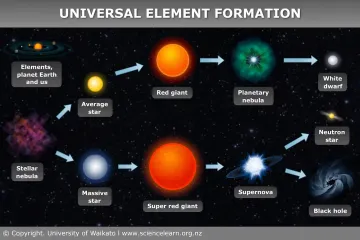
A key differentiator between an average star, like the Sun, and a truly massive star—one perhaps eight times the Sun's mass or more—is what happens next. [1] Smaller stars lack the gravitational power to heat their cores sufficiently to fuse carbon. They simply contract until they become a white dwarf, their elemental production essentially stopping at carbon or oxygen. [1][8]
Massive stars, however, possess the necessary immense mass, leading to even greater core temperatures and pressures, allowing them to continue fusing heavier elements in stages. [1][4] As the helium in the core is depleted, the core contracts again, igniting carbon fusion to produce elements like neon () and magnesium (). [1] This cycle of core contraction, heating, and ignition of the next element continues, creating an onion-like structure within the star, composed of concentric shells, each burning a different element. [1][8]
This sequential burning is a fascinating illustration of physics overcoming chemical barriers. Imagine a star that has burned through hydrogen, then helium, and is now burning carbon. Its core temperature must be substantially higher than what was needed for the prior stage. [1] For instance, the temperature required to fuse silicon is vastly greater than that needed for carbon. This escalating requirement means that each subsequent burning shell—from carbon to neon, then oxygen, then silicon—lasts for an exponentially shorter period. [1][4] The silicon-burning shell, which produces elements up to iron, might only last for a single day, whereas the initial hydrogen-burning phase could last for millions of years. [1]
We can conceptualize this element creation as a race against time and gravity, where the star must generate sufficient outward pressure from heavier, less efficient fusion reactions to counteract its own weight before the fuel runs out and the core collapses. [5] It’s a cosmic tightrope walk where the star literally builds its own support structure out of increasingly dense material. [4]
# The Iron Barrier

The element-building process culminates spectacularly at iron (), specifically the isotope iron-56. [1][7] When the silicon-burning phase concludes, the star's core is primarily composed of iron. [1] Iron represents a unique turning point in stellar nucleosynthesis because it possesses the highest nuclear binding energy per nucleon of all elements. [1][5]
This fact is crucial: fusing elements lighter than iron releases a net amount of energy, which is what supports the star against gravity. [1][5] However, fusing iron or elements heavier than iron consumes energy rather than releasing it. [1][7] In other words, when the core turns to iron, the furnace effectively shuts down. The star can no longer generate the thermal pressure required to oppose its own immense gravity, leading to catastrophic failure. [5][10]
# Heavy Elements Formation
Once the core is iron, the star's life as a stable fusion reactor ends abruptly. The lack of energy production causes the core to collapse in a fraction of a second, leading to one of the universe's most energetic events: a Type II supernova. [1][10] The incredible energy released during this explosion provides the conditions necessary to forge elements heavier than iron. [9][10]
# Supernova Synthesis
During the collapse, the core reaches unbelievable densities, becoming incredibly hot. The sheer shockwave and neutron flux generated by the explosion drive the creation of these heavier elements through rapid neutron-capture processes, commonly known as the r-process. [9][10]
The r-process involves atomic nuclei being bombarded by a massive flood of free neutrons in a very short timeframe. [9] Because the neutron density is so high, the nuclei can capture many neutrons very quickly, before they have time to decay radioactively. [9] This allows them to build up isotopes far heavier than iron, such as gold, silver, uranium, and plutonium. [1][10]
If we consider the elements created during the star's long life (up to iron) as the main product of its long-term operation, the elements created in the supernova represent the specialized, high-energy byproduct of its destruction. [4] Without this violent, final expulsion, these heavier elements would remain locked within the stellar remnant.
There is another significant pathway for creating elements heavier than iron, though it occurs primarily in slightly different environments or over much longer timescales: the s-process (slow neutron capture). [9] The s-process occurs mainly in aging, lower-mass stars like asymptotic giant branch (AGB) stars, where the neutron flux is lower. [9] This slower process builds elements like barium and strontium over thousands of years. [9] While large stars contribute significantly to the rapid creation of the heaviest elements via the r-process, the s-process ensures that many intermediate-heavy elements are also distributed across the galaxy by less violent stellar deaths. [9] The distinct difference between these two capture mechanisms—fast versus slow—explains the different cosmic abundances of elements like strontium and barium versus gold and platinum. [9]
# Cosmic Distribution
The creation of elements within the star is only half the story; they must also be released into the interstellar medium to form the next generation of stars, planets, and ultimately, living things. [6][8] The massive star achieves this expulsion during its supernova explosion. [1][10]
The shockwave of the supernova blasts the star's outer layers, which contain the newly synthesized elements from all its burning stages—from the helium-built carbon and oxygen, through the silicon-built iron, and the explosion-built gold and uranium—out into space at incredible speeds. [1][10] This ejected material mixes with existing gas clouds, enriching them with the complex chemistry needed for rocky planets and organic molecules. [6]
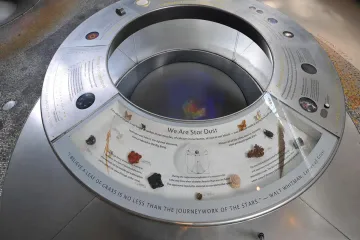
It is a sobering and wonderful thought that the iron in our blood, the calcium in our bones, and the oxygen we breathe were all forged inside stars that lived and died billions of years ago. [6] We are, quite literally, built from stardust. [6] A large star's legacy is not just its light, but the very foundation of the observable universe's chemical complexity. [2] The cycle is complete: hydrogen from the Big Bang is fused in large stars into elements up to iron, those massive stars explode, creating elements heavier than iron, and the resulting enriched clouds collapse to form new stars that repeat the entire magnificent process. [1][8]
Related Questions
#Citations
Stellar nucleosynthesis - Wikipedia
Star Basics - NASA Science
The Elements: Forged in Stars | PBS LearningMedia
Stellar Nucleosynthesis: How Stars Make All of the Elements
How does the process of nuclear fusion end up producing iron in a ...
The stars within us | NSF - U.S. National Science Foundation
How are new elements formed in the stars? - Quora
How elements are formed - Science Learning Hub
The formation of the heaviest elements - Physics Today
Ask Astro: How do stars make elements heavier than iron?