How do stars contribute to the formation of elements?

The vast majority of the chemical ingredients that make up our world, from the iron in your blood to the calcium in your bones, were not present at the birth of the universe. Instead, they were forged in the incredibly hot and dense environments of stars throughout cosmic history. This process, known as stellar nucleosynthesis, is the cosmic engine that transforms simple matter into the complex elements necessary for planets, chemistry, and life itself. [1][4]
Stars exist in a constant battle between gravity, which tries to crush them inward, and the outward pressure generated by nuclear fusion in their cores. [2][7] This very process of fusion is the mechanism by which lighter atomic nuclei combine to form heavier ones, releasing immense amounts of energy in the process. [4]
# Core Fusion

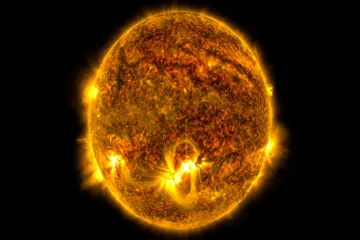
When a star like our Sun begins its life, its core is packed with hydrogen gas subjected to incredible temperatures and pressures. [4][7] Under these conditions, hydrogen nuclei (protons) collide and merge in a sequence of reactions, primarily the proton-proton chain, ultimately creating helium. [1][4] This is the star’s main-sequence phase, where it spends most of its existence, steadily converting its abundant hydrogen fuel into helium. [2][4] For a star similar to the Sun, this process is relatively slow, providing a stable energy output over billions of years. [7] The basic conversion of Hydrogen () to Helium () is the foundational step in cosmic element creation. [1]
# Layered Burning
Once the hydrogen fuel in the core is exhausted, the star can no longer resist gravity through that initial reaction. For stars of greater mass than the Sun—stars at least eight times more massive—the story becomes far more dramatic. [1][4] Gravity forces the core to contract, increasing the temperature and pressure sufficiently to ignite the previously formed helium into carbon () and oxygen (). [1][4]
In these larger, more evolved stars, this doesn't happen all at once; rather, it occurs in nested shells, creating an onion-like structure. [1][7] Once the helium fuel runs out in the innermost region, the core shrinks again until the temperature is high enough to fuse carbon. This fusion creates heavier elements, such as neon (), magnesium (), and sodium (). [1][4] As the core continues to contract and heat, subsequent layers ignite: neon burns to oxygen and magnesium, oxygen burns to silicon and sulfur, and finally, silicon fuses into iron (). [1][4]
It is fascinating to observe this progression across the stellar generations. A solar-mass star like our Sun will eventually stop at creating carbon and oxygen, gently puffing its outer layers away to form a planetary nebula, enriching the interstellar medium with these mid-range elements over an extended period. [1][3] In contrast, a massive star races through these stages, often completing the entire sequence from hydrogen to iron in a matter of a few million years, burning hotter and faster because its immense gravitational pressure allows it to reach the necessary ignition temperatures for heavier elements in rapid succession. [7]
# Iron Limit
The build-up of elements stops abruptly at iron. Unlike all the elements before it, fusing iron does not release energy; instead, it consumes energy. [1][4] When the stellar core becomes predominantly iron, the outward pressure suddenly vanishes, and gravity wins the struggle instantly. [1] The core collapses catastrophically in milliseconds, crushing matter down to unimaginable densities. [8] This collapse is the trigger for the most spectacular element-creation events in the cosmos.
# Explosive Creation
The elements heavier than iron—those that are essential for many biological processes, such as gold, silver, and uranium—cannot be made through standard, energy-releasing fusion in a stable star. [1][5] They require an immediate influx of extreme energy and neutrons, which only a star's death can provide. [5][8]
When the iron core collapses, it rebounds off the incompressible central remnant, sending a massive shockwave outward that tears the star apart in a Type II (core-collapse) supernova. [1][8] During this brief, violent moment, conditions are perfect for rapid neutron capture, known as the r-process. [1][5] Free neutrons flood the environment and are quickly absorbed by existing nuclei, creating extremely heavy, unstable isotopes that then decay into stable, heavy elements like gold, platinum, and uranium. [1][5]
A separate mechanism, the s-process (slow neutron capture), occurs in the late stages of less massive stars, such as Asymptotic Giant Branch (AGB) stars, creating elements up to bismuth (). [1] However, it is the r-process in supernovae that accounts for the heaviest elements we observe, including roughly half of all elements heavier than iron. [5] Type Ia supernovae, which result from the explosion of a white dwarf star that has accreted too much mass, are also significant contributors, specializing in creating large quantities of iron-peak elements. [1]
# Cosmic Dispersal
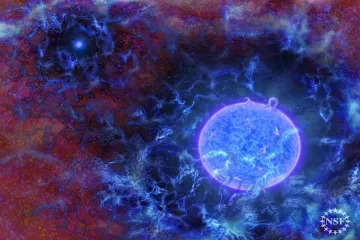
Creating the elements is only half the story; they must also be scattered throughout the galaxy so that new generations of stars and planets can form from them. [3][8] The supernova explosion acts as the universe's ultimate recycler, blasting newly synthesized material—including the elements from the star’s outer layers, which were already enriched by earlier fusion stages—into the cold interstellar medium. [3][8] This ejected gas and dust, rich in carbon, oxygen, silicon, and the heavy elements forged in the explosion, mixes with existing gas clouds. [8]
These enriched clouds eventually collapse under their own gravity to form the next generation of stars, like our own Sun, and the planets orbiting them. [3][7] Considering that the early universe contained only hydrogen and helium, every subsequent atom of carbon, oxygen, or silicon in your body is a direct product of stellar death that occurred long before our solar system existed. [3] The fact that the Sun is a second-generation star, meaning it formed from the remnants of previous stars, underscores this constant cosmic renewal. If we could analyze the composition of our Sun today, we would find that a small but vital percentage of its mass is composed of these heavy elements seeded by the long-dead giants of the early Milky Way. [7]
# Our Origins
The entire periodic table, barring the primordial hydrogen and helium, is a stellar legacy. [1] Understanding stellar structure and evolution, therefore, is not just an academic pursuit about distant objects; it is a direct inquiry into our own material makeup. [7] From the tiniest speck of carbon that forms the basis of organic chemistry to the trace elements necessary for planetary magnetic fields, the universe’s material diversity is built on the pressure, heat, and violence within stars. [3] The fact that these processes happen across cosmic timescales—some elements slowly over eons in aging giants, others instantaneously in a blinding flash—demonstrates that the cosmos employs multiple, distinct pathways to achieve chemical complexity.
Related Questions
#Citations
Stellar nucleosynthesis - Wikipedia
Star Basics - NASA Science
The Elements: Forged in Stars | PBS LearningMedia
Stellar Nucleosynthesis: How Stars Make All of the Elements
How are new elements formed in the stars? - Quora
How elements are formed - Science Learning Hub
Stellar Structure and Evolution | Center for Astrophysics | Harvard ...
Stellar Evolution - Chandra X-ray Observatory
How do stars generate elements "heavier" than lead? - Reddit